Barack Obama characterised his move to reform the immigration system this week as a pragmatic decision: a “common-sense, middle-ground approach” consistent with the actions taken by presidents before him.
His decision is viewed somewhat differently among critics and supporters alike. Obama, they agree, has taken a monumental step, plunging the White House into a politically volatile controversy by acting at a stroke to shield from deportation almost five million people living in the country illegally.
Democrats and Republicans on Capitol Hill differ on the merits of that decision, but they mostly agree it has been the most controversial move of the president’s second-term – and there are ways in which it could backfire politically.
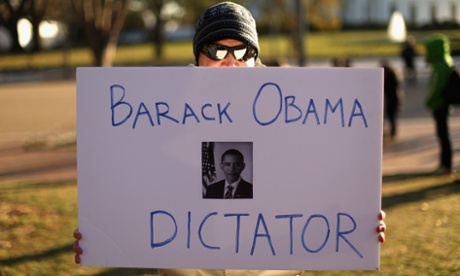
From the GOP’s perspective, Obama’s decision to plough ahead with executive action, ignoring the Democratic defeats at the midterm elections, smacks of arrogance.
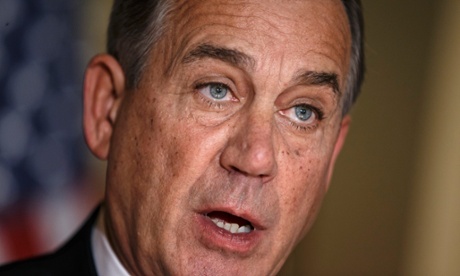
“The president has chosen to deliberately sabotage any chance of enacting bipartisan reforms that he claims to seek,” the Republican Speaker of the House John Boehner said Friday. “And as I told the president yesterday, he’s damaging the presidency itself.”
Both Boehner and the soon-to-be-installed Republican majority leader in the Senate, Mitch McConnell, have pledged to use their control over both houses of Congress in January to retaliate.
Relations between the White House and congressional Republicans were already strained before this week. All of the indications are that both sides are now determined to double down on an approach that puts conflict before compromise.
White House officials are preparing for battle, conceding that Obama’s move has angered many of his critics and, privately at least, accepting that the president can expect intensified opposition on a whole raft of unrelated measures, from his long-stalled nominees to any nuclear agreement forged with Iran.
It is unclear, however, precisely how a Republican-controlled legislature can curtail a president’s decree to focus on deporting “felons, not families” and give millions of undocumented migrants temporary access to work permits.
The most likely lever Republicans will pull is financial. No decisions have yet been taken, but GOP aides are exploring possible provisions that can be attached to spending authorisations that would somehow “defund” aspects of Obama’s action.
“We do need to figure out a way - and there are different options - to push back,” said Alabama senator Jeff Sessions, the incoming chairman of the powerful budget committee. “We do have legitimate congressional powers - power of the purse. Congress could use its power that way.”
Sessions was speaking on Friday to an audience of the Heritage Foundation, the right-wing think tank that pushed for last year’s government shutdown in protest at Obama’s Affordable Care Act.

There is little appetite among GOP leaders for a repeat of such a confrontational approach, but the party’s rank-and-file is less restrained, urging a fierce response on all fronts, from lawsuits challenging the president’s authority to moves towards impeachment.
Democrats, on the whole, are supportive of Obama’s decision, and believe that any over-reaction from the GOP will damage the party’s standing, particularly among Latino voters.
The president’s supporters argue that while his decision may infuriate Republicans, he was acting within the bounds of his power, and only after it became clear that bipartisan legislative reform was off the table.
Under pressure from conservatives, Boehner spent 18 months refusing to hold a vote on a bipartisan bill passed in the Senate. A blueprint for border security and comprehensive immigration reform, that bill would have gone much further than Obama’s executive order, providing stepping stones towards full citizenship for almost all 11 million people living in the US illegally.
“Had the House of Representatives allowed that kind of bill a simple yes-or-no vote, it would have passed with support from both parties, and today it would be the law,” Obama said in Thursday’s televised address.
The question is whether by opting for a controversial stop-gap measure, via executive order, Obama has ruined the chances of a return to the kind of comprehensive immigration reform that the White House hoped was within reach in 2013.
One of the strongest supporters of immigration reform, Angus King, an independent senator from Maine who caucuses with Democrats, said he was “concerned about the impact of the president acting alone”.
The presidential order, he said, “could actually make the reform we need more difficult by causing a backlash in public opinion and solidifying Republican opposition” to reform.
Similar concerns were raised in the lead-up to the announcement by three other moderate Democrats: West Virginia’s Joe Manchin, Claire McCaskill of Missouri and Jon Tester of Montana.
Obama’s supporters insist that comprehensive immigration reform was never going to be passed in the conservative House, regardless of executive action, before the end of his presidency.
But concern that Obama may have opted for the short-term option at the expense of a longer-term solution has been compounded by the morning-after realisation among immigration rights activists that Obama’s sweeping, historic announcement has considerable limits.
Just over half of undocumented migrants in the US do not qualify under either of the “deferred action” programs announced by the president. Those who do will only receive relief from deportation for two years, a protection that could be rescinded by the next president.
Even if they come out of the shadows, the millions who do benefit from Obama’s executive action will still be denied some of the basic rights afforded to citizens.
“Our immigration system is broken,” King said. “No one questions that. But, in order to achieve a long-term solution that brings people together, the Congress, including the House of Representatives – not the executive – must take the lead.”