In Irish drama the dead are always with us. From Yeats and Synge to McPherson and McDonagh, you find a procession of corpses who obstinately refuse to lie down. And, although we never actually see the dead son who drives the action in Frank McGuinness's new play, his presence haunts every line of this elegantly written, exquisitely acted Michael Attenborough production.
The situation is classically simple. A family gathers in its Galway holiday home to mark the 21st birthday of Eugene, who committed suicide two years ago; what we see is the divisive nature of grief. Margaret and Leon, the parents, have immersed themselves in work as, respectively, an English lecturer and thriving pub-chain owner. Meanwhile their children, Simon and Louise, have opted out of the rat race.
The most enigmatic character is their cousin, Bridget, who found the dead boy on the beach and suddenly produces his long-withheld suicide note.
The stage is set for revelations. But, although we learn a lot about the flawed Eugene, McGuinness is not out to mock false pieties. His theme, like McPherson in The Weir, is the way ancient superstitions persist even in modern materialist Ireland, and the way the culture itself is death-haunted. Margaret talks of "the curse" that is Eugene's legacy; and you see how it blights the family's lives so Margaret retreats into her primitive Donegal past and Simon decides he is incapable of having children. Even if McGuinness overstates his case, he leaves you feeling that contemporary Ireland's agnostic rationalism is the thinnest of facades.
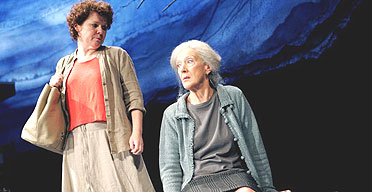
All this is highlighted in Bridget, who, in Eileen Atkins's breathtaking performance, dominates the play. What she brilliantly conveys is the self-conscious feyness of a woman who, when condemned as a witch, claims she is simply a "confused fairy". Atkins also makes you believe rural Ireland is still occupied by weird solitaries who act the wise fool. It is a performance of vitality and sadness, and reaches its apogee when Atkins announces "I'll love you and leave you; I'll close with a song."
Imelda Staunton has a harder task reconciling us to Margaret whose devotion to English poetry is no defence against breakdown; by sheer acting, she persuades us of the character's violent mood switches. Ian McElhinney is unequivocally good as the Dublin businessman who finds wealth cannot disguise grief. Aidan McArdle and Elaine Cassidy as the son and daughter make the most of less richly-written roles.
In following Shakespeare's injunction to "give sorrow words", McGuinness offers us a fascinating portrait of the damaged Irish psyche.
· Until March 3. Box office: 0207 359 4404.