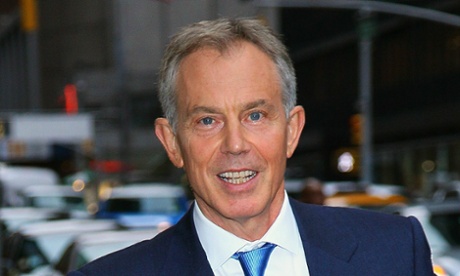
Oh dear, another day and Tony Blair is on the front page again. Since he left office to a standing ovation from fellow MPs, the headlines coming out of Fleet Street have been mostly negative. The Guardian’s “Blair lands another deal: advising Serbia” is not going to put a spring in the former prime minister’s step.
It reports that he has signed a contract to advise Aleksandar Vučić, now the reformist PM of Serbia but once a Milošević minister who called Blair n “English gay fart” during the air war for Kosovo.
The money comes from oil-rich Abu Dhabi, so critics are saying it undermines Blair’s role as the Quartet’s economic envoy to the Middle East as well as annoying the Palestinian government and Serbian opposition.
Oh dear again. What with the property portfolio, the fondness for executive jets, the contracts with some unsavoury regimes, even the alleged affair with Rupert Murdoch’s ex-wife – untrue, Blair has always assured his friends - and perma-tan, it gets harder and harder to defend the way he seems to operate nowadays, especially as he does so with few attempts to justify himself or his opaque corporate finances.
And yet it may still be worth a try. Last month a figure leapt from a critical article about Blair in the Times (paywall) which has joined other now-hostile Murdoch titles that were once his most reliable bulwark against most of Fleet Street, left and right. I know, because they used to be given stories at a time when – as Guardian political editor – No 10 was attacking the Guardian and we were giving him stick when we thought he deserved it.
This particular Times story reported that Blair had claimed £500,000 of taxpayers’ money since leaving office under a scheme devised by John Major to ease the ailing Margaret Thatcher’s problems.
It’s part PM’s pension, part staff salary costs, but buried away in mid-report was this: “Sources close to Mr Blair suggest he is worth roughly £10m and has donated a similar amount to charities since 2008”.
£10m in the bank is a lot of money, but so is £10m given to charity. We know he gave the proceeds of his memoirs, A Journey, to the British Legion – an obvious gesture of contrition for what became the disastrous occupation of Iraq.
Much of the rest must go in paying salaries to the 200-plus staff his foundations are said to employ around the world, in Europe, Africa and elsewhere. Even when taking pay cuts, high-quality staff don’t come cheap.
I’m uncomfortable with aspects of his legacy and some of the things I read about Blair’s current activities too. It’s not the place to discuss them here, though I don’t automatically assume that, if former enemies in Belgrade (keen to join the EU) now seek his advice, it must be a bad thing. Likewise other places, I just don’t know enough and don’t assume all his critics do either. Alastair Campbell wrote this about the Serbia trip in his blog.
My point is simply that a lot of people are out to get Blair, over Iraq, over New Labour’s domestic agenda and over his three election victories, which sometimes seem to annoy sections of the Labour party as much as they do the Mail and Daily Telegraph.
By distancing himself from the Blair/Brown governments – you can see why, but I’m not convinced he’s right – Ed Miliband has contributed to the narrative.
It’s more obvious why Tories, Lib Dems and the SNP join in. Murdoch too, though his suspicions of his young (now-ex) wife, Wendi, may have been used by the family cabal to drive her out. Because Wendi’s alleged crush was on Blair it drove media headlines. It’s how things are done sometimes.
As Campbell sometimes puts it: “They all still want to kill Tony after he’s died.” He’s a one-man, self-powered lightning conductor. Other former PMs have made money; Heath, Thatcher, John Major, even puritanical Gordon Brown, and they put it to varied uses. Blair attracts an unusual amount of flack for failings which rarely takes account of his good works, philanthropic , diplomatic and in terms of good governance: trying to clean up failing states.
You can find a flavour of it all – including what I take to be financial cross-subsidy - on his main website here. There are others, the Africa Governance Initiative, for example.
“I know he doesn’t make any money in Africa,” insists one ally who says Blair’s outfit played a significant role in ensuring that western governments and aid agencies stayed on the ground in west Africa to help contain the Ebola outbreak.
Blair’s office says there are three strands to his approach, which is based on the belief – do I mean hope? – that “globalisation will be the greatest force for good in the 21st century, spreading opportunity, knowledge and technology more widely and quickly than ever before”.
He concentrates on inter-faith conflict where globalisation creates friction, on innovation and on issues he got to know personally at No 10 and “cares about personally”.
It’s fine to be sceptical about some of this, but beware excessive cynicism. I might add that in busying himself in Serbia and its neighbours, and in Africa and Asia, Blair does at least seem to have an active foreign policy in the sense that Germany’s Angela Merkel has but David Cameron’s ministers convincingly do not. Despite memories of the wartime occupation of Yugoslavia, Merkel is a player on the telephone to Balkan capitals.
In “bit-part Britain” of 2015 the global activism of recent decades seems far away. There are worse things than sun-tanned Tony Blair on a plane.