Swansea has one of the highest coronavirus case rates in Wales at 27.9 per 100,000 people. Earlier this week it topped the charts with the highest rate anywhere.
Despite this, the latest figures in Swansea, published by Public Health Wales (PHW), show that 20 areas of the city have "low numbers" of infections with two or fewer cases detected over seven days.
As of Thursday, April 15, all of Wales' local authorities are now reporting fewer than 35 cases per 100,000 people for the seven days up to April 10. Cardiff, Anglesey, Gwynedd and Swansea have the highest rates at 31.6, 28.6, 28.9 and 27.9 respectively.
The infection rate across Wales now stands at 17.4 cases per 100,000 people for the seven days leading up to April 10, a slight drop from 17.6 on Wednesday.
How many people are in hospital with coronavirus in Swansea Bay?
Figures up until April 14 show that across the Swansea Bay University Health Board area, out of 1,110 general and acute beds in use, just two are occupied by a Covid-19 case. This is compared to the 116 beds mentioned in last weeks data up to March 31. This shows a big fall in the number of people in hospital with the virus.
And of the 25 occupied "invasive" ventilated beds, just one of those was occupied by a Covid-19 patient - last week it was two.
How many people have been vaccinated in Swansea?
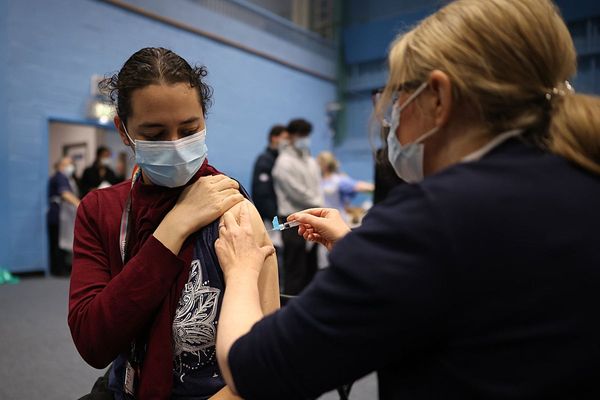
As of the week ending April 11, the total number of vaccine doses administered by Swansea Bay University Health Board stands at 261,383.
Which areas of Swansea currently have the highest and lowest rates of coronavirus?
Llansamlet and Ravenhill currently have the highest coronavirus infection rates in Swansea, with a figure of 71 per 100,000 people for the seven days leading up to April 10. This is followed by Cockett with 69.
Last week, Ravenhill had the highest coronavirus infection rate in the city, with a figure of 190 per 100,000 people. Even though Ravenhill still has the highest number of cases, the rate has dropped massively in the last week.

This data shows a breakdown of different parts of the city:
The total number of cases is followed by the incidence per 100,000 population (rounded to the nearest whole number), starting with the area with the highest infection rate:
Llansamlet - 5, 71
Ravenhill - 6, 71
Cockett - 5, 69
West Cross - 4, 62
Landore - 6, 58
Townhill - 5, 55
Penderry - 5, 52
Mynyddbach - 5, 55
St Thomas - 4, 48
Uplands - 4, 41
Brynmill - 4, 39
Killay - 0-2 , fewer than 40
Llanmorlais & Three Crosses - 0-2, fewer than 40
Dunvant and Upper Killay - 0-2, fewer than 36
Mayals & Bishopston - 0-2, fewer than 35
Sketty - 0-2, fewer than 32
West Gower - 0-2, fewer than 32
Gowerton - 0-2, fewer than 30
Pontarddulais - 0-2, fewer than 30
Bonymaen - 0-2, fewer than 27
Morriston South - 0-2, fewer than 27
Mumbles & Newton - 0-2, fewer than 27
Cwmbwrla - 0-2 , fewer than 26
Birchgrove - 0-2, fewer than 25
Tycoch - 0-2, fewer than 25
Llangyfelach & Tircoed - 0-2, fewer than 24
Morriston North - 0-2, fewer than 23
Clydach & Mawr - 0-2 , fewer than 21
Loughor - 0-2, fewer than 21
Central Swansea - 0-2, fewer than 20
Gorseinon - 0-2, fewer than 19
What does this data actually mean?
It is really important to bear in mind that this data is very volatile because it covers such small areas. Where an area has a very small population even one positive case can push up the rate of cases per 100,000 significantly.
You should therefore be cautious about drawing too many conclusions directly from the information.