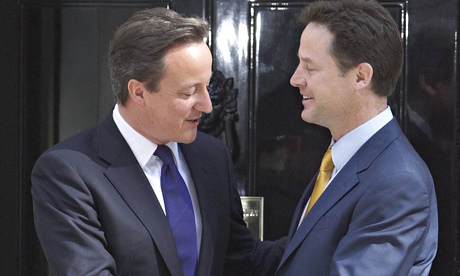
Your judgment that the coalition has both survived and functioned is probably correct (Editorial, 30 March). It is however important to understand how in practice the coalition has worked. Rather than, as might have been expected, seeking to reach agreement on each policy issue as it arose, the coalition essentially divided up the two party manifestos. The Conservatives agreed to support defined parts of the Lib Dem programme in return for Lib Dem support for a range of Conservative policies. This approach certainly enabled the Lib Dems to claim that a stated percentage of their manifesto had been delivered.
But while it may have precluded some wilder Tory policies, it also led in England in particular to a marked shift to the right in, for example, the privatisation of probation, the marketisation of the NHS and savage benefit cuts. These measures were effectively put through parliament on the strength of Lib Dem votes. There are alternative and possibly better forms of inter-party cooperation which the next parliament, if hung, may have the opportunity to test.
Robin Wendt
Chester
• You make the case for coalition in your editorial. But what we have now is a curiously undemocratic form – a marriage of convenience based on skewed voting practice, but for whose convenience? For coalition we need to look elsewhere. The AV proposal was always a non-runner, while the German two-vote system, one for the local candidate, one for the party, offers a solution. Popular, it would be uncomfortable only for thosezealots who think their party has a chance first-past-the-post but it would be closer to the ideal of democratic government. Then all we need is a semi-circular chamber; no more silly boy pranks, more down-to-business. Best practice, we can’t get enough of it.
Richard Payne
Ipswich
• Coalition government enhances democracy if only because by definition it requires cross-party consensus on many issues. Coalition is one way to overcome the gross lack of representation inflicted on the public by first-past-the-post elections in an era of multiparty politics. Sadly the Lib Dems may be punished for agreeing to, and remaining in, the coalition. They should not be. However, there may be other reasons to reject the Lib Dems on 7 May. Why should even traditional liberal voters support a party that shies away from delivering a positive and energetic campaign in favour of EU membership, the environment (why no outright opposition to shale gas extraction, for example?) and celebrating the positive impact of immigration? This election needs courage and principles. I await the party’s manifesto with interest.
Simon Sweeney
York
• As a Dutchman living in this country for over 35 years, I’m still astonished every time when election time comes. How is it possible that the great majority of the UK accepts that politicians consider it perfectly normal not to try and sell their own party’s manifesto to the general voting public, but instead to slag off all the other manifestos and with much malice and downright offensive personal attacks. In all aspects of civilised life one can find the word “compromise”. That is how it normally works. Especially in democracies. Why do British politicians think it is normal to be insulting to their colleagues?
Why do the British think the only true political stance is either left (Labour) or right (Conservative)? Are there no other possibilities? Should anyone outside these two parties be disregarded as totally useless and only spoiling it for these two parties to secure an absolute majority? Is the district system fair? Is PR wrong? Is a coalition government wrong? Is nothing ever done by a coalition government?
Well, whatever you do, make sure you don’t look beyond your borders and see how other countries work politically. You might learn something and that would be silly, wouldn’t it?
Henk Slagter
Hazlemere, Buckinghamshire
• Your poll analysis (1 April) clearly indicates the difficulties of forming a coalition government arising from the forthcoming election. There is one possibility that needs to be explored further: that of a grand coalition between the two major parties. If one ignores the vested interests of the right wing of the Tories and the extreme socialism of the left wing of the Labour party, it seems that the bulk of both parties have a lot in common in terms of policies. Both seek to attain a vibrant economy, increased living standards, a sustainable NHS, retaining Trident, sensible immigration policies and membership of a reformed EU.
The only real difference between the parties appears to be how to go about achieving those aims. If the main parties could put aside their dogma and egos and work together, maybe the disenchantment with politics by the British public would fade.
Ron Austin
Hadleigh, Suffolk


.jpg?w=600)