
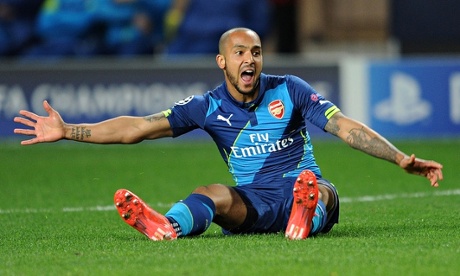
Raheem Sterling and Theo Walcott face each other at the Emirates Stadium on Saturday after briefly meeting up with England last week. Internationals will now take a back seat until the end of the season but the contract negotiations between Sterling and Walcott and their respective clubs will continue to dominate the back pages, with the latest escalation an interview the Liverpool forward gave to the BBC.
Sterling and Walcott appear to have arrived at crossroads in their careers, although there the similarities end. Perhaps the crucial difference is age. Walcott, 26, is six years older than Sterling and has not used that six years to confirm his youthful promise.
The player who was selected for a World Cup at 16 missed the cut for the next one, despite the performance of his life in a qualifying game in Croatia, and Arsenal fans have seen very little evidence since to suggest that Walcott might recapture the swaggering confidence that earned him a hat-trick in Zagreb and prompted Lionel Messi to say he was shocked by his exclusion from Fabio Capello’s eventual squad for South Africa.
Capello himself, once he had seen how pedestrian and one-dimensional England were in the group stages, admitted he had made a mistake in leaving out Walcott, although with injuries and intense competition for Arsenal forward places complicating the picture in recent seasons the player has found it hard to present himself as indispensable for club or country.
Sterling has a rather better chance of doing that, mainly because he still has most of his career ahead of him and the potential is there for all to see. He has been an undoubted success in Brendan Rodgers’ fluid and forceful counterattacking sides in the last couple of seasons, at least up to the point where he started to be used as a wing-back, even showing when asked that he could come in from the wing if need be and operate as an emergency striker. Whether he is quite as good a player as his advisers seem to think is a question half of Merseyside is asking itself.
He is still under contract for another two years but has turned down an extension worth around £100,000 per week and is apparently holding out for a figure closer to £180,000 – per week.
Although that is quite a hike for a 20-year-old on around £35,000 a week, the salient point here is that Daniel Sturridge is reportedly earning close to £150,000 a week. Sterling and his agent see no reason for such a disparity and they probably have a point. Liverpool are going to have to stump up to keep the player – that much is obvious – although the club’s American owners can play hardball with the best of them and will not sanction anything too outlandish. At the moment they are rather cleverly allowing Sterling to explore the limits of his popularity with his own supporters.
Sterling, unlike Walcott, is being closely monitored by clubs all over Europe and, if Liverpool decided to sell they would not be short of offers – great big ones, starting around £50m and quite possibly rising. Manuel Pellegrini recently suggested it may take £100m to prise Sterling from Anfield, though the Manchester City manager stopped short of confirming he would be interested at that price. With that sort of money on the table Liverpool become a selling club just like anyone else. Even the fans would not expect such business to be turned down, because few players are so brilliant, so absolutely central to a club’s success that they must be retained at any price. And if Luis Suárez was not one of them, then Sterling will not be either.
One feels that some sort of compromise could still be reached whereby Sterling signs on for a few more years at around £100,000 per week and then, assuming he can rough it for so long, makes his big decision on his future a few seasons down the line when he is a little older. Footballers never quite know what is down the line, however. It could be injury or loss of form and for all the Walcott reasons the time to cash in might be the present, with nothing to cloud future potential.
As if to confirm the suggestion that the fortunes of these two players are inextricably linked, there has even been the suggestion that Arsenal may buy Sterling and offload Walcott to Anfield. It seems unlikely, to say the least. Arsène Wenger has no record of breaking the bank and the wage structure to jump the queue of clubs fighting over a top transfer target, while Liverpool do have a slightly unfortunate record of frittering away incoming transfer revenue on less than robust replacements. Rodgers has said in the past he admires Walcott, though that is not the same thing as saying he would rather have him than Sterling. Selling that concept to the Liverpool supporters might be tricky, even for a loquacious Irishman.