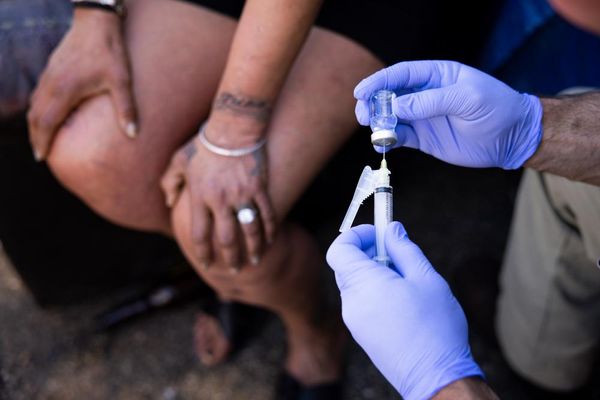
Anne McDermott’s son Scott died at Edinburgh Royal infirmary in January this year, at the age of 35, from what his mother believes was an overdose of Xanax. “Scott had been taking drugs since he was 17, but there had been no overdoses, no admissions to hospital in all that time,” she says. “Then Xanax came into it.”
Days after Scott’s death, Police Scotland issued a countrywide warning about taking medicines that had not been professionally prescribed and mixing prescription drugs with other substances, noting that the force had identified a recent increase in the abuse of Xanax “which appears to be mainly sourced from the internet or other illegal supply”.
Anne believes that Scott, a father-of-two who had just become a grandfather, started using Xanax alongside heroin when it became available from a local dealer. “When Scott died, he had six different drugs in his system. Three were prescribed by his GP - methadone, valium and gabapentin - and also cocaine, Xanax and heroin. I won’t lie, he’d been taking heroin for a long time, but the Xanax was the thing that was 100% different.”
The police investigation into Scott’s death is ongoing and Anne has concerns that it is being treated as “just another junkie death”. She believes that two other deaths among Scott’s associates since January may also be related to Xanax. “People are taking these drugs and not knowing what’s inside them,” she said.
According to annual figures, the numbers of drug-related deaths in Scotland in which Alprazolam, sold under the trade name Xanax, is implicated or been a possible contribution have risen dramatically over the past two years. Only a handful of deaths were recorded as involving Alprazolam between 2007 and 2015, but the figure rose to 24 in 2016 and 99 in 2017.
According to a breakdown of the figures prepared for the Guardian by the National Records of Scotland, those who died in 2017 were mostly men over the age of 35, fitting the profile of the so-called Trainspotting generation of long-term, habitual drug takers who first began using in the 80s and 90s. There were particular concentrations in Grampian and Lothian, which includes Scott McDermott’s home city of Edinburgh.
Monthly testing of more than 1,000 samples from substance misuse patients undertaken at Edinburgh Royal infirmary has found a notable increase in the presence of alprazolam. Technicians only started urine testing for the drug’s presence in March this year but have already found 9% of samples are positive for it.
Dr Paul Cawood, a clinical scientist in the hospital’s toxicology lab, said: “It’s around six times more potent than diazepam and, because it’s being made on the streets, they have no idea what they are taking. Most drug-related deaths are accidental overdoses. The number of problem drug users is relatively fixed in Scotland and heroin use is dropping, at least in Lothian. So it is likely that poly drug use is a major contributing factor to the recent increase in drug-related deaths.
“Benzodiazepines have a direct effect on suppressing breathing, but the main factor is likely to be the effect of poly drug use on judgment and behaviour leading to inadvertent overdosing.”
Roy Robertson, a professor of addiction medicine at the University of Edinburgh and a GP in the city, agrees with Cawood’s assessment. “People get completely knocked out, so can forget how much they have taken, and then some people have a paradoxical effect of agitation and then believe that they haven’t taken enough,” he said.
Further north, in Aberdeen, where 18 of the 2017 deaths were concentrated, Fraser Hoggan, the chief executive of the city’s Alcohol and Drugs Action support group, says that he sees two distinct groups of Xanax user.
“The benzodiazepam family has always had a strong correlation across Scotland, going back to temazepam in the nineties, then with NPS becoming more available and now we are seeing a higher prevalence of Xanax from the dark net market.
“People who have existing drug problems with opiates are using Xanax, but others are using it too. It has a broader appeal, because of ease of access and cost. Some staff have noted younger people using it, often given Xanax free in a package with MDMA to manage comedowns.”
He described the current market as “very fractured”, with different groups using in distinct ways: “I’ve never seen it quite so fragmented, and the bewildering range [of drugs available to buy] on the dark net has opened up new markets.”
The Trainspotting generation, however, are a group “fairly unique to Scotland” he said, and “in very fragile health already”.
The Grampian health board issued a drug alert last October following reports of illicit alprazolam use in the area, which pointed to “an increase in both hospital admissions involving self-reported alprazolam use and drug deaths where alprazolam is present”.
Hoggan says he has seen a number of deaths in Aberdeen where Xanax has been involved, but adds: “Drug-related deaths would be going up regardless of Xanax, though it probably doesn’t help.”
Scott McDermott’s diaries, which his mother discovered as she sorted through his belongings after his death, tell a sadly familiar story, full of vows to get clean and frustrations at another failed attempt.
Hoggan says: “There’s a lot of trauma among this group, whether its having children removed or losing partners and other family members to drugs, and they use drugs to self-medicate and forget. This is not just about Xanax. The trend was there beforehand.”