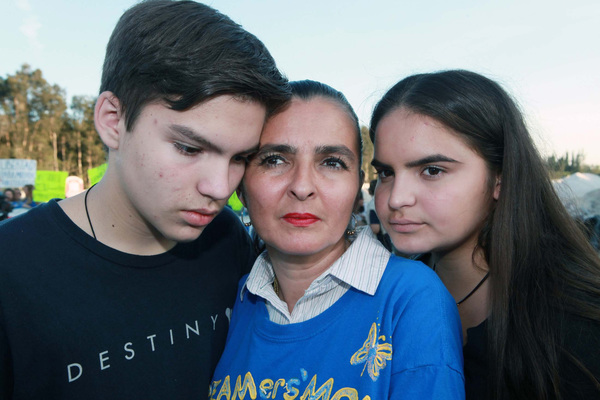
MIAMI _ Leonardo Morales was about to drive his children to school one September morning when federal agents in bulletproof vests arrested him for violating a deportation order.
"They said that they wanted to talk to him, and they tried to take him behind another car so we wouldn't see, and they handcuffed him," said his daughter, Valeria, 16. "It was awful."
Her dad has been held at Krome detention center since.
The family's struggle is one that terrifies many of the 11 million undocumented immigrants living in the United States _ especially after President-elect Donald Trump threatened mass deportations of undocumented immigrants he described as criminals in a nationally televised interview Sunday night.
Eleven years ago, Morales, his wife and their two children fled guerrilla war and drug gangs in Colombia, where they lived in a city called Palmira, in a region the local press once called the country's "violence capital."
They came to the United States on a tourist visa, applied for asylum, and settled into a quiet and successful life in Kendall. A search of public records shows Morales, who works in construction, does not have a Florida criminal record. Valeria and her brother Juan _ young children when they arrived _ now speak perfect English. They're not as comfortable in Spanish.
Miami is their home. And they can't imagine a life without their dad by their side.
"We are a family of four," said Juan, 14. "We don't want to lose our father."
"(My husband) is a man with no criminal record, who has contributed much to the community," said Yaneth Mejias, Morales' wife. "We haven't hurt anyone."
A federal official familiar with the case confirmed Morales does not have a criminal record in the United States.
Mejias says their ordeal is the fault of a man who told them he was an attorney and mishandled their asylum application. Like many requests from those fleeing South America, their application was denied.
"Unfortunately, we arrived in this country without knowing anyone, and we fell into the hands of one of the many who do not do their job with love," Mejias said.
The man, Fredy Barragan, is a former federal immigration officer who in 2002 was sentenced to 10 months in prison for conspiring to accept bribes from immigrants seeking admission into the United States. Barragan now runs a Hialeah-based business called F K Immigration Services. He told the Miami Herald that he clearly advertises the fact that he is not a lawyer.
While he doesn't remember the details of the Morales case, Barragan insisted: "There's no way I told them I was an attorney. I'd get in huge trouble for that. All the paperwork I give to clients says in big letters I'm not an attorney."
(The website for his business prominently states, "We are NOT attorneys.")
"If I messed up their paperwork or told them I was an attorney, they wouldn't deport him," Barragan said. "They would give them a chance to stay until I was dealt with."
He said the family was looking for a scapegoat.
Compared to other regions, relatively few people leaving South America receive asylum.
In fiscal year 2014, South Americans made up about 4 percent of the nearly 24,000 people granted asylum, according to statistics from the U.S. Department of Homeland Security.
More than half of successful applicants came from just four countries: China, Egypt, Syria and Ethiopia.
Morales' asylum request was turned down on Dec. 20, 2010. A judge ordered his deportation, the usual penalty for losing an asylum case. He appealed, but the Board of Immigration Appeals in Washington, D.C., rejected the appeal and affirmed his deportation late the next year.
Many undocumented immigrants who haven't committed a crime are deported.
In fiscal year 2015, the United States deported more than 96,000 undocumented immigrants with no criminal record, or roughly 260 per day, according to federal figures. That was down from previous years after the Obama administration began prioritizing the arrest of undocumented felons. (During the same time period, the U.S. deported nearly 140,000 undocumented immigrants convicted of crimes.)
Over two terms, President Barack Obama deported more than 2.5 million people, more than any other U.S. president.
Living in the United States in violation of immigration laws is not a crime under federal laws, unless the immigrant has previously been deported or removed.
Like the Morales family, nearly half of undocumented immigrants enter the country legally using tourism and business visas and then continue to live here after their visas expire, according to the Pew Hispanic Center.
The Morales case is a reminder that undocumented families live in constant fear of being torn apart.
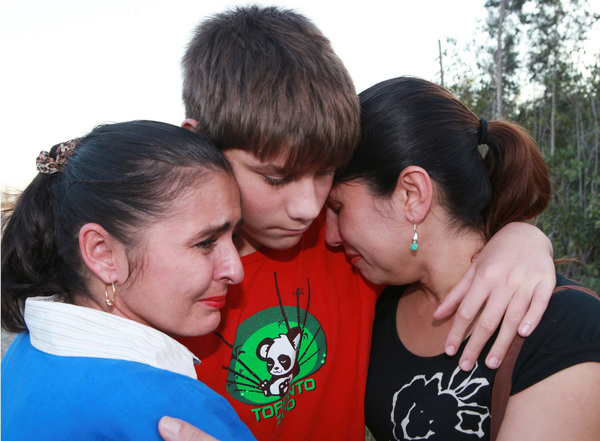
Juan and his mother could be detained at any moment.
"Every time before I leave the house, I look outside," he said. "There's no sense of safety. I don't know who to trust anymore. I don't know what will happen next."
One member of the family is safe _ for now.
Valeria has taken advantage of Deferred Action for Childhood Arrivals (DACA), an executive action signed by Obama in 2012 that provides work permits for undocumented immigrants who arrived in the United States before they turned 16 and meet other qualifications such as school enrollment, military service and clean criminal records. Valeria wants to go to college to study neonatology. Juan, who has applied to the same federal program, wants to be an immigration lawyer.
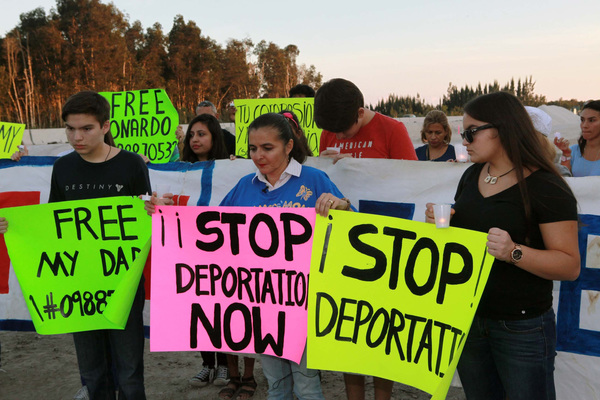
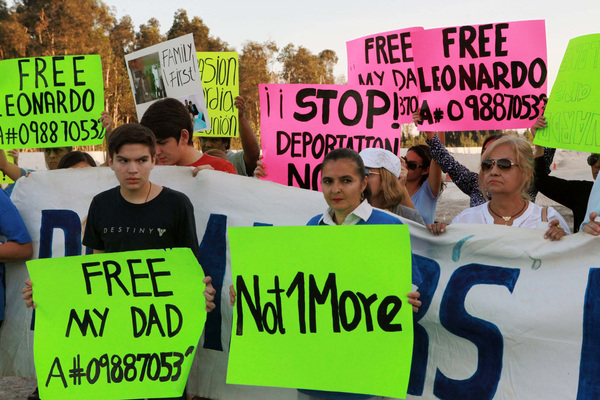
On Saturday afternoon, the two children and their mother joined about 40 friends, family members and immigration reform activists for a vigil outside Krome in West Miami-Dade County.
The protesters held signs that read "Libertad para mi papa," "We want to stay here," and "Stop deportation now." Big-rig trucks and cars passing by in this heavily Hispanic part of South Florida honked when they saw the gathering.
Andrea Hernandez, an American citizen originally from Ecuador, was among those who attended the vigil. Her husband, Carlos, is also being held in Krome. "We live in fear," she said.
Trump's election has scared many undocumented immigrants. On Sunday, he appeared on "60 Minutes" and said he will deport or jail up to 3 million undocumented immigrants allegedly engaged in criminal activity. He could also work to undo DACA.
"People are very scared of what he promised to do," said Claudia Saucedo, a member of the activist group Dreamers' Moms, which helped organize the vigil and has advocated for the passage of Congressional legislation called the DREAM Act that would provide a pathway to citizenship for the undocumented. "We prefer to believe that as a businessman he will think about how immigrants contribute to this country. We came here for a better life, for security, not to cause problems."