What can playwrights do to get more women on stage? It’s a question I wrestle with all the time. According to the most recent data, there are roughly two men on stage to each woman in the UK, and it gets more depressing if you start counting lines and stage time. It’s not as simple as just writing more roles for women. Maybe the question should be: what can playwrights do to put more women centre stage?
When I got asked to write my first children’s play, Operation Magic Carpet, I wanted it to have a female lead. I was writing it at the same time as a book about my literary heroines, and getting infuriated by the mythologist Joseph Campbell, author of the storytelling bible The Hero with a Thousand Faces, limiting his hero’s journey to men. “Women don’t need to make the journey,” he said. I think we do. I wanted my play to have a bold, curious young heroine who drove the narrative, had a proper quest with high stakes and jeopardy, and a huge whizz-bang shape-shifting fight – which, in a production directed by a woman and designed by a woman, will be choreographed by two female fight directors.
Last year, the women’s theatre collective I helped found, Agent 160, decided that instead of just producing more plays by women, we would also experiment with writing more roles for women. We were tired of not seeing women on stage, or seeing them relegated to the sidelines, playing stereotypes, or objectified. These are some of the less awful (and more printable) casting calls collected on the blog Casting Call Woe: “We are looking for an actress to play a dead naked body”; “There’s something unnerving about her. Maybe she’s just read too many books”; “You’d be scantily clad, stripped, washed down, wrapped in cling film and then killed”. I want theatre to reflect society as it really is, and to boldly imagine ways it might change. I don’t want it stuck in the past, and I don’t want it to treat me as though I don’t exist.
I’m excited that other theatre companies are also commissioning playwrights to write more roles for women. Sphinx Theatre’s Women Centre Stage festival has a whole raft of new plays with strong female roles, and I’m thrilled that Lucy Kerbel’s company Tonic Theatre has commissioned three plays for schools and youth theatres to produce, with roles for female performers aged 12 to 21. Kerbel believes that: “If we can change young people’s expectations, that will mean change when they become the next generation of playwrights and theatre managers.”
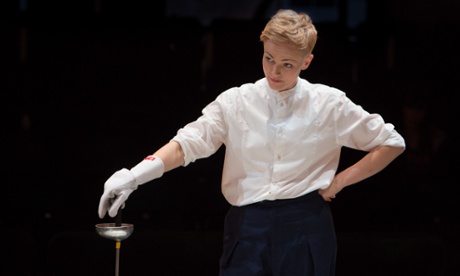
Of course, it’s not just down to playwrights to change things, nor should it be. I’d hate to feel pressured into only writing heroines – sometimes I like writing a hero, and sometimes the story demands it. And anyway, new plays are only part of the picture. Directors can help too, with gender-blind casting of classics, such as in Sarah Frankcom’s Hamlet and Phyllida Lloyd’s all-female Julius Caesar and Henry IV. Or they can revive plays with lead roles that were written for women in the first place – anyone who thinks there aren’t enough of those should read Kerbel’s 100 Great Plays for Women.
But as the actor and playwright Stephanie Street, one of the founders of the Act for Change project, says: “Playwrights can make conscious choices.” More than one playwright I know has made a personal commitment to try to write more and better roles for women. I’m trying to make more conscious choices, too – and not just when it comes to gender. Act for Change campaigns to make theatre (and TV, film and radio) reflect society, not just in terms of gender but also age, class, race, sexual orientation and disability. And I’ll own up now: although Operation Magic Carpet has a female lead, men do outnumber women in the cast. All five characters (and four of the actors who play them) are Middle Eastern. For this piece, I wanted to write Iraqi characters. Iraqis are also underrepresented – and stereotyped – in theatre. More than one actor who auditioned said what a relief it was not to be playing a terrorist.
It isn’t just a numbers game, and it isn’t just down to playwrights, but I hope that if we keep making conscious choices about the characters we write, then we won’t just change theatre but maybe also the world.
- Operation Magic Carpet is at the Polka theatre, London, until 24 May.