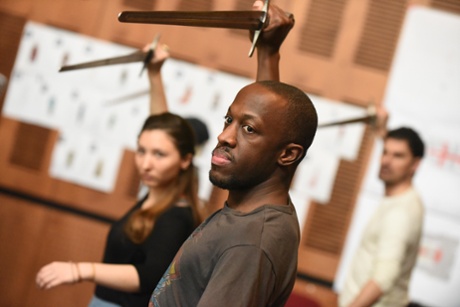
“ExCURsions,” said Ruth Cooper-Brown, loudly. “Ala-RUMS,” said Rachel Bown-Williams, louder. “Ala-RUMS. I like that. We keep saying it.” They’re desperate words – excursions means sorties at a run towards an enemy, deliberately out for trouble, while alarum is from the Italian “all’arme” – ie weapon up … incoming. Original stage directions for action in Shakespeare tend to the terse – everybody exeunts off, then there are those alarums and excursions. Plus drums of course, and trumpets in the bugle-call sense – a battlefield communications system more than music. But that’s it from Will, company please fill in here.
Ruth and Rachel are heads of the combat suppliers RC Annie, called in by Shakespeare’s Globe in London to fill in the rough stuff in its epic production of King John. The language in King John is always aggressive, with a roar of artillery (which is anachronistic – trebuchets, not gunpowder, slung projectiles circa 1200) and full of words that sound like assault and battery indictments, the best being “bethumped”. But that’s only background rumbling. For actual battles, director James Dacre pulled the one-line stage directions out for Ruth and Rachel as basis for what they call their “fight manifesto” – three scenes of wordless story, carte blanche to tell it as they please, provided it serves character and greater plot. Action can save exposition.
And how does that happen? Take Bastard Faulconbridge (Alex Waldmann). Rachel and Ruth sketch him out: he’s cynical but sound-hearted, by ancestry a warrior, but all mouth until he goes into his first encounter. When violence – to his surprise – works for him, he realises he has potential. By the big, mid-play confrontation, “we gave him a battle axe,” said Ruth, explaining it wasn’t an aristo weapon, so there was his bit-of-a-lad character reinforced: the axe meets Shakespeare’s demand that he behead his father’s murderer.
The Dowager Queen Eleanor (Barbara Marten) once co-led a crusade and she, not her son John, is the will of iron behind the French expedition. History requires she be taken hostage in that central encounter, but “she doesn’t make it easy,” said Ruth. “We wanted her to have a sword. She begged the director and came back with this little dagger,” said Rachel. It was later upgraded to a proper blade, and you get to see a flash of her determination. When she dies soon after of old age, John is left lost and floppy.
And how many people in this mighty middle battle? “Oh, seven,” said Ruth. “Seven with names, they fight in the centre.” There’s more “ghost-fighting, shadow-fighting” on the periphery of the audience’s view, said Rachel: the whole shebang had to be adjustable to staging by candlelight in the dark and stony Temple Church or the lofty aisles of Salisbury Cathedral before it reached the Globe. (“I wanted arrows,” said Ruth. “Not to hit anything, to go over the audience so they could feel what it was like.” She didn’t get her way.) Seven is a substantial roster in stage combat, not just because of the logistics of space and the varying fitness and training levels of an acting cast, but because a theatre audience “reads” live action much as they would real violence. They are shocked by sudden aggression, then see the action as specific moments: nobody will register exactly the same view of events, everyone in the theatre would give a different witness statement, just as they would if they encountered actual trouble. Movies make us believe we can take a panopticon view of action, watch many figures fight simultaneously both in mass and in detail. But what eyes and minds grasp live is a couple of characters in tableaux held for a millisecond on the story beats, linked by continuous kerfuffle.
Ruth and Rachel explain that not even the original Globe audience, who paid to watch staged sword fights and wrestling as sports, would have really got, move by move, what was going on. But what they’re interested in is trouble as character – Ruth came into fight-direction through acting, and says “all drama is conflict, action is the most direct way to express that.” The duo did the brutality for Rona Munro’s James of Scotland trilogy in Edinburgh and at the National Theatre in London last year, which began with a casually horrible beating-up and ended, three nights later, with the battlefield murder of a monarch: almost the entire script was a fight manifesto. (“Rhona likes fighting,” said Ruth. “She wants to write a pirate fight. With tankards.”) And the tough part, for performers as well as audience, was less the arbitrary executions or the poetical wimp James I who transformed himself into a swashing sword-swinger (“We gave them things they needed to learn by next week, and they went off and did it,” said Rachel), than the central play, James II, where the cruelty was intensely domestic. “That’s always more vicious,” said Ruth, “when it’s in the house and they go for the knife.”
By way of contrast to King John, Rosie Kay’s 5 Soldiers, which Kay first choreographed some six years ago when UK troops were still in place in Afghanistan, is remarkably unviolent for much of its running time. That’s running as in boots on the ground, since her dancers – accurately young, cast as officer, NCO, male and solo female squaddies – double round whatever drill hall or barrack space they’re performing in for long stretches, then idle restlessly fiddling with their packs; few military fictions ever got the hurry-up-and-wait aspect of soldiering so right. Rosie went on army training exercises (as, later, did both her original and current revival casts), first on Dartmoor, watching the trainees acquire cohesiveness, and a muscle memory of what must be done when it all kicks off. She was not prepared for “how much of it is more reaction than action”, with the drills and rituals like daily ballet class, not a place where movers get to think, but where they become unified bodies (and a unified body). One of the show’s truly frightening moments, when a disturbed lad can’t stop falling into the herringbone formation drill, kneel and aim, kneel and aim, exactly reproduces a rifle recruit zombified by 72 sleepless hours whom Rosie had to gently redirect into a calmer place.
Although the business and rationale of the soldiers she studied was conflict, there’s little of it in the performance, which stresses the tension of troops waiting less to do violence than to be in place where violence is done to them. Rosie precisely depicts infantry in modern asymmetric warfare in hostile territory it hasn’t quite taken and can’t hold, an understanding that came out of her second bout of training observation, when she played as an irregular enemy. “And all the initiative was on our side,” she said – freedom to take action alone, impromptu, but with the emotional certainty of familiar civilian life all around, able to melt into it.
Perhaps the military should have theatrical training – to learn how to read human, as much as army, body language and groupings in civilian spaces, to improvise scenes by reacting to prompts, and to control an audience mood – in fact, to study the rest of the play, not just the fight sequences. Even to learn how to breathe – part of the tension of 5 Soldiers, and the beat of its soundtrack “music”, is her dancers’ audible breathing, which she uses to suggest how soldiers deal with their constant awareness of violence through suppression. Nobody takes a long deep breath or expels one. Like Ruth and Rachel, she returns to those moments when the tension in people and atmosphere, and the revved-up energy level that generates, creates action.
But whereas in the invention of Ruth and Rachel, conflict lets protagonists go physically beyond their words to resolve them in motion, in Rosie’s drama, the climax doesn’t happen that way, as it often doesn’t in actual warfare now. And there’s no resolution for her soldiers, they’re going to go through all of this again tomorrow. Their antagonist isn’t human, doesn’t even feel human-controlled (though it is) – not a character with a story of its own, but an imaginary prop – an improvised explosive device inadvertently stepped on during patrol. “One in four patrols found IEDs,” Rosie said about Afghanistan, “and ours has gone out more than that without anything happening, they’re overdue this time. Their number is up.”
Ruth and Rachel carefully craft lethal action to be believable in a theatre, whether long, mesmerised seconds with a knife at the throat, or the kinetic charge of a football game one kick away from a melee.
In Rosie’s danced imitation of life, there’s no sequential tableaux of “action”, just a misplaced footstep, boom; man down, his fellow soldiers lugging him off towards medical care by his remaining limbs. His narrative is instantly rewritten by what feels like fateful accident. It turns out the great conflict, which Rosie researched in military hospitals and physical and mental therapy units, is within this soldier’s own character. It’s the violence of his struggle with a changed reality, and himself.