Get all your news in one place.
100’s of premium titles.
One app.
Start reading
The Guardian - UK
The Guardian - UK
Environment

The world's melting glaciers

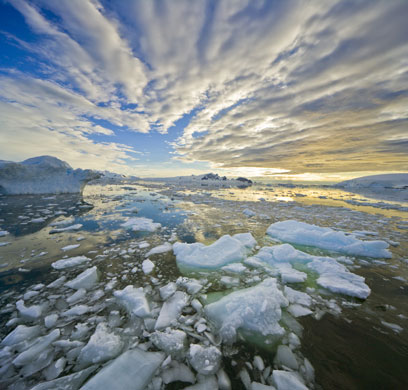
Glaciers under treat: Bergy Bits in Holtedehl Bay Under an Evening Sky
Antarctica. A polar landscape of snowy hills, dramatic cumulus clouds and coastal glaciers. A glacier is a large, slow-moving mass of ice formed from compacted layers of snow, that slowly deforms and flows in response to gravity and high pressure. Glaciers cover vast areas of the polar regions and are found in mountain ranges of every continent except Australia Photograph: Momatiuk /Eastcott/Corbis
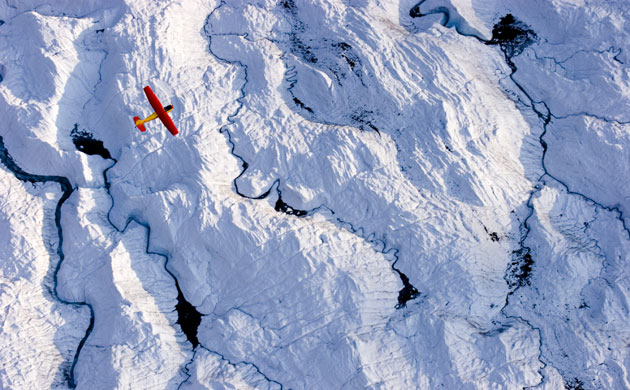
Glaciers under treat: Small Plane Flying Over Glacier
An airplane flies over a glacier in Wrangell St Elias national park, Alaska. Glacier ice is the largest reservoir of fresh water on earth, and second only to oceans as the planet's largest reservoir of total water Photograph: Frans Lanting/Corbis
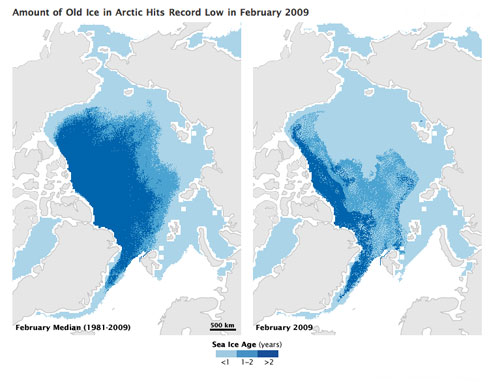
Glaciers under treat: Amount of Old Ice in Arctic Hits Record Low in February 2009
The summer minimum and the winter maximum are the two pivotal milestones in the annual cycle of Arctic sea ice, and are key indicators of Arctic climate. Over the past two-and-a-half decades, the extent of sea ice at the end of summer (mid-September) has declined significantly. The winter maximum (end of February or mid-March) ice covering is much younger and thinner than it was in the past.

This pair of maps shows the median age of February sea ice from 1981-2009 (left) compared to February 2009 (right). Ice more than two years old is dark blue, ice that is one to two years old is medium blue, and ice that is less than one year old is light blue. Compared to the median conditions at the end of winter, the ice pack of February 2009 contains much less old ice (dark blue)
Photograph: MODIS/NASA
Glaciers under treat: Aerial view on the surface of Greenland Ice Sheet
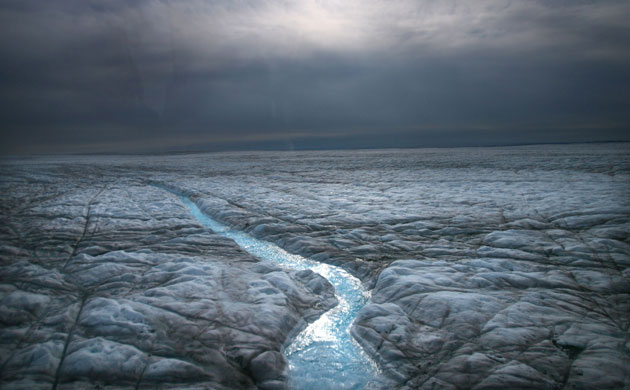
Meltwater lakes and streams on the surface of an ice sheet south-east of Jakobshavns glacier, Greenland. Ice sheets sit on land and if they melt, sea levels will rise. In March 2009, a new study found that the Greenland ice sheet is riddled with channels that could quicken ice loss and speed sea level rise Photograph: James Balog/Corbis
Glaciers under treat: Melted water runs over the Greenlandic Icecap , east to  Ilulissat
Melted water runs over the Greenlandic icecap, east of the town of Ilulissat. Scientists believe that Greenland, with its melting ice caps and disappearing glaciers, is an accurate thermometer of global warming Photograph: Uriel Sinai/Getty Images
Glaciers under treat: the glacier Blomstrandbreen in Norway
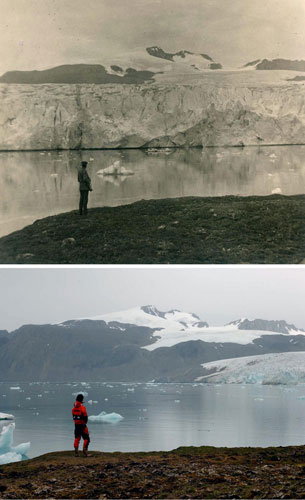
Glaciers around the world are retreating at unprecedented rates as temperatures rise due to climate change. This composite image shows the Blomstrandbreen glacier retreating nearly 2km (1.25 miles) since 1928. It has lost 35m per year since 1960 and this rate has accelerated in the past decade. The top photo, by the Norwegian Polar Institute, shows a man with a rifle watching the southern front of glacier, taken from Gerd's Island on 6 August, 1928. The bottom image shows Norwegian climate campaigner Truls Gulowsen standing at the same spot on 2 August 2002 Photograph: Greenpeace
Glaciers under treat: Climate Change in the Alps
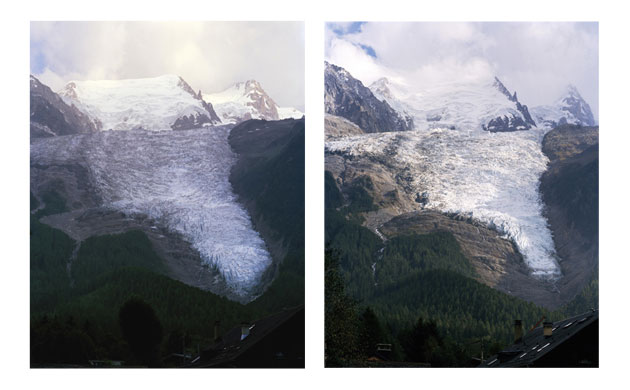
Climate change in the French Alps near Chamonix: 12 Mar 2007 (left) and 12 Mar 2008 (right) Photograph: Rex Features
Glaciers under treat: Bossons glacier in the French Alps near Chamonix
Bossons glacier in the French Alps near Chamonix on 12 Mar 2007 (left) and 12 Mar 2008. Since 1850, half the volume of Europe's Alpine glaciers has disappeared and it is thought that by the end of the century half of those left will have gone Photograph: Bjorn Lux/Rex Features
Glaciers under treat: Switzerland - Environment - Global Warming - Glacier
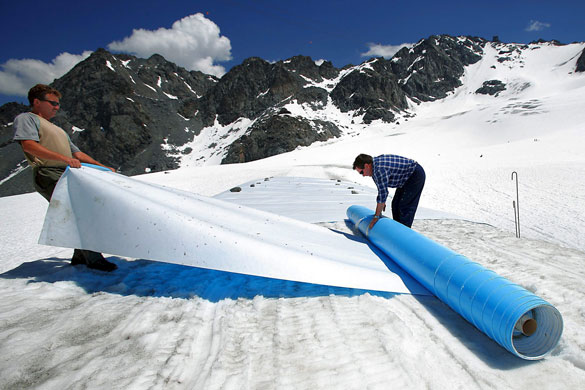
Nendaz Mont Fort, Valais, Switzerland. Stephanne Metrailler and Dominique Wuillamoz roll out an insulating cover over the Tortin glacier which covers 2,000 square miles and prevents the ice from melting in the summer heat. Glaciers retreat when there is less snow in the winter than what is melted away in the summer Photograph: Olivier Maire/Epa/Corbis
Glaciers under treat: the termini of the glaciers in the Bhutan-Himalaya.
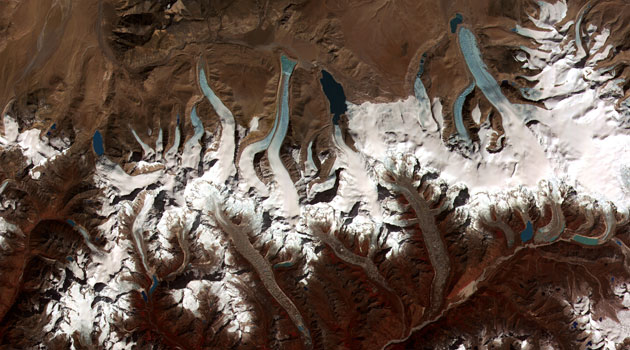
This Nasa satellite image shows glaciers in the Bhutan-Himalaya region. Glacial lakes have been rapidly forming on the surface of the debris-covered glaciers in this region during the past few decades Photograph: NASA
Glaciers under treat: Himalayas Greenpeace China's Himalaya trip
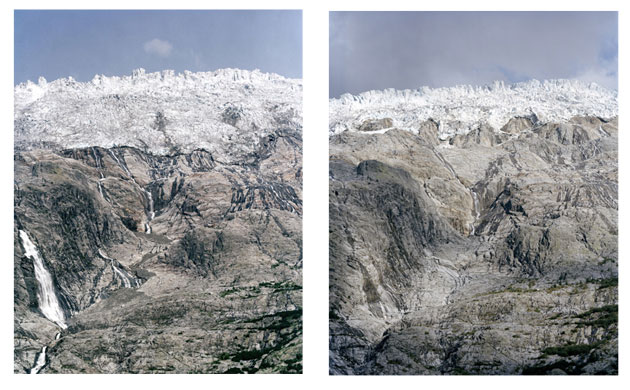
Pictures showing the contrast between the glaciers in 1968 and in 2007 when Greenpeace visited the Himalayas Photograph: Greenpeace
Glaciers under treat: The peak of Mount Kilimanjaro
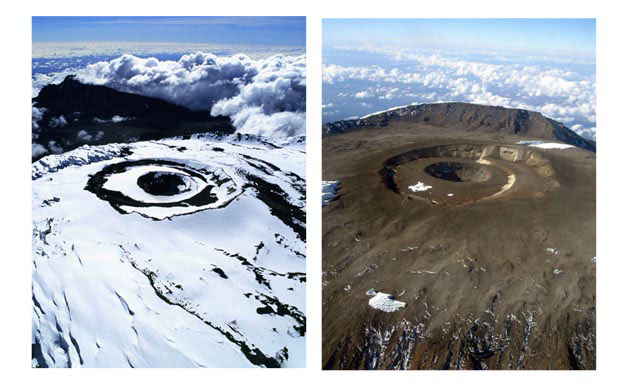
The peak of Mount Kilimanjaro in east Africa as seen from an aircraft in 1992 (left) and 2005 (right). The famous ice field that is just three degrees south of the equator could completely melt away in the next 20 years if the earth continues to warm at the current rate, scientists claim Photograph: Corbis
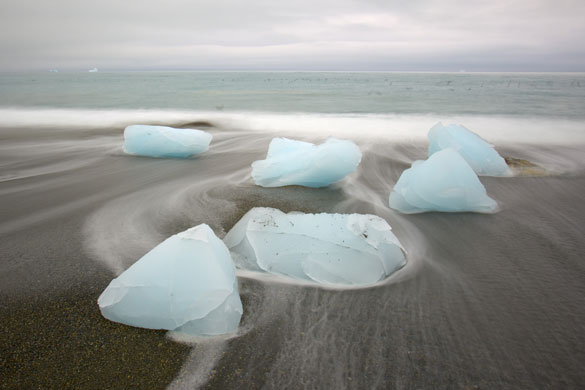
Glaciers under treat: Melting Chunks of Glacier Ice on Beach on South Georgia Island
South Georgia and the South Sandwich Islands. Melting chunks of ice from calving glaciers left on the beach by high tide Photograph: Momatiuk/Eastcott/Corbis
Glaciers under treat: Upsala Glacier in Patagonia, Argentina
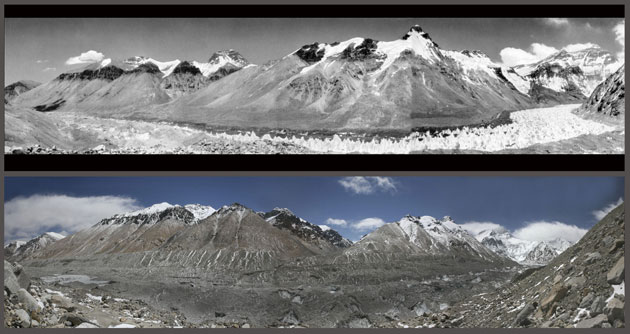
A combination photograph shows an image from 1928 (top) of the Upsala glacier in Patagonia, Argentina, contrasted with a 2004 photograph (bottom) of the same view. The pictures illustrate the extent to which climate change has caused the ice to melt away this century. Greenpeace campaigner Joris Thijssen, said: "Rising temperatures are causing glaciers to melt all over the world. Here in Patagonia, they are disappearing at a rate of 42 cubic kilometres every year – faster than anywhere else on earth. In both (1928 and 2004) the composition is made from three separate viewpoints to form a panoramic image Photograph: Greenpeace
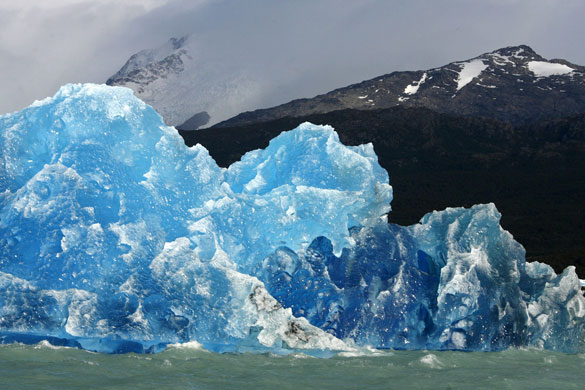
Glaciers under treat: Upsala glacier floats on the waters of Lago Argentino
A mass of ice broken off the Upsala glacier floats on the waters of Lago Argentino in the Parque Nacional Los Glaciares, in the Patagonian province of Santa Cruz. The glacier, one of the largest in the southern hemisphere, has a wall of ice of more than 60m (197ft) above the water surface that is 37 miles (60km) long, with a total surface of 232 sq miles (595 sq km). According to Argentine scientist Jorge Rabassa, by 2020-2030 most of the Patagonian glaciers will be gone Photograph: Enrique Marcarian/Reuters
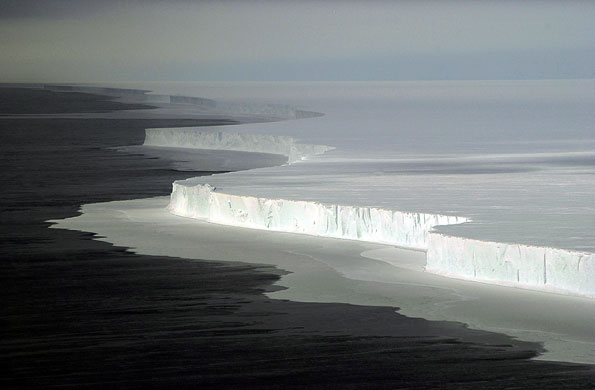
Glaciers under treat: B-15A iceberg in McMurdo Sound after it broke off  Antarctica
The sun illuminates the face of the massive B-15A iceberg in McMurdo Sound after it broke off the Ross Ice Shelf in Antarctica, November 2000. Scientists warned in 2004 that its bulk has disrupted air and water currents that normally break up pack ice in McMurdo Sound, the main maritime access route to three Antartic bases. This may lead to the death of tens of thousands of penguins unable to reach open water for feeding Photograph: JOSH LANDIS/AFP
Sign up to read this article
Read news from 100’s of titles, curated specifically for you.
Already a member? Sign in here
Related Stories
Top stories on inkl right now
One subscription that gives you access to news from hundreds of sites
Already a member? Sign in here
Our Picks
Fourteen days free
Download the app
One app. One membership.
100+ trusted global sources.