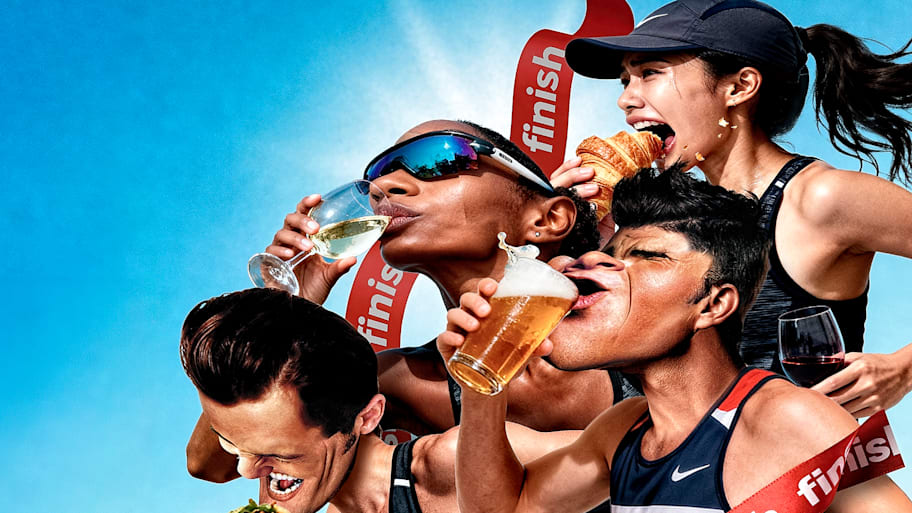
Chicago couple Melanie Pozdol and Victor Hilitski really should have a meet-cute. She can drink four beers and run a mile in a little over six minutes. He once ate 19 samosas and ran 21 miles in a little over six hours. In a perfect world, they’d have crossed paths with each other jogging on the Loop while stuffing their faces with deep-dish pizza or something. But, no, they just met at a wedding.
The fact that they are part of the city’s gastronomical racing community and never met before that day shows just how expansive that universe has become. And it’s not just Chicago. Raleigh has a race that combines a five-mile run with a dozen Krispy Kremes. The Bay Area has an IPA 10K. Last year, runner and entrepreneur Simon Evers got the idea to stage a bakery half-marathon in Copenhagen when his company was putting out a magazine dedicated to 10 of the city’s top bakeries. When he realized the total distance between them was 13.1 miles, he took it as a sign. (“It was written in the sky,” he says.) This September, Evers brought the idea to Brooklyn; he got 17,000 applications for 100 spots. The list goes on and on, and they all owe a debt of gratitude to France’s 40-year-old Marathon du Medoc, during which runners sample wines, cheeses and oysters. (Yes, oysters.)
Starting your own food race from scratch
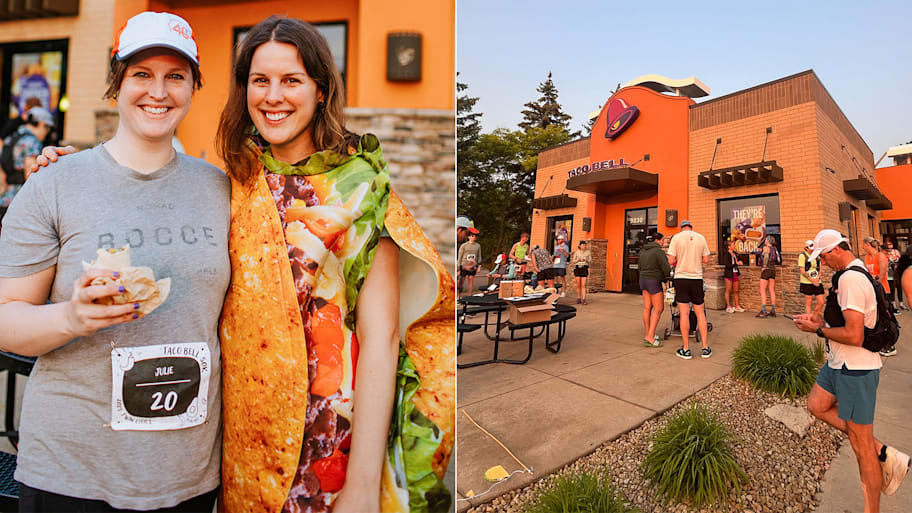
These events stand apart from, say, competitive hot dog eating in that they replace at least some of the gluttony with something that’s actually good for the body. That was what Julie Knopp was thinking when she saw that Denver was hosting a 50K Taco Bell ultramarathon. She couldn’t make it, so she decided to bring the idea to the Twin Cities, where she runs communications for a non-profit. “The reason I was initially interested in distance running was primarily the training and the accountability to train, rather than the event itself,” says Knopp, who ran her first marathon—by herself—during the pandemic. “But I think this sort of race has made the event itself something shinier, something that I look forward to.”
The rules are simple: Run 31.1 miles, stopping along the route at seven Taco Bells, where you must purchase and eat a food item, including at least one burrito and one Crunchwrap. (This would be an interesting place to point out that Knopp is vegan. With its ample beans and veggies, she says, “Taco Bell is super customizable.”)
Knopp wasn’t really plugged into the Twin Cities running community, so she just posted the idea on a few Facebook groups. She got so many entries—more than 50—that she had to cap the field and cede some of the administrative work to her friend Sarah Super, who encouraged runners on race day while dressed as a taco. Knopp mapped out the course herself, then ran it in segments and rode it on her bike to make sure it was tenable. The response was overwhelming. A major Taco Bell franchisee reached out about partnering next year, even though Knopp didn’t ask the restaurants for permission because she was afraid they’d say no. It’s the same reason she didn’t apply for any permits. “This whole thing was rogue,” she says.
A similar ethos inspired Craig Woods to start the Samosa Stumble in 2022. “I come from the DIY, punk rock community world,” says the 43-year-old who works at Northwestern and plays in a band called The Feat. “I grew up going to concerts in YMCA basements and church basements.”
He and a friend both live in Chicago’s Little India neighborhood and became obsessed with the samosas at a restaurant called Oberoi’s. (“They’re gigantic,” Woods says. “Not your typical tiny samosa.”) Woods got into ultramarathons during the pandemic and, inspired by the bizarrely cruel endurance races staged by course designer Lazarus Lake, decided to come up with his own challenge: Eat a samosa and run a 1.1-mile loop every 20 minutes until you drop out. Most of the competitors—there were just north of 50 this year—come from his Rogers Park Running Club. “The first couple of rounds, people are excited and happy and it’s fun,” he says. “People are like, This is cool. And then it gets real sick and gross after a while. I was taking that mindset of making something just fun, but super ridiculous.” One four-time quitter confessed to trying to increase her appetite with pot, but it turns out marijuana is not, at least in this case, a performance-enhancing drug.
The 2023 race was legendary. Hilitski downed 19 samosas and still finished second. “I stopped eating when I definitely reached the limit of having fun and just not finding a reasonable explanation in my mind why I’m doing this,” he says. (It didn’t help that the Ironman vet had gone for a 50-mile bike ride that morning.)
Woods didn’t compete in that race. He took part in the first one, stopping at six, but now he serves as a referee/hype man. Wearing a striped shirt, he taunts his runners, offering them cash to quit and singing Boyz II Men’s “It’s So Hard to Say Goodbye to Yesterday” to each one who drops out. (Not very punk, Craig.) He was once accused of serving spicier samosas later in the Stumble, a charge he neither confirms nor denies.
Knopp is gentler toward her competitors, probably because she was so moved that so many strangers—including one who came from Alaska just to take part—fulfilled her dream. “I think in many ways it’s a kind of a tough time to be alive for a lot of people right now,” Knopp says. “Many of us spend a lot of time on our phones or somewhat isolated. I think we want more joyful experiences. And there’s a sense of community that you can find in these runs that is kind of scarce these days. There’s an instant bond you can get when you show up to a 50K fueled by Taco Bell with 50 strangers.”
Training for a food race is not easy. Knopp says the key is getting used to eating while running, so she’d often heat up a frozen burrito and take it on a run with her. Past that, you’re basically trying to keep the food down while maintaining your pace.
A good ole beer mile
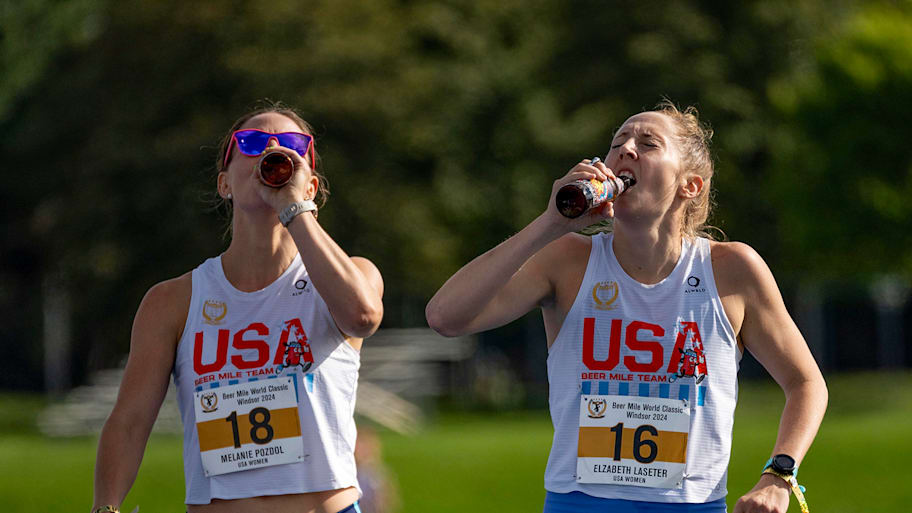
On the other hand, there’s the competitive beer mile. (Drink a beer, run a quarter mile and repeat three times.) It’s much more fast-paced—the men’s world record is 4:27.10—so the margins are tighter. That means every detail must be minded, beginning with the choice of beer. The rules specify an ABV of at least 5% in a 12-ounce bottle. (That caused a problem at the 2025 Beer Mile World Classic in Portugal, where most beers come in slightly smaller bottles. One member of the U.S. team had to check a dozen cases of beer in their luggage.) “You don’t want anything super flavorful, like an IPA,” says the best women’s beer miler in the world, Elizabeth Laseter. “I like Bud Light Platinum a lot, because it comes in a bottle with a twist-off cap, and that’s really easy and efficient if you’re just trying to drink it as quickly as possible.”
Laseter got her start as a freshman at Johns Hopkins, where she ran cross country and track. After the season she was introduced to her first beer mile, which her teammates held at 10 p.m. on an isolated track. (Beer milers can go rogue, too.) It was a needed change of pace. “I had kind of a tough time with college training, just because it was pretty intense for me,” she says. “So much of the time we have to be so serious. And this was an opportunity to be absolutely ridiculous and just have fun and act like total idiots.”
Laseter ran 7:37, almost beating all the men, and started thinking, There might be a future in this. And there has been. She’s won three Beer Mile World Classics in a row, most recently with a time of 5:56. Her three-peat came on the heels of Pozdol’s 2022 title.
Becoming an expert chugger
Unlike Laseter, Pozdol is a relatively slow runner, so she makes up her time in the chug zone, where she can put away a bottle in about six seconds. “She’s the best chugger in the world,” says Laseter. There are a couple of reasons for this:
Training regimen
For obvious reasons, beer milers can’t train with real beer. Some prefer non-alcoholic alternatives, but both Pozdol and Laseter swear by Topo Chico seltzer, which they say is harder to get down than a brew. “The discomfort of chugging a Topo Chico is horrible,” says Pozdol.
Science
Pozdol spent plenty of time filling up beer bottles with water and then pouring them into a sink at various angles to find the ideal tilt. (She says it’s around 45 degrees.)
The oboe
Yes, the oboe. Pozdol used to play it professionally. “Playing the oboe requires a lot of breath control, and that breath control from the oboe very much translates to breath control in chugging,” she says.
A good old competitive spirit also comes in handy
Pozdol, who has also competed in a pizza mile, once entered a burger-eating competition when she lived in Montana. “I was the only female participating,” she says, “and so people were like, ‘She’s not going to finish.’ And so I was like, ‘I’ll show you.’ ” In 2019 Pozdol won a corn-eating competition outside of Chicago by putting away five and a half ears in two minutes. She now dreams about a competition she would almost certainly win by default: “My true goal is to do a corn on the cob mile.”
This article was originally published on www.si.com as The World of Competitive Food Races Is More Creative, and Tastier, Than You Probably Think It Is.