The conflict between Mexico's dissident teachers' union and the federal government has crossed into new territory. After five consecutive days of strikes, road closures, and clashes in the streets of the capital, the movement has escalated dramatically: teachers breached the headquarters of the federal Education Ministry, major highways connecting Mexico City to surrounding states were shut down, and President Claudia Sheinbaum publicly refused to meet with union representatives — all while the countdown to the 2026 FIFA World Cup ticks louder by the hour.
Here's the full picture.
Who Is the CNTE?
The Coordinadora Nacional de Trabajadores de la Educación (CNTE) is one of Mexico's most powerful and combative teachers' unions. Unlike the larger, government-aligned SNTE union, the CNTE has historically positioned itself as a dissident, grassroots organization with deep roots in southern states like Oaxaca, Chiapas, and Guerrero — regions with large Indigenous populations and some of the country's highest poverty rates. It has a long history of street mobilizations that have periodically paralyzed parts of the country.
What Do They Want?
The demands go beyond a pay raise. The CNTE is calling for the total repeal of the 2007 ISSSTE Law — the federal law governing pensions for government workers — and a return to a solidarity-based pension system, where active workers contribute to fund the pensions of retirees, with benefits calculated based on final salary and years of service rather than individual savings accounts tied to financial markets. On retirement age, the union proposes a return to 30 years of service for men and 28 for women, regardless of age — meaning a teacher who begins at 22 and completes 28 years of service could retire at 50, rather than waiting until 65.
The CNTE is also demanding a 100 percent salary increase, a direct meeting with President Sheinbaum, and a new system for school assignment and teacher promotion.

What Has the Government Done?
Sheinbaum campaigned on promises to address teachers' labor grievances, but after one and a half years in office, her government has yet to deliver on the pension reform rollback the CNTE has long demanded.
As of June 3, the CNTE and representatives of the Interior Ministry, Education Ministry, and ISSSTE had held five rounds of working-group talks without reaching any agreements.
Then on June 4, Sheinbaum drew a clear line: the president ruled out meeting directly with the CNTE, stating that her cabinet secretaries have the authority to negotiate, and warning that the government cannot commit to demands that aren't fiscally viable.
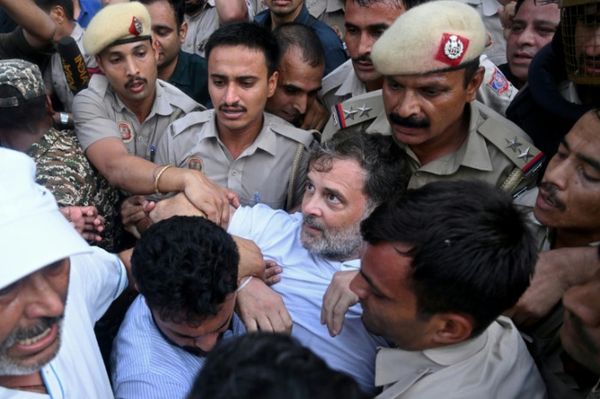
Her framing of the conflict has also shifted. On June 5, Sheinbaum characterized the violence during the protests as deliberate provocation designed to force her government into repression, something she categorically ruled out. "What do they want? Repression. There will be no repression," she said at her morning press conference. Her Interior Secretary, Rosa Icela Rodríguez, followed with a call for the union to reflect on its "shared responsibility" to build solutions through dialogue.
How Did It Escalate?
The first week of June has seen a rapid intensification of tactics.
On June 1, the CNTE launched its nationwide strike with a massive march in the capital. Protesters attempted to tear down metal barriers near the presidential palace using hammers and improvised explosives, and at least three people were injured — including two teachers, one with an eye injury.
On June 2, teachers toppled five-meter-high promotional soccer statues that had been installed along a major boulevard as part of World Cup celebrations.

On June 3, a group from the CETEG — the CNTE's most combative faction, based in Guerrero — broke into the federal Education Ministry building, knocking down the entrance with a street sign pole and injuring at least two police officers.
On June 4, the movement spread to the country's highway network. Teachers from Oaxaca, Puebla, and the State of Mexico took over toll booths on the Mexico City–Puebla, Mexico City–Cuernavaca, and Naucalpan–Ecatepec highways, raising the gates to allow free passage for thousands of drivers. Authorities also reported expected concentrations at toll booths on the Mexico City–Toluca and Mexico City–Pachuca highways. The actions were largely peaceful — a deliberate contrast to the confrontations earlier in the week.
A CNTE leader from Zacatecas warned bluntly: "If the government rejects our demands, there will be no more negotiations."
Six Days to Kickoff
Mexico is a co-host of the 2026 FIFA World Cup alongside the United States and Canada. The CNTE's national assembly voted to sustain an indefinite strike through the tournament, explicitly to pressure the government by threatening to disrupt one of the most-watched sporting events on the planet.
Hundreds of striking teachers have established a camp on streets surrounding the central plaza in the capital, where authorities have been constructing a public fan zone for the World Cup's opening match on June 11. Metal barriers now ring the area to keep protesters out.
With no agreement reached and both sides hardening their positions, the coming days will test whether Sheinbaum bends toward direct talks — or whether Mexico's World Cup opens in the shadow of one of the country's most visible labor standoffs in years.