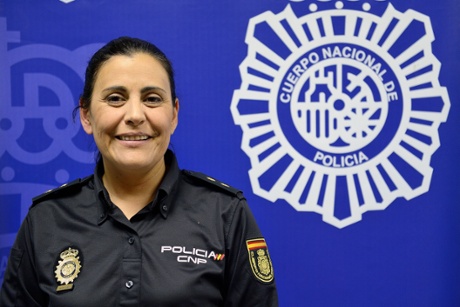
The baseball bat – blue with a fluorescent yellow stripe – was tucked neatly under Olga Lizana’s desk, next to her constantly moving feet.
“It’s not for safety,” said the police officer, who has a habit of swooping in unannounced on some of Britain’s most wanted criminals. “It’s my little souvenir,” she said smiling.
The bat belonged to Andrew Moran, one of Britain’s most wanted criminals, who spent years on the run in Spain.
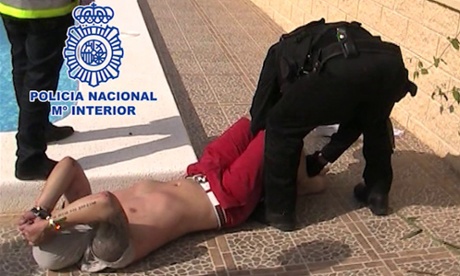
The search for Moran, one of hundreds that Lizana and her team handle each year, culminated in a dramatic arrest as he lay sunbathing with his girlfriend in Calpe on the Costa Blanca.
The arrest ranks among Lizana’s top moments as head of the Spanish police’s fugitive unit, working with police and intelligence units around the world to root out foreign criminals hiding in Spain. “He thought we would never catch him. When the video of his arrest came out, I received calls from around the world – the Americans and the Swedes even called me – it was a spectacular arrest.”
The fast-talking 41-year-old is one of the leading forces behind the cleanup of Spain and, in particular, the Costa del Sol, working around the clock to rid the area of its reputation as a safe haven for foreign criminals. “This is not a good place for criminals to come anymore,” said Lizana. Since it launched in 2006, Operation Captura – the multi-agency initiative between Crimestoppers, British and Spanish authorities – has caught 68 out of 86 British fugitives in Spain on its list.
In her cramped office in Madrid, Lizana rushed to open a window. “It doesn’t bother you if I smoke, does it?” she asked as she traded a well-chewed pencil for a pack of Marlboros. “I wouldn’t get any work done if I had to step out every time I needed a smoke.”
Fluent in English and French, along with her native Spanish, she switched effortlessly between languages as she answered her constantly ringing phone. As many as 10 requests a day come from countries looking for fugitives, wanted for crimes that range from the mundane to murder.
“We had a Polish man who was wanted by the Romanians for stealing a chicken and a pair of boots,” she said. “When I asked him about it, he told me that he didn’t have shoes and he was hungry.” She shrugged as she exhaled a cloud of smoke. “These aren’t considered crimes in Spain, but it’s our job.”
It’s these cases that Lizana passes to local police or to the 11 others on the team she leads. But the Brits she often keeps for herself. “The Brits are in for big crimes – serious robberies, drug trafficking, sex crimes,” she said. “The other ones you have to do because it’s your job, but it’s not the same rush.”
The prevalence of British criminals around Spain’s Costa del Sol has helped earn the area the nickname Costa del Crime, a reputation in part exacerbated by the breakdown of extradition agreements between Spain and the UK from 1978 to 1985. Lizana is keen to show that things have changed: three of the 10 people publicised in March as Britain’s most wanted in Spain have been caught in recent weeks.
Her success has come with an unexpected side effect: Lizana has become a walking encyclopedia of the habits of expat communities in Spain. “I know where the Scottish go, or those from Liverpool or Manchester, which bars, shopping malls and gyms they go to.”

She works in close collaboration with a National Crime Agency officer based at the British embassy in Madrid as well as British police. “I always tell them that the key word here in Spain is ‘wait’,” she said, noting, for example, how long it can take to get a search warrant in Spain.
Lizana, who started her police career in counter-terrorism, had rarely been to the Costa del Sol when she began working at the unit five years ago.
“Now I know it like the back of my hand,” she said. The job comes with hours that would make even the most eager hesitate and she often has to drop everything to dash across Spain for an arrest. “My phone rings 24 hours a day. I never make plans because everything changes all the time. If I have to travel to Málaga, I think I’ll be going for five days and end up staying 10.”
Relationships are impossible to maintain, she says. “It’s a job that absorbs all my time. I never turn off my phone. The person next to you gets tired of not being able to make plans, or you being on the phone while on vacation.”
Still, Lizana couldn’t imagine doing anything else. In a country where female police officers are few and team leaders are overwhelmingly male, Lizana has known what she wanted since childhood. “I always wanted to be a police officer. I just knew,” she said.
In those rare moments of down time, she indulges in American television series such as Without a Trace or Law and Order. “I think of it as training.” she says. Last summer, she took a vacations of sorts, heading to Málaga with her mother. After ensuring her mother was comfortably set up on the beach, Lizana drove off, using her vacation to research the area and check out a few leads.
She frames her battle against crime in the Costa del Sol as a David and Goliath match – her small team fighting a reputation that has been entrenched for decades. “The first time I was working with British authorities, I met up with them at the Alicante airport to carry out a surveillance operation. They asked me where the rest of my team was,” she said laughing. “I said there is nobody else.”
As Costa del Sol drifts further away from its Costa del Crime nickname, Lizana is eyeing a new challenge: a position as a chief inspector. “But moving up would mean more office work rather than street work, so I’m not in a huge rush,” she said, smiling. “The office is good, but when you’re out on the street – that’s when you feel like a real cop.”