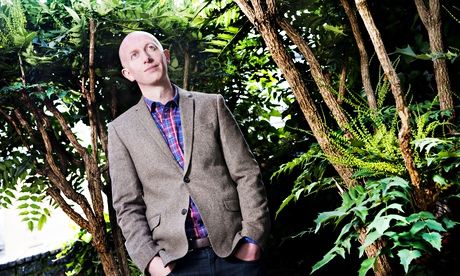
There seems to be no end to Piers Torday’s anarchic imagination. In the first two books of his Last Wild trilogy, he introduced us to a world ruined by climate change and dominated by the fear of disease and the wild creatures carrying it; The Dark Wild won last year’s Guardian children’s fiction prize. In this world, human beings are crowded into the last remaining city, which is run by “Factorium”, an evil monopoly that controls every aspect of their lives. The only available food is ‘FormulA’, a disgusting pink concoction produced by Factorium, and animals have been almost entirely wiped out by an illness called “red-eye”.
Many dystopian novels have a similar setting. What makes Torday’s trilogy stand out is the extraordinary cast of characters he assembles to fight against Factorium and its evil creator, Selwyn Stone. The trilogy’s hero is a boy called Kester. He is mute, but he can communicate telepathically with animals. This gift enables him to collect a band of comrades, including a rat, a cockroach, 100 pigeons and a mouse who dances what she wants to say. These characters have an eccentric charm that is both comic and moving, and they are as important to the book as the two girls, Polly and Aida, who also join forces with Kester.
There is such a long cast list that it takes a while to introduce everyone at the beginning of this third book. That makes the start rather slow, and likely to be confusing for new readers. It is worth persevering, however. The story really gets going with the appearance of the world’s last blue whale, closely followed by the arrival of Councillor Fenella Clancy-Clay, a new villain, who arrives in a glass ship and whisks the children off to “hair and makeup”. All Torday’s characters are precisely imagined, and described with a crisp economy that makes them easy to visualise, from Fenella, with her translucent skin and icicle necklace, to the terrifying tattooed Eck in the jungle of Faraway.
Kester and his friends are hunting for the Iris, a tiny capsule of microdots containing the DNA coding for every living thing in the world. At the start of the book it is lost, tucked into the cheek pouch of a mouse who is hiding somewhere. It must be found before Selwyn Stone gets his hands on it. Wildness must be defended and preserved.
Two opposing images run through the book: the huge heart of the blue whale, echoed in the shape of Faraway Island, with its jungle packed with unknown plants, some perilous and some useful to humans; and the man-made, sterile beauty of Fenella’s glass boat and the Glass Towers where she takes the children. They sum up the serious issue at the centre of the trilogy: the fate of wildness in a planet increasingly damaged by human choices and actions. It would have been easy to give a glib answer by ending the book with an optimistic resolution. Torday avoids that trap with an elegantly light touch as a final twist leaves the central question hanging in the air: will human beings finally make the planet uninhabitable and be forced to start again on another world?
• Gillian Cross’s Shadow Cat is published by OUP. To order The Wild Beyond for £4.99 (RRP £6.99) go to bookshop.theguardian.com or call 0330 333 6846. Free UK p&p over £10, online orders only. Phone orders min p&p of £1.99.