
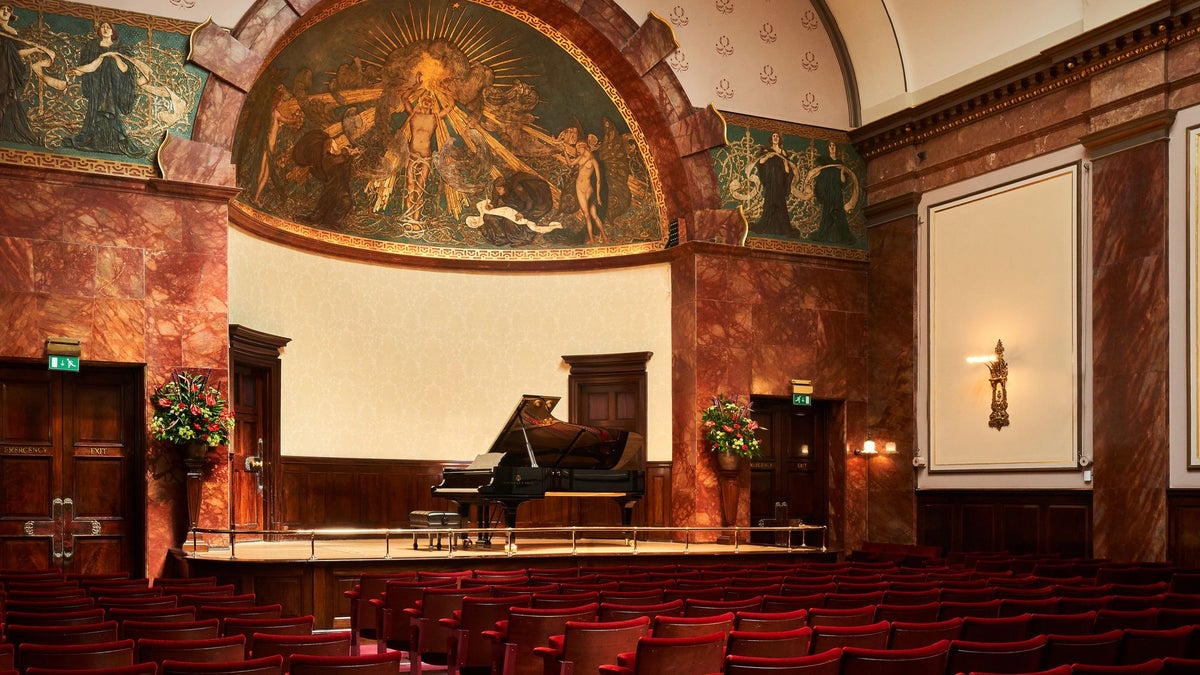
The Wigmore Hall is the London venue that classical musicians most love to play in. This spring it celebrates 125 years since it opened as a place for recitals and small-scale ensembles – the stage cannot hold a full orchestra and the intimacy of sound for 550 listeners would be spoiled if too many musicians were crammed onto it. The oblong hall faces a recess, rather like the apse of a church, and is overlooked by a beautiful gold mosaic of a figure reaching for the sun.
It began as Bechstein Hall, a place to demonstrate the quality of the firm’s pianos, which were sold from the shop next door. These days, Bechstein has its modern showroom further up the street and Steinway’s is just across the road. So the name was changed to the Wigmore Hall, after the street in which it stands, when German sounding names became a focus for antagonism at the start of World War Two. Right from the beginning, though, the finest musicians wanted to play here, as the array of signed photographs in the backstage green room attests.
The hall went through a relatively barren patch in the 1970s but since then its reputation as a centre for the best chamber music has climbed steadily, to the point where its concerts, often two per day, are well-filled (if not always sold out). This has placed it in the enviable position of being able to refuse Arts Council England's grants, as the management decided that the conditions attached to this money would be detrimental to the freedom of the hall’s programming.
Next to the star names that queue to perform here, the hall plays a vital role in establishing the reputations of those performers who may not have a wide following in London yet, but deserve one. It promotes many of these concerts itself but also partners with organisations such as the Young Concert Artists’ Trust (YCAT), formed over 40 years ago to mentor a small selection of talented newcomers each year, as well as presenting them to live audiences. One example is pianist Ignas Maknickas who, after collecting a shelf full of competition prizes from Aarhuis to Zagreb, could be heard in a lunchtime concert on 24 March. His interpretation of Robert Schumann's Kinderszenen (Scenes of Childhood) brings out the playfulness but also the minor tragedies of a child's perception, the way one miniature adventure can be followed by a serious song of discontent.
Maknickas does his best to make the Preludes of his fellow Lithuanian, Mikalojus Ciurlionis (1875 – 1911), compelling without quite succeeding. There are echoes of too many late Romantic composers but not the originality. The pianist is on safer ground with Chopin's waltzes and nocturnes, and in the famous Barcarolle, Op. 60, but here his technique shows that there is still room to mature: too many temptations to slow down without good reason, too much use of the sustaining pedal so that the sound becomes overloaded with confusing harmonics. Maknickas is clearly a very fine pianist who will repay YCAT's faith in him, but his musicianship is still a work in progress.
Already at a high level of vocal maturity but not yet a prominent name in Britain is the French mezzo-soprano Marianne Crebassa (25 March, accompanied by pianist Joseph Middleton). Hers is one of those sumptuous mezzo voices I just want to bathe in on first hearing. It is rich, dark and has colours that fully bring out both the gorgeous tones of Debussy's Chanson de Bilitis and the stark desperation of Mahler's Kindertotenlieder (Songs on the Death of Children). The latter is in grim contrast to the life-affirming warmth of the Schumann piano pieces played by Maknickas. Mahler's songs are not pleasant but they are not meant to be. They drain the emotions and Crebassa understands how to wring out the listener's responses to the grief in Friedrich Rückert's words. Luckily the mood of Ravel's Five Popular Greek Melodies relieves the tension and sends us out humming.
.jpg)
The Wigmore Hall's official festival period for the 125th celebrations will run from Monday 25 May to Sunday 7 June. Joseph Middleton will be playing in that too: for the opening gala along with composer Thomas Adés, violinist Alina Ibrogimova and singers Cédric Tiberghien and Louise Alder. Middleton will also partner soprano Carolyn Sampson on 14 June. Other highlights will be concerts by two great octogenarian heroes of the early music movement; Jordi Savall, directing Hesperion XXI in works by Monteverdi (26 and 27 May) and William Christie with Les Arts Florissants in Handel's chamber opera, Acis and Galatea (1 June). The festival closes (7 June) with Christian Tetzlaff celebrating his own 60th birthday by playing Bach's sonatas and partitas for solo violin.






.png?w=600)




