The weird world of the incredibly small – in pictures
Researchers created these nanoscale craters by putting a layer of complex carbon-containing molecules on a silicon surface, then blasting it with electrically charged clusters of bismuth atoms. The images were taken using an atomic force microscope, which works like a blind man feeling his way with a cane. The microscope has a sharp tip that scans across the surface to build up an image Photograph: National Physical LaboratoryNanotechnologists use wafers of silicon as transistors, which act as the ‘switches’ in electrical circuits. The intricate candelabra-like shapes in this image were created when a silicon wafer was heated to melting point then left to solidify Photograph: John Hart/NanoblissThese images show the difference between natural (left) and heavily bleached hair (right). On the untreated hair you can see layers, called cuticles, separated by steps like overlapping roof tiles. Bleaching erases these steps, damaging the hair and leaving behind a rough surfacePhotograph: National Physical Laboratory
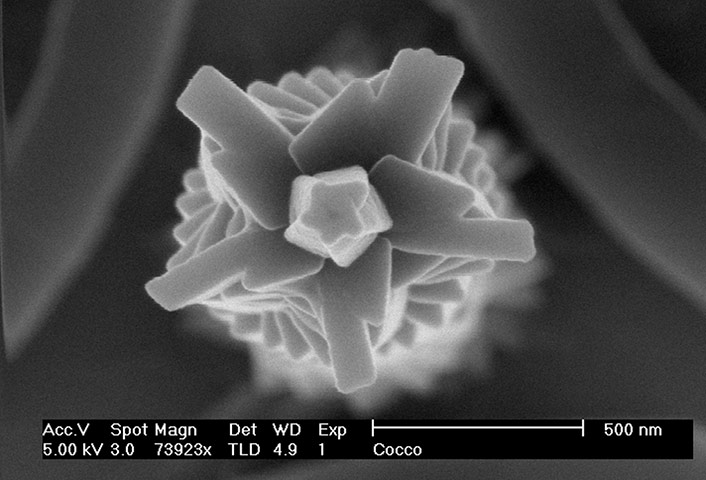
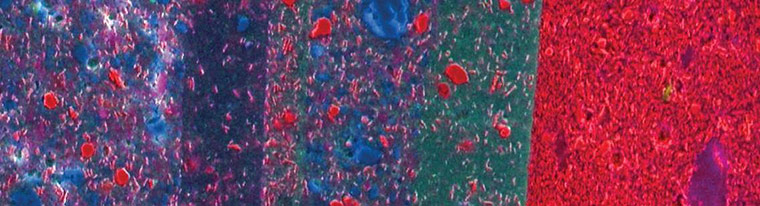
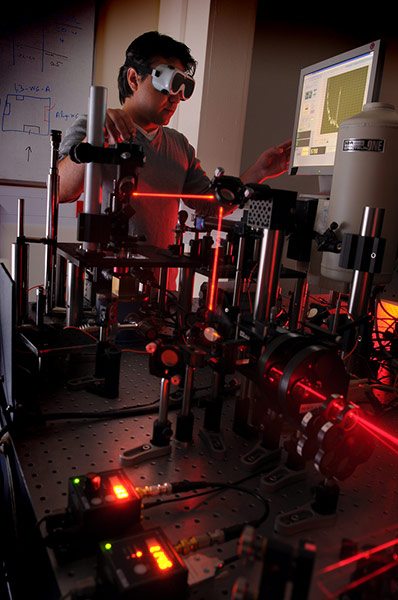
A whole new family of 'two-dimensional' materials called MXenes is made up of sheets of titanium carbide, each only a few atoms thick. Researchers are exploring potential applications to store energy in electrochemical capacitors – the devices that enable trams to travel short distances without overhead wires – and in lithium-ion batteries. The material was imaged using a scanning electron microscope (SEM) at a magnification of more than 20,000 timesPhotograph: Babak Anasori, Michael Naguib, Yury Gogotsi and Michel W. Barsoum/Drexel University/Courtesy of the Materials Research Society's Science as Art CompetitionThis is an alga called Rhabdosphaera clavigera, the creature whose exoskeletons make up a large portion of the White Cliffs of Dover. Plankton like these are built from nanocrystals of calcium carbonate Photograph: Roland Kröger and Renee Van De Locht/University of YorkThe tip of one of the creatures's spines. Scientists hope to discover how nature makes these symmetrical structures on the nanoscale with such precision – with a view to creating new materials Photograph: Roland Kröger and Renee Van De Locht/University of YorkThis is a 1-millimetre cross-section of a paint sample found on the demolition site of a building from the Victorian era. It reveals around 13 layers of paint that were applied over the years. An analysis showed that lead was present in many of the layers, but not the toxic chemical arsenic that was used in many paints of the timePhotograph: Oxford InstrumentsAn enlargement of the previous image reveals spots of lead (red) about 10 micrometres widePhotograph: Oxford InstrumentsThis researcher is aligning an experiment to test a quantum computing circuit. A conventional computer processor solves a problem by trying one solution at a time, whereas a quantum processor can explore all the possible solutions simultaneously at lightning speed. The research at Toshiba Research Europe uses photons travelling through optical circuits, where they interact with each other to perform logic operations Photograph: Toshiba Research Europe LtdPart of a quantum computing circuit. The thin slab of semiconductor is etched with a pattern of holes, each around 200 nanometres in diameter. A tiny blob of a second semiconductor inside the slab emits photons, which can be used to process quantum information. The narrow central line traps and guides individual photons, making it one of the most efficient light sources ever made Photograph: Toshiba Research Europe LtdThese spikes are nanoparticles of gold resting on graphite, which is made of sheets of carbon atoms. The researchers scattered the nanoparticles onto the surface to measure the sharpness of the probe tip of their atomic force microscope. By chance, they also discovered that the nanoparticles tend to cluster at the edges of the graphite sheets, which 'form' steps on the surfacePhotograph: National Physical Laboratory
Sign up to read this article
Read news from 100’s of titles, curated specifically for you.