Aunty under attack – again
The Australian published a story on Wednesday which claimed that the ABC was the worst performing television broadcaster in 2014, and compared it unfavourably with Ten.
It’s just one of several stories attacking the public broadcaster that the paper has published this year, and we’re only a few weeks in.
This time the media reporter Darren Davidson claimed the ABC’s TV budget was bigger than that of the commercial networks Seven, Nine and Ten, and was “between roughly $510m and $560m”.
“Roughly” is right, because it is nowhere near that figure. The ABC TV director, Richard Finlayson, told staff on Wednesday that the report had “massively overstated” the size of ABC Television’s budget and the size of the acquisition budget.
“It is the latest in a long series of anti-ABC, pro-Ten stories from the Australian,” Finlayson said. The “grossly inaccurate back of the envelope calculations” had led the Oz to state the ABC Television budget is greater than the commercial networks.
Finlayson: “If only this were the case – the fact is we achieve highly competitive results with significantly less money.”
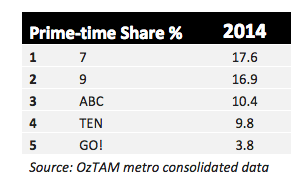
What Davidson left out of his story was the inconvenient fact that the main ABC channel beat Ten in the overall annual TV ratings for the second year running: 10.4 to 9.8. It’s true the ABC lost audience share in 2014, as did Seven and SBS. Only Nine and Ten increased their share, Ten largely because it came off a record low in 2013.
How not to report
The infamous tabloid TV show Today Tonight may not be broadcasting nationally any more but in the smaller states, where it still airs a local edition, it is still up to its old tricks.
The Australian Communications and Media Authority has found that the Tasmanian edition of Today Tonight breached the personal information and privacy provision of the commercial television industry code of practice. The story, which aired in 2013, was standard fare about a neighbourhood dispute in which one couple was accused by a former friend of living in a property they hadn’t paid for.
What stood out in this case was that the journalist filmed through a window and inside the house, according to the Acma investigation. But wait there’s more. She also named the couple’s street and suburb, and footage “clearly showed personal information and signatures on a contract relating to the property”.
The broadcaster of the program, Southern Cross, an affiliate of Seven, has promised to use the incident in training sessions about how not to report.
Cartoon caution
Last week the Sydney Morning Herald had to publish an adjudication by the Australian Press Council which said that a Gaza cartoon by Glen Le Lievre caused greater offence than was justifiable in the public interest.
But the punishment didn’t end there. In the wake of an intense campaign against the SMH, the paper has introduced a number of internal measures to ensure it doesn’t offend again.
An extra layer of approval has been introduced for all cartoons before publication; and the editor-in-chief, Darren Goodsir and the news director, Judith Whelan, attended seminars convened by the Jewish Board of Deputies. Further seminars are planned for the top layer of senior editorial staff.
Goodsir told the Weekly Beast it had been a roundtable discussion on antisemitism and associated matters which included a presentation from experts selected by the Jewish Board of Deputies.
“It was a very productive session that occurred late last year; and I am grateful for the time and effort that went into the presentations. I feel newsrooms cannot be educated enough about the sensitivities involved in reporting on a range of community issues; and I aim to use this experience as a template for further sessions this year on other relevant news issues.”
The Disney version
Speaking of the press council, the outgoing chairman, Julian Disney, is likely to throw a few bombs when he addresses the National Press Club in Canberra on 4 February.
It’s just a few weeks before he steps down and he may choose to answer his critics at News Corp who have regularly bombarded him with criticism over the council’s adverse adjudications. The professor’s main theme will be the importance of maintaining good standards in the digital age at a time when the print media is in decline.
A spokesman for the press council has confirmed the regulatory body has received at least one complaint about the late-afternoon edition of the Daily Telegraph which was published on 15 December while the siege in the Lindt Cafe was under way.
The edition was criticised for its factual errors and tone and headline “IS takes 13 hostages in city cafe siege”.
While we will have to wait several months before that matter is investigated by the council, Disney did make a statement on 16 December which criticised some of the coverage without naming anyone.
“Much of the coverage has been excellent and has not hesitated to tell painful truths when necessary,” he said the day after the siege. “But there have been some deeply regrettable errors and exaggerations, spreading dangerous misinformation without any reasonable basis. This type of material can be a serious risk to public safety, as well as causing an unjustified level of fear and distrust across the community.”
In defence of Gillian Triggs
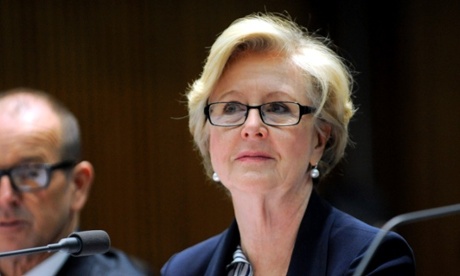
A number of human rights law professors jointly drafted a letter to the Australian in support of Professor Gillian Triggs, president of the Australian Human Rights Commission, who has been described by Richard Ackland as “the latest victim of a heavy-handed campaign by the Australian newspaper”.
“We write to express our concern over the recent criticism of one of Australia’s most respected independent public office holders, Australian Human Rights Commission president Gillian Triggs,” the letter began.
“In our view, [the relentless attacks] are based on a misunderstanding of the role of the commission. Independent public office holders are an important part of modern democratic societies. Their task is to ensure accountability for abuses of power by government. Their capacity to perform this role depends on their independence and ability to act impartially.”
According to one of the signatories, Dr Alice de Jonge, the letter was sent on Sunday 18 January and, despite follow-up emails and phone messages, there has been total silence from the Australian. The letter has since been published by the Conversation and New Matilda.
Game of thrones, the ABC version
The next few months at the ABC will see senior journalists competing against each other for several key editorial jobs which are up for grabs at the same time.
Four Corners, Foreign Correspondent – and perhaps even 7.30 – will all be looking for new executive producers.
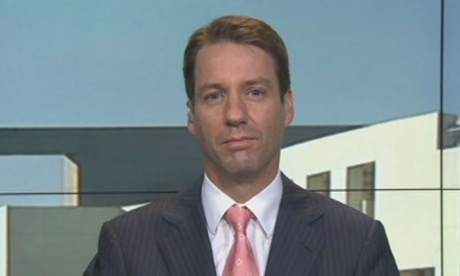
Program sources say the 7.30 executive producer, Sally Neighbour, has expressed an interest in taking over from Sue Spencer when she vacates the Four Corners throne in March. If this were to happen, the EP spot at 7.30 would be open too.
Foreign Correspondent’s EP, Steve Taylor, has resigned to head up Seven’s Sunday Night program after Mark Llewellyn was stood down.
The departure in December of Canberra reporter Mark Simkin to be Tony Abbott’s chief of communications has also left the position of chief political reporter open. And with Chris Uhlmann’s appointment to the new position of ABC political editor, the ABC will also be looking for a new host for AM.
We can reveal that the excellent Jerusalem correspondent Hayden Cooper is returning soon and a new Jerusalem correspondent will be announced in the coming weeks.