#tentgate
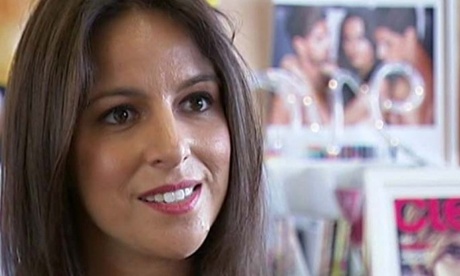
Sharri Markson, the Australian’s indefatigable media editor, appeared on The Bolt Report on Sunday but failed to address the burning media issue of last week: #tentgate.
The Sunday morning show, produced and paid for by News Corp for Ten, described Markson as the “target of an ABC/Fairfax smear” in pre-show adverts.
But once live, Markson and Bolt never got around to discussing why the Age was “100% wrong” when it reported, last week, that Markson had been asked to leave the Emirates marquee at the Melbourne Cup after allegedly harassing ABC’s Insiders host Barrie Cassidy.
“Nothing happened today,” Markson tweeted after an Age editor said on Twitter that she had been asked to leave the tent. “I’m fine. It’s a completely fictitious story.”
Markson then dug up evidence to prove that she had NOT been ejected from the airline’s VIP tent. Her colleague Darren Davidson reported that the Age was “under pressure” to apologise to her.
So how did this 100% wrong story come to be?
According to Cassidy, Markson wouldn’t take no for an answer when she approached him with a News Corp videographer, Eric George, to ask for an interview.
Cassidy’s companion complained to Emirates staff and when Markson was found to be gone from the tent five minutes later, some of those concerned came to the conclusion that she had been evicted. Cue the Age story.
As ever, questions remain. What was Markson trying to interview Cassidy about? And where is the video diary that Markson and George were apparently making at the Melbourne Cup? There’s still no sign of it on the Australian’s website.
Walking to the Walkleys?
Last week we reported that the ABC was the only TV network not to hold a 2015 programming launch, thanks to looming budget cuts.
Now we hear the lack of spare cash in the ABC’s news division means management will not pick up the tab for nominees who live outside Sydney to attend the 59th Walkley awards for excellence in journalism next month.
The ABC scored 29 nominations in the Walkleys this year but some journalists who were nominated have been informed by email they will have to pay their own airfares and accommodation if they want to be there to pick up any awards they may win.
An ABC spokesman denied that this was budget related. “These matters have always been up to the discretion of the EP or line manager and are not a reflection of any budget cuts,” he said.
Where did all the journalists go?
Estimates vary, but about 20% of journalists, including subeditors and photographers, have been made redundant from Fairfax, News Corp, magazines and TV since 2012.
This year even more photographers left the daily news game when Fairfax outsourced to Getty Images and we’re soon to see hundreds of journalists and producers made redundant by the ABC and regional newspapers.
A team of researchers from four universities has been keeping track of these people with an online survey called New Beats.
The point of the research, funded by an Australian Research Council grant, is to discover whether their skills have been lost to journalism entirely and what the consequences are for the industry.
It turns out many of the hacks made redundant are now in public relations, at universities, freelancing, or working for digital-only outlets.
Interestingly most say they have suffered a drop in income, but have achieved a better work life to compensate.
If you are one of those refugees from the collapse of legacy media, New Beats wants to hear from you. More information is on its website or on Twitter.
One of the members of the New Beats team and the head of journalism at La Trobe, Lawrie Zion, will discuss the project at the Storyology conference on 2 December.
Prank call station in court again
The media watchdog will have another chance this week to penalise the Southern Cross Austereo-owned Sydney radio station 2Day FM for the prank call answered by the British nurse Jacintha Saldanha, who later took her own life.
The radio station has been fighting the Australian Communications and Media Authority (ACMA) through the courts since its investigation found that the call by Mel Greig and Michael Christian to the hospital where the Duchess of Cambridge was a patient breached its licence condition.
The case will be heard in the high court in Canberra on Tuesday. ACMA is asking the court to uphold its finding that 2Day broke surveillance laws by recording and airing the segment without consent.
The radio station has argued that ACMA does not have the authority to find it guilty of a criminal offence, an argument which the federal court upheld in March. But if ACMA is successful in overturning that ruling in the high court, 2Day FM may be subjected to the toughest of penalties, including a total broadcast ban.
Stone age journalism?
While Sunday Night’s executive producer, Mark Llewellyn, awaits his fate at home after allegedly being suspended for assaulting one of his producers, one of his more controversial stories is the subject of yet another court case on Wednesday.
When ACMA ruled that Sunday Night’s 2011 story about the Suruwaha Indians was capable of provoking racism and inaccurate, Seven refused to accept the watchdog’s verdict and pursued a judicial review in the federal court.

But the federal court agreed with ACMA, saying that describing Amazon Indians as child murderers, “stone age” relics, and “one of the worst human rights violators in the world” was inaccurate.
Known internally as “Sunday Tonight” for a tabloid style which evokes the daily current affairs show Today Tonight, the program is appealing the federal court’s decision.
Counter culture
Further to our story a fortnight ago about Tom Switzer being in talks with Radio National for another conservative show on the ABC radio network, we can tell you the working title for the program is Provocateur. The existing conservative program, hosted by Amanda Vanstone, is called Counterpoint.
Stokes and media ownership
Fairfax’s chairman, Roger Corbett, used the AGM last week to slap Canberra over its paralysis on media reform, calling on the prime minister, Tony Abbott, to show “decisive leadership” and dump laws that limit the reach of media companies and prevent them from owning a newspaper and a TV or radio station in the same town.
The communications minister, Malcolm Turnbull, says he is waiting for media “consensus” but it’s not a lack of consensus that’s holding things up – everyone else agrees it’s Kerry Stokes.
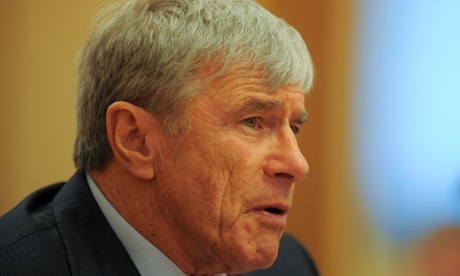
The Seven West Media chairman outed himself as the barrier to reform before Corbett made his remarks.
Asked about the progress of reforms, Stokes said: “I don’t think there’s anything to discuss. I’m sure that [the government will] canvass everyone’s opinions on a range of issues and at a time when we can decide the broad range of issues. I’ll be very excited about reform. Just not bits and pieces.’’
The bulk of the reform package – the abolition of the “reach” rule and the amendment of the “two out of three” ownership rule – are both now opposed by Stokes alone.
Drop by drop
A few snide remarks at Sunday’s Coalition launch for the Victorian election. The state’s biggest-selling newspaper, the Herald Sun, has been campaigning for the government for months, publishing the dorkiest pictures of Labor’s leader, Daniel Andrews, it can find.
The paper’s reward is routine “drops” of government initiatives, including the centrepiece of its formal launch on Sunday – a $3.9bn public transport splurge.
Labor says it won’t play the “drop” game during the campaign. We’ll see.
Keeping up with history
A leading media academic, Professor Bridget Griffen-Foley, has spent several years working on the definitive history of the Australian media, from the first Aboriginal newspaper in 1836 to the restructure of Fairfax Media in 2012 which saw 1,900 jobs lost.
A Companion to the Australian Media was an unwieldy task even without the media landscape transforming as the book was being written.
But the pace of change has been so rapid that entries were being updated even as the book was going to press.
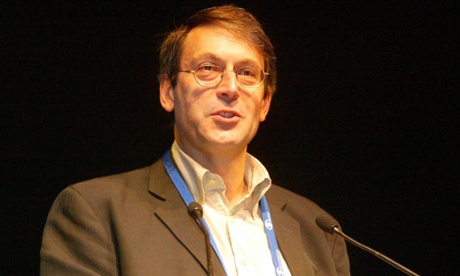
Griffen-Foley, the author of a recently republished biography of Sir Frank Packer, commissioned 300 media players and commentators to research and write hundreds of entries for the book, from biographical ones to those relating to the press, radio, television, advertising, public relations and new media.
Contributors include the Australian’s veteran media commentator Mark Day and Private Media’s publisher, Eric Beecher. The thick volume with 500 articles is available from Australian Scholarly Publishing.
• Guardian Australia will publish its media diary, The Weekly Beast, every Monday