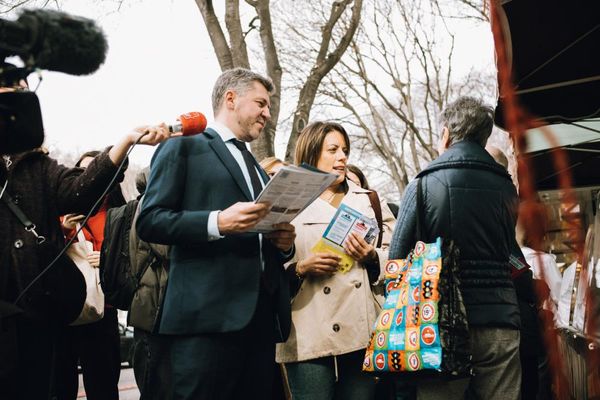
A Channel Nine report about religion in schools which claimed instructors were using “hidden codes” to convert children to Christianity breached the accuracy provision of the TV code of practice, broadcasting authorities say. The report on A Current Affair last year said that a “fanatical religious group” called Access Ministries was using “dirty tactics” and “cult-like behaviour” to try to convert children in the classroom. One of the so-called secret codes was a puzzle which when completed by the kids said “Jesus is alive! He can be our friend today!”
But the Australian Communications and Media Authority found that it was inaccurate to say that Access Ministries misled parents as to the nature of the religious instruction it provides because they were contracted by the Victorian education department to do just that. Acma said viewers were told that Access Ministries “was converting children and misleading parents as to the nature of its instruction in a particular religion, including instruction in how to live and behave according to the tenets of the particular faith”.
“In fact, instruction in religious beliefs was what Access Ministries was both entitled and expected to do within the Victorian education system,” the report says. The most damaging line in the report came when Acma said A Current Affair presented “a range of material that encourages the viewer to infer the opposite of what is the case on a key factual matter, while avoiding any pointer that might suggest a different view is possible”.

Julia Baird reveals terror of being diagnosed with rare cancer
The ABC host Julia Baird stunned us all with a piece in the New York Times last week about her diagnosis with cancer. The co-host of ABC TV’s The Drum had quietly taken leave from her job when she discovered tumours in her abdomen. In Was it cancer? Getting the diagnosis, Baird revealed she had been diagnosed with a rare form of cancer and undergone surgery but was recovering well. Despite intense media interest after the publication, Baird has refused all media requests, preferring to let the her words speak for themselves.
At the weekend she made her first public appearance since the NYT piece as a panellist at the Festival of Dangerous Ideas at the Opera House. Sources told Weekly Beast festival organisers and friends were dismayed when a reporter and a photographer from the Australian showed up unannounced in the green room at the Opera House in an attempt to interview Baird about her cancer diagnosis. The request was declined.
The Australian turns on the praise for Foxtel’s offering
The media industry is still trying to work out whether a piece in the Australian’s media section was an ad for Foxtel or a news story about the competitive streaming video on demand market in which Foxtel now has to compete with US service Netflix as well as local rivals Stan (Nine/Fairfax) and Presto (Seven/Foxtel).
Foxtel is half-owned by Rupert Murdoch’s News Corp, and the Australian has never been afraid to give the pay TV operator a leg-up or to diss its rivals with lines such as: “Netflix’s library of movies and TV shows is vastly inferior.” “New customers are tuning into Foxtel’s channels like never before, driven by television advertisements promoting no lock-in contracts, no set-up costs, the iQ video recording device and 45 channels all for a monthly payment of $25,” the Australian’s reporter Darren Davidson wrote. All the piece needed was a phone number at the bottom and it would have been complete. Media and marketing website Mumbrella has revealed that Foxtel’s numbers were not as impressive as the company would have us believe as they had been inflated by the inclusion of Presto – which it half owns – in its subscriber numbers.
Not half
The newly released Australian Sports Commission’s Level Playing Field report found just 25% of journalists reporting on sport are female and that women feature in just 7% of sports programming in Australia, down from 11% a decade ago. While coverage of male sport made up 81% of television sports news, women’s sport made up just 8.7%. Next Wednesday Women in Media has convened a panel of top female sports journalists who will reveal all about working inside the male-dominated arena of sports reporting. The lineup features the Grandstand legend Debbie Spillane and the Four Corners reporter Caro Meldrum Hanna from the ABC, Nicole Jeffery from News Corp, Jessica Yates from Fox Sports and Yvonne Sampson from Nine.

ABC and BBC divide on language barrier
The British government, and much of the UK media including the BBC, have chosen to use the word “migrant” rather than “refugee” to describe the people arriving recently on Europe’s shores who are fleeing war or persecution. Al-Jazeera does not agree and “will instead, where appropriate, say refugee”. The BBC explained its choice of “migrant” here. But in Australia, the ABC has rejected the term “migrant” because it has has different associations for Australian audiences. The ABC’s editorial policy adviser, Mark Maley, says the preferred term is generally “asylum seeker’”, arguing it is non-pejorative and it encompasses both genuine refugees and migrants seeking refuge. “Distinguishing between ‘migrants’ and ‘refugees’ is often impossible and they are not mutually exclusive,” Maley says in an advisory note to journalists.
The keeper of the Guardian’s style guide, David Marsh, agrees that the term migrant is pejorative and wrote recently that it was often better just to call them people. “The language we hear in what passes for a national conversation on migration has become as debased as most of the arguments, until the very word ‘migrants’ is toxic, used to frighten us by conjuring up images of a “swarm” (as David Cameron put it) massing at our borders, threatening our way of life,” he wrote. The terms refugees, displaced people and asylum seekers, “all of which have clear definitions, are more useful and accurate terms than a catch-all label like ‘migrants’, and we should use them wherever possible”.
Story-telling
The ABC’s managing director, Mark Scott, has been chosen to give the inaugural Brian Johns lecture at Macquarie University on 15 September, on “The future of the Australian story”. Johns was a predecessor of Scott’s at the ABC who led the organisation between 1996 and 2000. The annual lecture has been established by the Centre for Media History at the university and the Copyright Agency to honour Johns, who was also the CEO of SBS in the late 1980s.

In demand
At least two Australian media outlets are chasing a TV interview with Mark Hanna, the former head of security for Rebekah Brooks who said on Friday that he would blow the whistle on Rupert Murdoch’s UK newspapers. Hanna uploaded a video to YouTube the day after it was confirmed Brooks had been rehired as chief executive of News UK. Hanna, who was acquitted last year of plotting to pervert the course of justice, claims he was “extremely close” and trusted by executives at News International and he wants to show how “underhanded” they have been. Hanna’s accusations have been rejected out of hand by News UK. A spokesman said the YouTube video was an attempt to force the company into offering an “unreasonable financial settlement” to Hanna, who has taken it to an employment tribunal.