Welcome back to another edition of My Take 5. This week we are covering the expanding scope of the US-Iran war before Trump’s sudden halt to the strikes, again; Ukraine’s targeting of Russian e-commerce company Wildberries and why this matters; Kazakh President Tokayev’s plain-speak to Putin; migrant rush at Spanish exclaves of Ceuta and Melilla; and Taiwan’s development of a hypersonic cruise missile. So, let’s get to it.
Get breaking news anytime, anywhere. Download the TOI app now!
Saudi joins US in strikes:
Tit-for-tat strikes between US and Iran took place this week as mediators like Pakistan scrambled to bring the warring sides back to the negotiating table. But what is of particular concern in the latest round is the seeming expansion of the conflict. This was exemplified by the joint Saudi-US strikes on Iran-backed militias in Iraq this week. The target of those strikes was Iraq’s paramilitary Popular Mobilisation Front, which is dominated by Iran-aligned Shia militias. The group said that at least 20 of its members had been killed in the strikes. True, there have been reports that Saudi Arabia and UAE have been quietly carrying out strikes against Iran during the course of the war as Iran’s IRGC has targeted these countries in retaliation for Washington’s military action against Tehran. But this is the first time that the Saudis have openly collaborated with the Americans in striking Iranians assets in a third country like Iraq.
Similarly, reports are coming in of drone strikes at Egypt's Mediterranean port of Damietta, which sparked fires on two natural gas carrying vessels. The needle of suspicion for the attack is pointing towards the Iran-backed Houthis, who have previously targeted shipping in the nearby Red Sea. Plus, in this round, Iran has increasingly targeted US military assets in Jordan.
Taken together, there appears to be a clear geographic expansion in the scope of this war in the latest hostilities. But again, the fundamental question is how long can Iran and US keep this up. There is a clear limit for both countries in terms of their weapons stockpiles. Iran certainly is in no position to replenish its missile stockpile in the middle of this war – US has also gone after its military industrial production base. But US too is running low on platforms such as Patriot and THAAD interceptors, and Tomahawk missiles. Therefore, both sides will hit a limit at some point. But when that is, is difficult to tell at the moment.
Update: At the time of filing,Trump just announced– not for the first time – that he was calling off a major strike on Iran to allow negotiations with Tehran to resume. This, he said, was done after allies such as Saudi Arabia, UAE and Qatar urged de-escalation. There is no telling at the moment whether the negotiations will indeed resume. Although it’s the logical thing to do. But both US and Iran want to emerge as victors. Hence, reconciling their positions will be difficult. A pattern of start-stop war is becoming normalised.
Ukraine hits Wildberries:
Russia’s war against Ukraine continues unabated, with Moscow stepping up large-scale attacks over the past week on Ukrainian cities, including Kyiv. On July 30, Russian strikes focused on Kyiv and Lviv that killed nine people. Then again on August 1, Russian missile strikes hit Kyiv, leading to another nine deaths and significant damage to civilian infrastructure, including residential buildings, warehouses, and even the Lithuanian embassy in the Ukrainian capital.
The thing to note about these attacks is that Russia’s mass missile strikes now are increasingly composed of ballistic missiles. Which means that Russia is exploiting Ukraine’s serious dearth of ballistic missile interceptors at the moment. President Zelenskyy has been repeatedly pointing this out in his meetings with foreign leaders. The US Patriot air defence system is the only platform that Ukraine has that can counter Russian ballistic missiles. However, an acute shortage of Patriot inceptors, not just in Ukraine but worldwide, thanks in part to the US war against Iran, has left Ukraine unprotected.
Further, analysis of Russian ballistic debris shows that many of these Russian missiles are freshly made and just one or two months old. That means Russia is not stocking up on these missiles and is using them to exploit Ukraine’s defensive gaps. Perhaps Russia is calculating that Ukraine will receive fresh batches of Patriot interceptors later in the year, in time for winter. This would make it difficult for Russia to weaponise the winter against Ukraine like it did last winter. So, Moscow is using this moment to strike Ukraine as hard as it can.
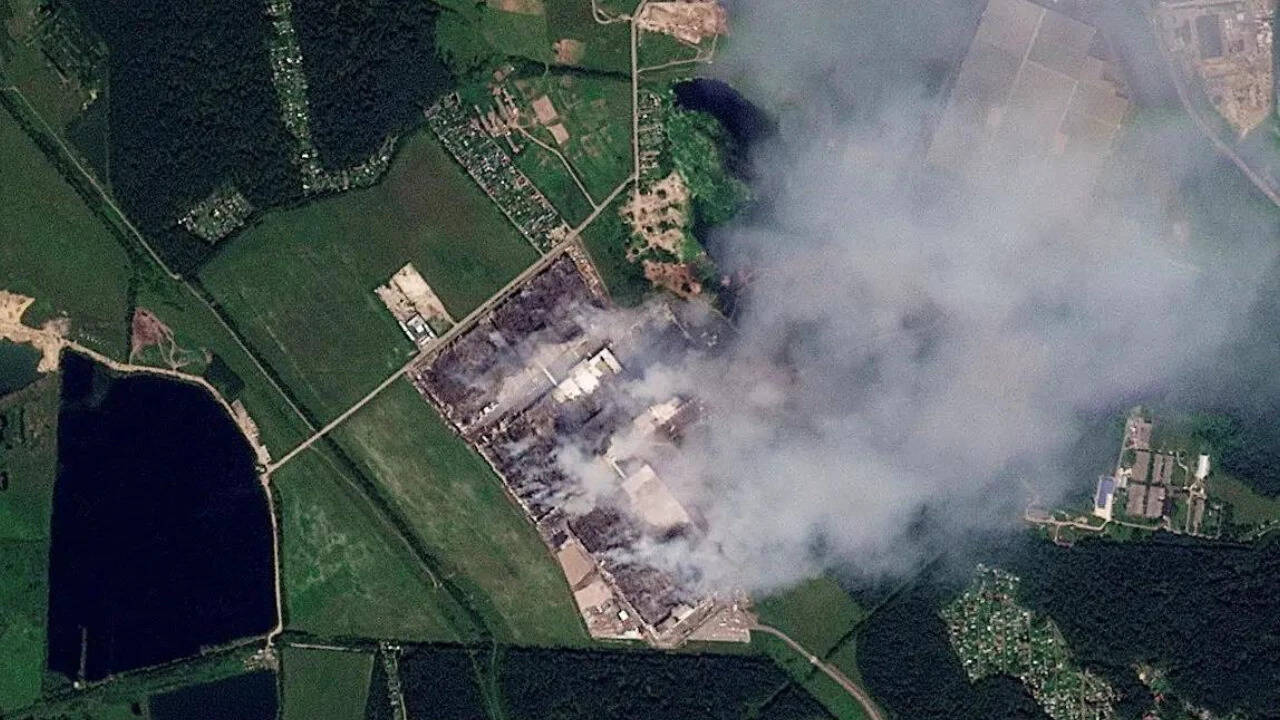
But Ukraine too is stepping up its strikes on Russian military and logistics infrastructure. In addition to Russian oil refineries and Russia’s shadow fleet transporting sanctioned Russian energy, Ukraine has been targeting warehouses belonging to Russia’s largest e-commerce company Wildberries. Called the Amazon of Russia, Wildberries stores and sells everything, including military equipment and dual-use parts. In fact, there have been reports that Russian soldiers fighting in Ukraine have been ordering equipment like body armour and drone parts through Wildberries. This makes the company complicit in sustaining Russia’s war machinery against Ukraine.
Ukraine destroyed another Wildberries logistics complex in Vladimir.
For a month, Ukraine has been methodically destroying Wildberries logistics hubs in russia, each containing $1-1.5 billion in inventory.
To make matters worse, after the first strikes on Elektrostal,… pic.twitter.com/JJoja68422
— Roman Sheremeta 🇺🇸🇺🇦 (@rshereme) August 3, 2026
Wildberries and its founder are already under international sanctions. The company is also the largest taxpayer in Russia. Therefore, Ukrainian strikes against Wildberries serve a dual purpose – degrade Russia’s war logistics, and disrupt supply chains that make Russians feel the war.
Kazakhstan’s Tokayev tells Putin to freeze the war:
In aninteresting development, Kazakh President Tokayev told Putin face-to-face that it was time to freeze Russia’s war against Ukraine and return to negotiations, specifically the Istanbul 2.0 format. Tokayev further stated that Kazakhstan respected the Ukrainian people and their language and culture, and that it wasn’t very clear to many people, including Kazakhs, why this war was taking place.
Of course, Tokayev's words had little impact on Putin, and the Kremlin later rejected the idea of freezing the war. This is hardly surprising. After all, Ukraine has been proposing for quite some time now that Russia freeze this war along the current frontline, implement a total ceasefire, engage in an all-for-all exchange of PoWs, and start peace negotiations. But Russia has flatly rejected this. In fact, it hasn’t even been willing to implement a ceasefire for any significant length of time.
Nonetheless, Tokayev telling Putin to stop the war is significant. Kazakhstan is one of Russia’s closest allies. And if Astana is bewildered by Russian actions, it pretty much shows that few believe in Russia’s logic for continuing this war.
Migrant rush at Spanish exclaves:
The past week saw a sudden massive rush of irregular migrants entering the Spanish exclaves of Ceuta and Melilla, located within the territory of Morocco in North Africa. In fact, Ceuta and Melilla are EU’s only land borders with continental Africa. As per bilateral agreements and official arrangements, Morocco cooperates with Spain to control and restrict irregular migration to the exclaves. However, in the latest rush, almost 40,000 irregular migrants made their way to Ceuta and another 1,135 to Melilla. Additionally, 67 people died attempting the crossing, mostly by sea.
It’s noteworthy that with the cooperation of Morocco almost all irregular migrants who entered Ceuta and Melilla have been returned by Spanish authorities. But the incident did not prevent European politicians with right-wing, anti-immigration leanings from politicising the issue. Italy suspended its border-free Schengen arrangement with Spain and France strengthened its own border checks with its southern neighbour. Plus, 22 EU members have issued a joint letter calling for coordinated action to strengthen EU’s external borders. Needless to say, this is reactionary. If at all there is a pertinent question to ask here it is this: Why in the 21st century does Spain still retain two exclaves in Morocco, with no land connections to the Spanish mainland, when these pieces of territory should be rightfully returned to Rabat?
It’s funny that Ceuta and Melilla, products of past European colonial imperialism, can get European right-wingers so worked up. If you don’t want such periodic irregular migrant surges, just give up these exclaves.
Taiwan beefs up missile strength:
Taiwan has completed the design of a hypersonic cruise missile that could go into production as early as next year. Christened Ching Tien, the missile is speculated to be able to reach velocities of three to five times the speed of sound and possess a range of 1,250km. If the missile goes into mass production as planned, it would significantly boost Taiwan’s deterrence capabilities vis-à-vis China.
A hypersonic cruise missile of this range could theoretically target Beijing and Wuhan. And this would give pause to the Chinese PLA in its war plans against Taiwan. With China constantly intimidating Taiwan and regularly conducting threatening military drills around the island nation, it certainly makes sense for Taiwan to boost its defensive and deterrence capabilities before it is too late. Russia’s war of aggression against Ukraine stands as a lesson for Taiwan. It must not delay strengthening its military capabilities.
Stay updated with the latest news on Times of India. Get all the trending City News, India News, Business News, and Sports News. For Entertainment News, TV News, and Lifestyle Tips, visit Etimes.