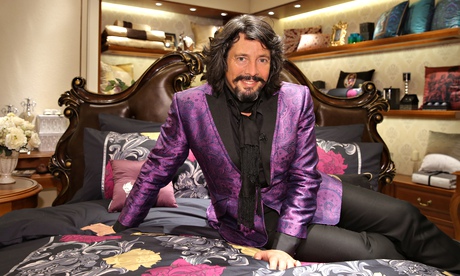
Laurence Llewelyn-Bowen: Cracking China (BBC2) | iPlayer
The Outcast (BBC1) | iPlayer
Dispatches: Escape from Isis (C4) | All 4
Dragons’ Den (BBC2) | iPlayer
It is hard, unless you have a keen ambition to play no further role within British society, not to become exercised about the BBC at the moment. There exists so much to be proud of, so much shared beauty, cruelty, history, laughter, heartache, music; so much of our reaching out to the world encompassed in these past urgent 95 years: and yet, as its crises loom, the corporation still careens like a headless dodo with a firecracker up its jacksie, as much use as a Greek cashpoint.
An example. On one big summer-hopeful Friday night (12 June), on its main channel – from 8.30pm to 10pm – it offered insulting rot. Staff number more than 20,000. One might have thought a scheduler could have been press-ganged into work. Instead we got The Vicar of Dibley and New Tricks, both lazy soft-shoe shuffles, one execrable, and both repeats – and then, love him though I do, Graham Norton until 11.20pm with two rehashed guests doing the same shtick.
Rumbling along all that time was an incomprehensibly huge PR row over Mr Clarkson, who is after all just a splenetic asshat. Then there was Wimbledon 2Day, about which the more said the more filthily justified. Then just last week, Nicholas Witchell “interviewing”, interminably, a man about his wife having had a baby. I needed a fast shower to escape from catching Stupid. The BBC, I have sometimes thought, should be Mozart nudging elbows and spilling gin in a broken 1920s Parisian bar with Homer Simpson. Instead it can lurch with increasingly shocking dysfunctionality into Alan Yentob nursing a spritzer in a Swansea Premier Inn with a reluctant Keith Lemon.
And here, now, they give us something about Laurence Llewelyn-Bowen, about whom much the most fascinating fact is that he hasn’t yet been slugged to death with tarred rope.
Larry went to China, and was stupefyingly rude to everyone. He handed out photos. Of himself. Having apparently taken a Polyjuice Potion to morph into a version of our own Jay Rayner, with revoltingly less charisma, he insulted his translator, his PR, his hosts. Larry’s fabrics are good, well-designed, tasteful, wonder who did them. Larry’s own creation – ugly sculpted dogs – would shame Poundstore. He tried to sell “style” to the Chinese on the borrowed backs of Kate Middleton and Victoria Beckham.
To be fair, on another channel, Richard Branson popped up to lend whatever is the opposite of gravitas to Up in the Air, another puff piece of such unashamed chivalry I was tempted to swoon. But why these people? Why might I care a fig for Laurence Llewelyn-Bowen (allegedly stylish) or a faggot for Richard Branson (allegedly normal)? I would rather, in terms of intriguing conversation, have a chat with the piece of lint I pulled from my navel on my ninth birthday.
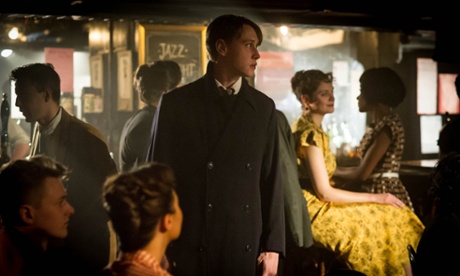
And then the BBC gets me in the guts. The Outcast was as good as a Sunday evening gets. Mesmerisingly misted, set in the decade before I existed (is there ever any more fascinating decade?), and an utter treat, it retold Sadie Jones’s fine tale of a mother, an impossibly sweet boy, an impervious father back from the war, a gin-and-teacups drowning. And showed how an idyllic riverside Wonderland, through a small boy’s eyes, can suddenly become the darkest thorned slime of dreams.
Greg Wise, the father, played it as straight and terrifying as his moustache, and I don’t know why he now doesn’t get more major roles, having sprinted in 15 short years from toy boy to grand gent. Hattie Morahan was too briefly wonderful, the kind of jolie-laide free spirit that every man falls for and every son adores. Finn Elliot, the kid, was bee-sweet. But all the hard acting was left to George MacKay – I’ve seen Sunshine on Leith nine times now! – as the grown kid, Lewis, who had to make sense of a) adolescence, b) bullying and c) the drowning of his mother, and to do it all without the myriad benefits of being aged nine. Young Lewis’s face (Finn) simply beseeched trust. Older Lewis’s face (George) is a face that fears its future. So he goes to whores, and burns down a church. This is beautiful, and it is damned, and I’m itching for episode two tonight.
Perhaps the finest Dispatches this year told us things about Isis – actually I’ll call it Daesh from now on, as that hints in Arabic at sublimely deserved mockery – which would normally make a scorpion roll over and laugh like Falstaff, were it not for the unbelievable truths. Four million women now living under Daesh rule, most trying to escape through one desperate means or another. “We were coming up with ways to kill ourselves,” said one escapee, relatively brightly. “Electrocution? Knives?” Three of her friends succeeded in this way. Everyone speaks of… “black. Just… darkness in Raqqa.” In Raqqa, once a functioning home to humanity, the “police” have now begun insisting on the complete veiling of women. I mean complete. Even the eyes have to be double-veiled. They are literally blinded (Daesh would prefer this to be the future. Half the population on Earth unable to see). But all the better to blind them to men’s sexual charms, and, you would think, to distract men from theirs, but, surprise, no. “He dipped his toe in honey and forced it into my mouth,” said a teenage rape victim.
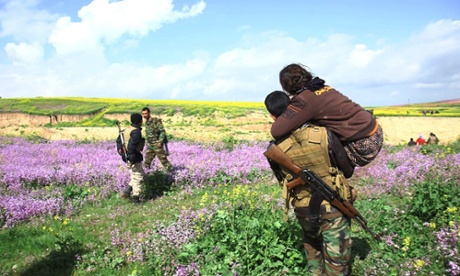
One Khaleel al-Dhiki, possibly the bravest man I’ve seen in documentaries this century, rescued Yakudi women with little more than a small yellow mobile, and a pair of cojones that should eventually be set on Trafalgar Square’s fourth plinth.
Touker Suleyman is a bit of a winner, but in general the new beasts in Dragons’ Den make Peter Jones look the most charismatic. One relatively charmless greed-contestant fronted up Sarah Willingham, to be met with: “This is the most disrespectful pitch. I never expected to sit here and be offended in this way.” His reply: “I’m sorry, I didn’t realise I was talking to God.” Sadly, he didn’t say that. He skulked off. This show has had its day. The BBC hasn’t.