Game of Thrones (Sky Atlantic)
Orange Is the New Black (Netflix)
Jordskott (ITV Encore)
The Saboteurs (More 4) | 4oD
Humans (Channel 4) | 4oD
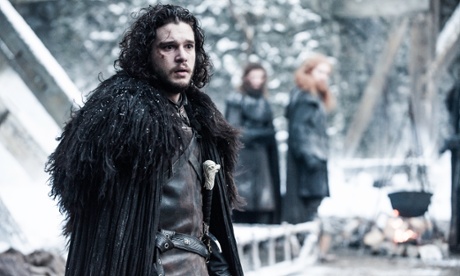
The last episode in this series of Game of Thrones was the most Shakespearean yet, which is saying a lot, and all of it good. I’ll apologise in advance to all those of you who, when encountering others whanging on about this clever grownup fantasy, grow pencil-in-the-eye bored to a degree normally encountered when someone insists on telling you too much about their dreams, and those dreams feature either pre-stressed concrete or the best B-roads by which to avoid Winchester in the third week of August. But, as you’re demographically likely to be a little older, though far from starting to wonder where the laces go in your slippers, perhaps there’s intellectual succour to be had in the knowledge that some young things are larnin’.
What they larnt last week, if they’ve any brains at all, would have been to go back to some pieces of source material, ancient and modern. The black-betrayed death of Jon Snow echoed of course the more… killy… bits of Julius Caesar (Act 3, Scene 1, if you must). One felt every single frozen dirk’s gut-punch, and Kit Harington was reduced to having to act with only his eyes, which he did achieve with a singular bravado, and those eyes would still be enough for most women.
Cersei Lannister’s Long Walk of Atonement had wholly different new resonances – I thought instantly of those misbegotten, shaven-headed French “collaborators” documented postwar by, among others, Lee Miller, with all the implied criticism of “the mob” – and, despite the bloodied shambles of her feet, and the slugs and faeces thrown, Lena Headey’s glister would still be enough for most men. And then there was Stannis, overcome by a pincer movement which outpunched every CGI-d battle scene in The Lord of the Rings, and then slain in the woods (“Go on, do your duty,” he muttered, as bored as if confronted only by roadworks outside Winchester) by Brienne of Tarth, a gentlelady you wouldn’t want to encounter at the wrong end of a filthy wet wood, least of all nursing a grievance and a broadsword.
Or was he? Is Stannis actually dead? Actually, is Snow? We saw a sword swing down… we saw blood trickle on ice… many philosophical and existential questions must follow. Good luck, kids, but I bet the answer is cleverer than my generation’s tawdry solution to the Dallas dilemma of resurrecting cast.
What is cruelly clear is that the makers of GoT have a vicious task ahead – as George RR Martin sweats to finish his latest – in remaining true to the spirit of the books, keeping hold of cast members as they get exponentially more famous, and continuing to make the most thunderously visceral global TV phenomenon yet encountered. I suspect a stunningly elegant fist will be made of whatever develops. But after such successes from Tolkien, and Martin, might I just suggest someone read Stephen R Donaldson?
After such bloodletting, it was almost a relief to get back to wallow with the all-too-human dementors of Orange Is the New Black, suddenly back for a whole new season on Netflix, and the simple joys of crackheads, wookies, meth-heads, Wiccans, stand-in mamas, cross-gender papas, snatch-smuggling, and, in fact, the multifarious delights of an ill-run Stateside women’s prison, run with the throaty aerofuel of lovely barbed gags and several pit-stops for raucous lesbianism. The writing credits do not include Mrs Gaskell or Sandra Dee.

It is not only terrific fun but terrific truth, and I can say that as a straight white man living nicely apparently a billion miles away.
The opener, featuring a Mother’s Day at the jail, had everything you could possibly want from sharp American television: the reunions gone wrong; the poor mad black kite-woman untrusted around children; the dry coming from the barren, as in: “I hate kids. They don’t drink… they haven’t travelled.”
In fact, the jail this season is suffering a surfeit of pleasantry, inasmuch as that can impinge on a battery of unhappy, mixed-race women denuded of free life, making a terrific best of that life but often getting it wrong. The pleasantry can’t last – as someone says: “Nice is for cowards and Democrats” – but the male warder, Pornstache, has finally been jailed, if unhappily not knifed; the “coke kitties” are being let out, there’s an easier breeze to things. There are quotes from the sainted Calvin and Hobbes, and the lovely loathsome Big Boo has a great cameo in which he/she quotes Freakonomics to allow the ofie trash Doggett (Taryn Manning, my and perhaps everyone’s secret favourite) to forgive herself for her five abortions, here marked with crooked crosses in the shape of lollipop sticks.
This series is able to say more about humanity, race, femininity, bullying, poverty and rare grace than a glitteratum of pricey thinktanks.
Other episodes feature bedbugs and concordant race hate/hygiene habit truths, the conventions of womanhood, abuse of the kosher meal programme or Pennsatucky’s heartbreaking backstory, all adding up to so much more than the sum of its parts. Oh, it’s good.
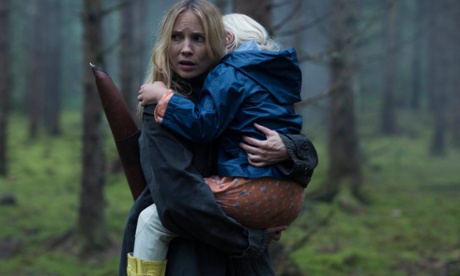
Two Scandis have erupted of late: one terrific, the other so far struggling. Jordskott has everything one’s come to expect from Scandi noir – Sweden’s long, slow pine forests, sludgy with mist or numinous and be-rivered; a troubled detective gone back to a funeral; a missing child. What elevates this is partly Moa Gammel, perhaps the most beautiful of all Scando-heroines in recent years, and a wise script which makes great nods to the folktales of forest history. There are runes, but not too many: a child grows roots, from her fingers, but not too many; sinkholes around the town of Silverhöjd, and here there are many. It is hugely subtle, captivating, addictive.
On the other hand, the Norwegian-born The Saboteurs lost me very early on, when a bunch of Norge commandos were being trained in Scotland early in WWII to attack their Norsk hydro plant, which produced heavy water, vital to the Germans for their… have I to spell it out? “What’s so important with this water?” asks one. Haven’t you seen The Heroes of Telemark, yøu dølt? Døh.
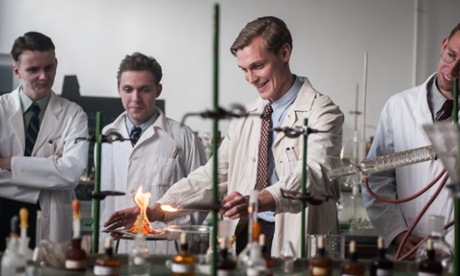
Anyway, cue a decent enough reconstruction of the Nazi bomb plan, and Anna Friel, the only human deemed suitable to ever portray a clever posh female spy apart from Rachel Weisz, and some middling acting but… why? We know how it ended! We don’t know with Jordskott…
Humans was a lovable piece of Sunday-night dross. The robots were trying to a) rebel, and b) at the same time, find a soul. Any comparisons with the Labour party will be referred upwards.