While Greek drama is being staged with urgent modern meanings, an elderly Shakespeare production is being only gently stirred. In 1963 Peter Hall, then running the Royal Shakespeare Company, and John Barton created The Wars of the Roses trilogy: Henry VI, Edward IV and Richard III. It was a theatrical revolution. They mixed together Shakespeare’s three Henry VI plays and Richard III, amalgamating characters, severely cutting lines and adding pastiche passages by Barton. Hall has said he wanted to make plain the chain of retribution that is the spine of the plays, linking them, and “the corrupting seductions experienced by anybody who wields power”. He did.
Trevor Nunn, later himself to run the RSC, but then setting out as a young director at Coventry, hitchhiked to Stratford again and again to see the cycle of plays. Now he has revived it.
The clarity and vigour are still apparent. Hall and Barton’s version cleared away the baffling recitations that were parodied (“Get thee to Gloucester, Essex. To Wessex, Exeter”) in Beyond the Fringe. They laid bare the dynamics of power and intrigue.
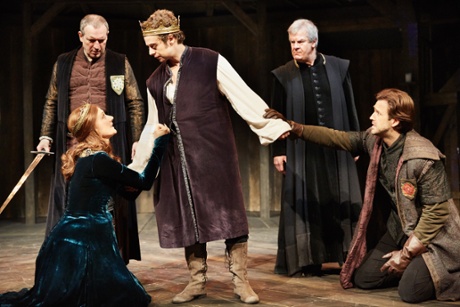
At a cost. Nunn’s production, rightly criticised for its all-whiteness, presents a group of pop-up greats, gilded figures, some dashingly performed, who wrangle with each other in a vacuum. The scenes with “the poor” are terrible. Dun-coloured peasants, drooping under those depressing hats with dangly bits at the sides, slump at the same time, roar in the same way and make identical gestures. Shakespeare certainly did not write the rebel Jack Cade as a hero; an interesting programme note by Richard Wilson explains that he may have been digging at Christopher Marlowe in his depiction of the rabblerouser. Still, Rufus Hound has it in him to make more of Cade than the booming blockhead he becomes in his rushed scenes.
There is diffuse excitement but little inflection. There are bear hugs, breastplates, trumpets. Much running across the stage roaring, often in clouds of smoke. Deathbed scenes in which characters deliver a speech and then flop backwards. Severed heads like Christmas puds.
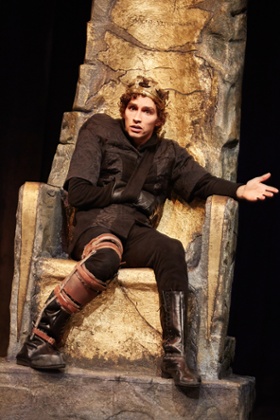
Joely Richardson, got up like Snow White’s stepmother in a smirk and a velvet kirtle, makes a sharp-edged Queen Margaret, beginning as a wheedling seductress, ending as a she-wolf. She has some of the best curses in Shakespeare. When will a director weave together the words of Shakespeare’s female seers and sorrowers? Robert Sheehan is a startlingly glamorous Richard III, who uses his disabilities to win power. His mouth slips over his face like a lizard. He springs on his twisted leg, as if it were a prosthesis that is helping to bounce him towards the crown. He sidles his jaw towards a victim’s shoulder, as if he is not bullying but seeking support.
Yet the stand-out performance is a surprise: when was Henry VI so interesting? Alex Waldmann makes him fresh, strange and convincing. He begins as an ingenious comic turn, a child at sea among the powerful. On his ascent to the throne, he gleefully, lightly claps his hands. He wanders off and forgets to take his sceptre with him: it might as well be a rattle. He is a morsel for the predators around him. Yet as he ages, the innocence that makes him a hopeless ruler becomes a human strength.
Nine hours is a long time for a tribute pageant. Surely the best way of honouring a theatrical revolution is a new revolt.
• At the Rose, Kingston upon Thames until 31 October. Box office: 020-8174 0090