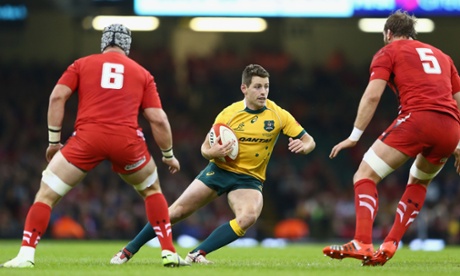
Two wins, and three Tests against France, Ireland and England to go for the Wallabies European tour – an expedition some believed doomed to fail given the team’s recent off-field troubles. In fact, such is the cautious level of expectation from Australian rugby supporters, the feeling was one of immense relief when the Wallabies survived a cliff-hanger against Wales last week.
That sense of relief doesn’t do Wales justice though; they are a markedly better team than their world ranking of seven suggests. The Wales of last week certainly looked far more threatening than the 2011 World Cup outfit, who might have played in the final but for a controversial red card in the semi-final against France. For Australia to knock off Wales in Cardiff in this purple form took some doing.
Wallabies fans should have gone on an epic bender. Instead, they just said phew. Welsh supporters might disagree, perhaps saying the Wallabies ought to be mightily relieved given the home team’s complete domination in the scrums and Israel Folau’s gift-wrapped intercept try, a 14-point turnaround no less with Wales certain to score had the errant pass found its intended target. However, the counter-argument is the game was there for either team to win in the final minutes, and the Wallabies proved their mettle to close it out. Indeed, in only his second game in charge, new coach Michael Cheika has delivered an important psychological turning point for a team prone to throw away Test matches in the last 10 minutes, as was the case earlier in the season against the All Blacks (twice, in Sydney and Brisbane), and the Springboks in Newlands. To finally close out a win is a significant milestone in the team’s development.
But here is what we learned so far:
Foley is the World Cup No 10
The Wallabies fly-half selection is settled: Bernard Foley. The NSW Waratah pivot’s Test career has come along in leaps and bounds. In a well-deserved man of the match performance against Wales, he unequivocally proved he has the temperament for high-stakes Test rugby, whereas his main rival at 10, Quade Cooper, has been found wanting previously. Cooper will no doubt play a valuable second-string role for the Wallabies but it’s hard to see him displacing Foley.
Wallabies backline could be one of the best
Now the issue of a goal-kicking five-eighth has been settled, the Wallabies backline has the making of something truly special: Nick Phipps/Will Genia at 9,Foley at 10, Kurtley Beale (when he returns) at 12, Tevita Kuridrani at 13, Folau at 15, and Henry Speight, Adam Ashley-Cooper and Rob Horne as wing selections. That’s a backline to be feared. Alas, it needs a forward pack to match.
Scrum has to be sorted out before World Cup
The scrum is the obvious sore point. It’s often said rugby union scrummaging is a science, but surely it’s not of the unfathomable rocket variety. The Wallabies must fix their wobbly and inconsistent scrum if they are to have any chance in next year’s World Cup. Cheika has only been in charge for two matches and the scrum woes have been evident for years. But it is now his problem to fix. The return of skipper Stephen Moore from injury can’t come soon enough.
Hooper has to do more work on the deck
Stand-in captain Michael Hooper needs to do more off the deck at the breakdown. Hooper has been excellent with his ball carries but now that the hugely underrated Scott Fardy is injured, more pay is needed from a spoiler/fetcher at the breakdown. Hooper is potentially leaving himself exposed to losing his World Cup starting spot to David Pocock unless he gets over the ball more. Cheika will have an interesting selection call to make in terms of getting the backrow balance right once Fardy and Pocock are fit to resume. Now is certainly not the time for Hooper to become complacent.
The issue of getting more line-bending runs from the locks and no 8 are also issues. Will Skelton still looks a year or two shy of having Test rugby stamina for repeat efforts over 60-70 minutes. However, Cheika may have no choice but to go with him now unless he gets more out of James Horwill, Sam Carter and Rob Simmons. Luke Jones could be a solution if given time enough playing time before the World Cup.
North/South gap has closed
It will be interesting to see how the Wallabies fare against France this weekend. This columnist has long given up trying to gauge the form of French Test sides. Only the French could lose to Tonga in a World Cup pool match, make the final and then go within a whisker of beating the All Blacks in an Eden Park final. They are utterly unpredictable. And only the French could invent the phrase “triple revenge” as their motivating cue this weekend, a reference to their three-Test series whitewash against the Wallabies in June. What is evident from last weekend, however, is that the All Blacks, Wallabies and Springboks would have reassessed the scale of difficulty in winning next year’s World Cup. The gap between the hemispheres has never been closer. Ireland proved that last week by beating the Boks. England, whose player depth is frightening, had the All Blacks under the cosh for long periods and bombed a couple of tries. And, as already mentioned, the Wallabies win against Wales was no mean feat.