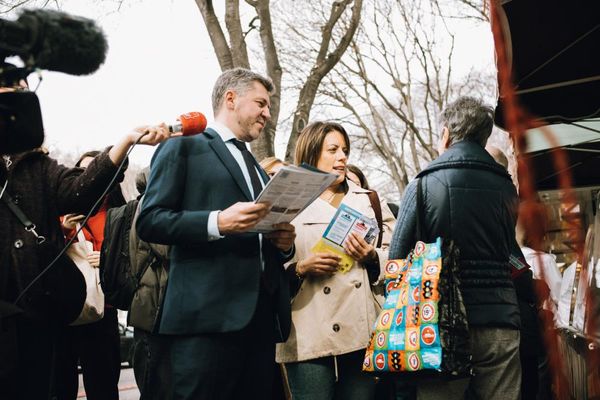
DES MOINES, Iowa _ Iowa Democrats streamed Monday night to more than 1,650 community meetings _ or caucuses _ in church basements, senior centers, high school gymnasiums and other warm places, beginning the monthslong national process of choosing a nominee to face President Donald Trump in November.
With polls showing several tightly bunched candidates, the race looked to be a four-way competition among former Vice President Joe Biden, former South Bend, Ind., Mayor Pete Buttigieg, Massachusetts Sen. Elizabeth Warren and the perceived front-runner, Vermont Sen. Bernie Sanders, who barely lost in Iowa in 2016.
Counting on the state's penchant for political surprises, others in the field _ Minnesota Sen. Amy Klobuchar, New York businessman Andrew Yang and billionaire political activist Tom Steyer _ were hoping for a better-than-expected showing to stand out even if they failed to finish atop the crowded field.
A weekend of sunshine and unseasonably warm weather yielded to a cold and blustery day, with temperatures hovering near or below freezing by the time it grew dark. Still, there appeared a good chance turnout would set a record, topping the nearly 240,000 who voted in 2008, reflecting the closely fought nature of the race and the fervor among Democrats eager to defeat Trump.
Candidates continued stumping up to the last possible moment.
Senators tied down in Washington by the impeachment trial of Trump called into radio programs and appeared on TV via satellite before jumping on chartered flights to hurry back to Iowa. An hour before the caucuses began, Buttigieg emailed a fundraising plea.
"If you know anybody in Iowa, now is the time to call them," he wrote, "and make sure they're caucusing tonight to help turn the page to what must come next."
Sanders decisively won the first precinct-level caucus, a daytime gathering that drew food-processing workers scheduled for evening shifts in Ottumwa. Those voters otherwise would not have been able to take part Monday night. Instead, they participated in a satellite caucus, one of several intended to boost attendance.
Of the 15 who gathered at a local union hall in southeastern Iowa, all but one backed Sanders, according to the Des Moines Register.
In an effort to further broaden engagement, other caucuses were held in more far-flung places, including Palm Springs, Calif., and Glasgow, Scotland, where Sanders once again prevailed with nine votes, followed by Warren with six and Buttigieg with three.
"It was everything I wanted it to be _ spirited, lively, friendly," said Colyn Burbank, a 31-year-old master's student at the University of Strathclyde, who hosted the caucus in the living room of his West End flat.
For all the idiosyncrasies _ a limited voting window, the requirement to publicly declare one's preference, the negotiations that take place _ Iowa's caucuses represented a signal moment in the long, turbulent Democratic contest.
A field that at one point surpassed two dozen contestants, the biggest ever in modern times, has already shrunk by more than half and will be reduced even further after Monday night.
The results also promised to offer clues to what Democrats most prefer as they set out to defeat Trump: familiarity or a fresh face? A reassuring figure who builds on the work of prior Democratic administrations, or a fist-shaker promising change that is more far-reaching and radical?
Sanders, who four years ago waged an unexpectedly strong insurgent campaign against Hillary Clinton, represents the latter, speaking of political revolution in terms that frighten many in the party establishment even as its energizes his base of younger voters.
Biden, making his third try for the White House, has built his appeal around the argument he is most electable because of his appeal not just to centrist Democrats but also independents and Republicans who have grown disaffected with Trump.
Between those poles were Warren, bidding to become the country's first female president, the 38-year-old Buttigieg, who offers himself as the candidate of generational change, and the rest of the field. (Former New York City Mayor Michael R. Bloomberg did not compete in Iowa, focusing instead on several later contests, including California's March 3 primary.)
For all the complaints about Iowa _ too white, too rural, too lightly populated, say the critics _ the state's political impact is indisputable: five of the last seven winners have gone on to claim the Democratic nomination, including the last three.
From here, the race heads to New Hampshire, which holds the first primary Feb. 11, then on to Nevada and South Carolina, with either of two scenarios possible: a quick wrap-up on Super Tuesday, when California and 13 other states vote, or a prolonged fight to the last day on the calendar, June 7, or beyond.
The caucuses, which originated in the early 1970s as a party-building exercise, operate under a distinct set of rules that make them unusual and highly unpredictable.
Democratic voters gathered at an assigned place where they stated their support for their preferred candidate. If that candidate failed to meet a 15% "viability" threshold they were eliminated from consideration and their backers had a choice of throwing their support behind another candidate _ that is where the bargaining takes place _ or going home.
The Iowa Democratic Party planned to release three sets of results Tuesday night: tallies of the first preference of caucusgoers, the final alignment and the total number of "state delegate equivalents" each candidate received.
The latter will be used to apportion 41 of Iowa's 49 delegates to the national nominating convention in Milwaukee this summer and was the basis for declaring the first-place winner of the caucuses.
The release of different numbers was a concession to Sanders and his backers after his hair's-breadth loss to Hillary Clinton in 2016. It was intended to address concerns the process was too opaque and failed to reflect the true depth of a candidate's support.
The release of so many tallies, however, threatened to further muddy the outcome and add to the criticism of Iowa's outsized influence.
Several states, including California, advanced their contests to undercut the caucuses. Instead, Iowa gained in import and influence, as candidates deluged the state and voters around the country counted on caucusgoers here to begin culling the field. Candidates held roughly 2,500 Iowa campaign events, per the Des Moines Register, and aired so many commercials it was impossible to watch television without feeling overwhelmed.
Regardless of the outcome, for many Iowans the greatest sensation Tuesday night was relief the politicking was over.
At least until the general election begins.