To find out what our audience think about what we do and how we do it, and to see where we can make improvements, we carry out an annual readers' survey. This year, we spoke to 784 Guardian readers, 616 Observer readers, and 2001 readers of theguardian.com. The respondents are based in the UK, Europe, US, Australia, and the rest of the world.
We asked the following questions:
Q1. Do we uphold our purpose?
Q2. Do we fairly reflect society?
Q3. Are we transparent and open about ourselves?
Q4. What sustainability issues really matter to a media business?
Q5. How well do we cover sustainability in our coverage?
Q6. Should our content reflect environmental and social concerns?
Q7. What type of advertising is unacceptable?
Q8. Has our coverage influenced our readers' behaviour?
Q1. Do we uphold our purpose?
Awareness among our online audience of our ownership by the Scott Trust remains low (46% compared with the Guardian at 79% and the Observer at 77%). But almost all of our readers (Guardian 94%, Observer 96%, theguardian.com 88%) feel its mission is reflected in our content.
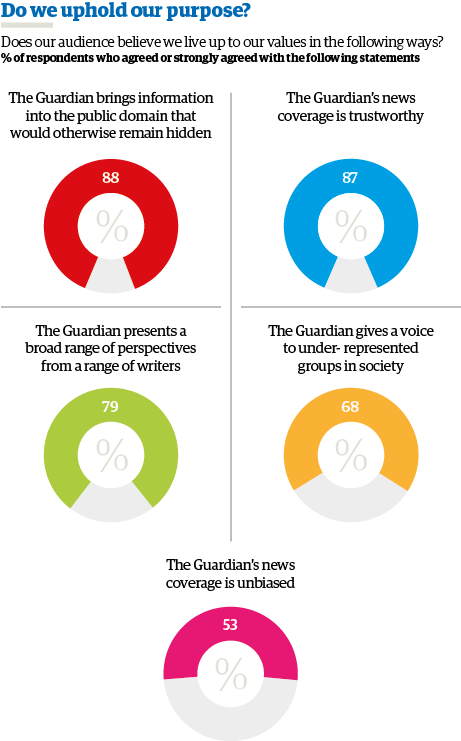
It is important for us to understand if our audience think that we are living up to our core purpose and our Scott Trust values. And our research confirms that readers believe our investigative journalism plays a crucial role, when it comes to unearthing information that it is in the public interest to reveal. But just over half (53%) of all respondents agreed that our coverage is unbiased – among our online audience, only 45% agreed.
Q2. Do we fairly reflect society?
As a media organisation, our content and writers can have significant reach and influence, so we have a responsibility to reflect the experiences of and give voice to all members of society, not just those who wield power or have influence. To that end, over the last year, we have done a lot to improve access for the more marginalised sectors in society.
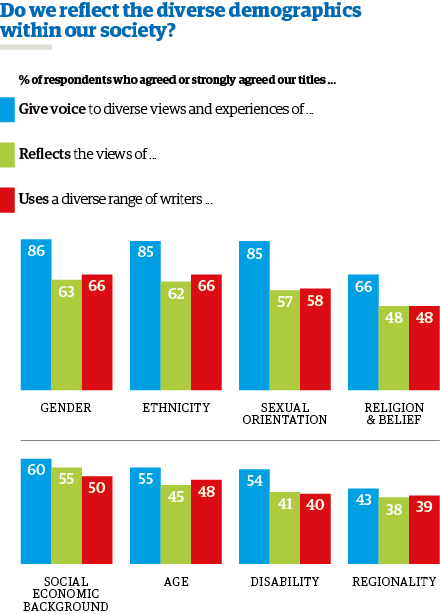
Almost 80% of our readers believe that we present a broad range of perspectives from a range of writers. But, only 68% agree that we give voice to or actually hear from typically under-represented groups in our society. Our online audience sample, who are the most diverse, do not think we are as representative of those groups as our paper audience, although the number is up by 15% on last year.
Our readers do not believe that we give equal voice to all demographic groups. And while we are performing well in representing the diverse experiences of ethnic (85%), sexual orientation (85%) and gender groups (86%), as in previous years, we performed poorly in terms of our coverage of regional diversity (43%). This has improved this year, along with disability (54%). It is important to note that our online audience, who are from more diverse social groups, rated us lower than our paper audience in all areas except regionality.
We also wanted to find out whether content reflecting and written by diverse groups in society encourages people to read our publications and if there are particular voices in society that we represent well and that interest our audience more than others.
We found that the voices our audience believe we represent well are also the ones that appear to have the most influence on their reading. For example, gender, ethnicity and sexual orientation scored highest for both questions. The data implies that our audience value or rates the representation of diverse views in our coverage above their desire to read it. This is true for all our titles and social groups. For example, 55% feel that we give voice to diverse age groups, but only 45% read our titles because of this coverage.
We also asked whether people read the Guardian/Observer/.com because our journalists and contributors are from a cross section of society. The scores are similar to the previous questions, with the ethnicity, gender and sexual orientation of our writers and contributors proving the most common reasons for reading us.
Q3. Are we transparent and open about ourselves?
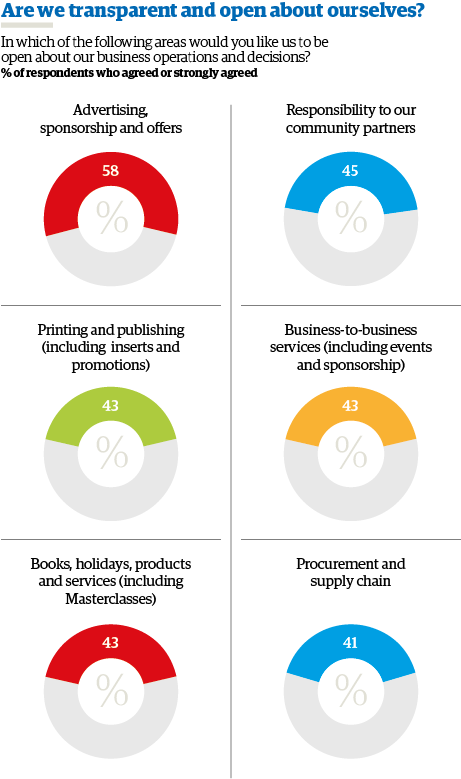
The vast majority of both our paper (Guardian 97%, Observer 96%) and digital (96%) audiences agree that businesses should be open and transparent in the way they operate. This is the first year that we have seen digital audiences rate openness as highly as our paper readers do. That said, only 66% of our online audience and 75% of our paper audience agree that Guardian News & Media is transparent. This is an improvement on last year's scores but there is clearly still room for improvement. When we asked where is it most important for us to be transparent in our decision making, advertising, sponsorship and offers were at the top of the list for all three audiences (Guardian 66%, Observer 67% and .com 53%), followed by our responsibility to our community partners (45%).
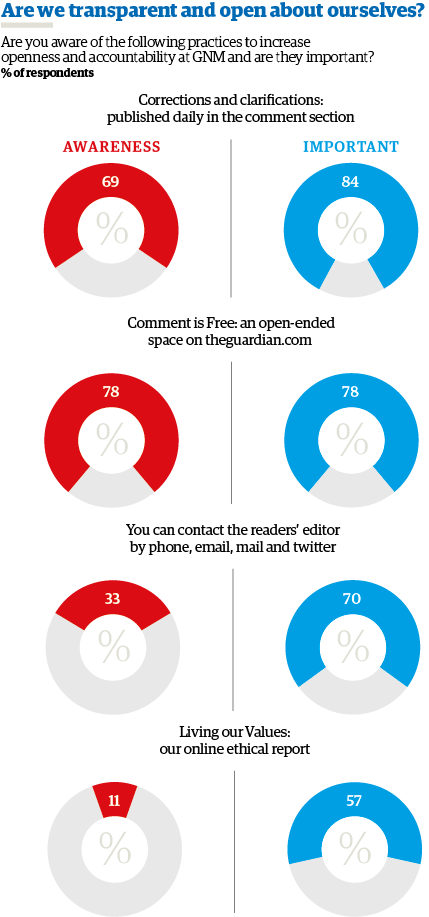
We want to be open and accountable about how we make editorial and business decisions. Levels of awareness of our efforts to do this were mixed: Comment is Free (81%) and online commenting (70%) had the greatest awareness among our digital audience, who also rate the Living our Values report (67%) as more important than our paper readers do (Guardian 43%, Observer 45%). In all cases, our readers' awareness of our practices was lower than or equal to the importance they attach to them. For example, only 11% of respondents were aware of our Living our Values ethical report but 57% felt it made an important contribution to our commitment to openness. The conclusion we can draw is that we are doing the right things but we are not very good at telling people about them.
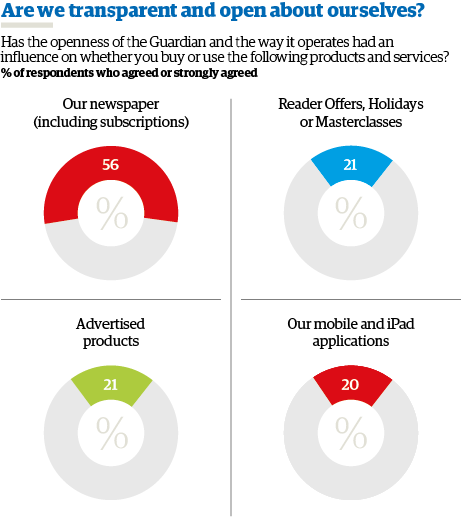
It is important for us to be open and transparent to make sure we align with the Scott Trust values. We also believe that this approach will build trust and engagement with our audiences. We tested this theory by asking people if our open approach influenced their decision to buy or use Guardian products and services. We found our openness has the most influence on our audience's decision to buy the newspaper (56%), followed by reader offers and advertised products, both at 21%.
Q4. What sustainability issues really matter to a media business?
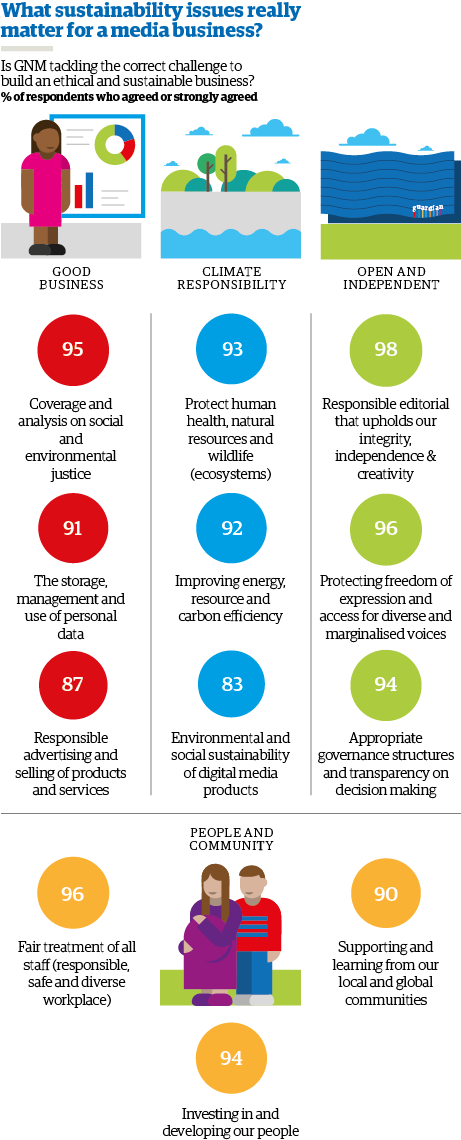
We asked our audience if we were tackling the correct sustainability challenges in order to make us an ethical and sustainable business. Our audience feels that the "Open and Independent" and "People and Community" challenges were the most important areas for us to address. Responsible storage and use of personal data is also considered important by both our digital readers (91%) and our paper audience (90%). The only other issues equally important to paper and digital audiences is the integrity of our editorial (98%). There was a 7% increase in digital readers who feel the environmental sustainability of digital media products is important.
Q5. How well do we cover sustainability in our coverage?
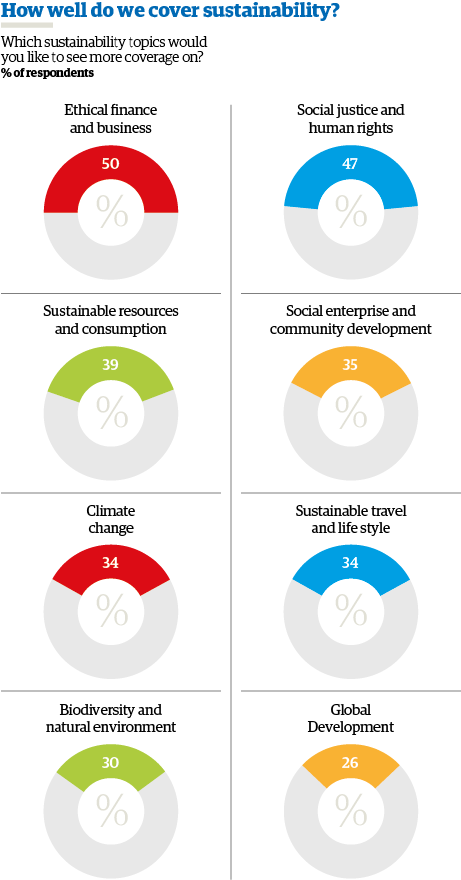
In general, our coverage of sustainability issues was rated highly, with the exception of sustainable travel and lifestyle (46%). Readers said they would like to see more coverage of ethical finance and business, which came second from bottom in terms of coverage rated good or excellent. Both digital and paper readers gave our human rights and social justice coverage the highest rating (87%) and also wanted more coverage of this topic (50%). Only 11% of readers did not want any more coverage of sustainability topics.
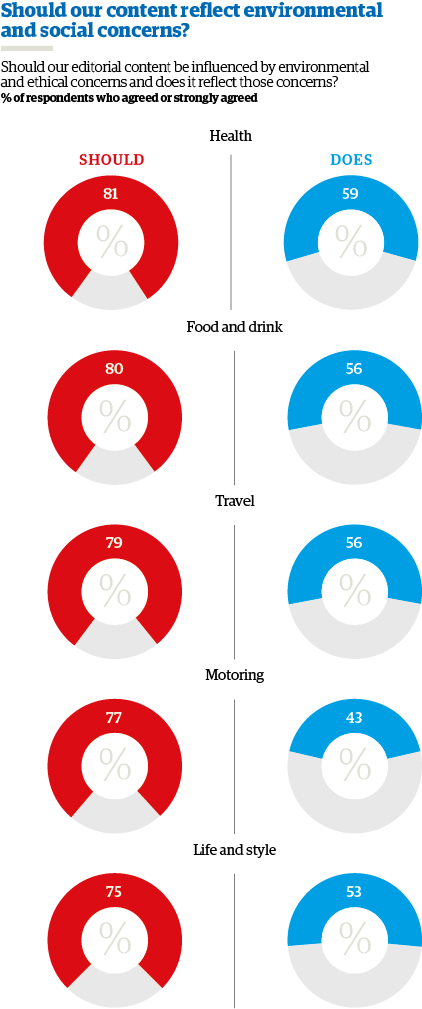
Q6. Should our content reflect environmental and social concerns?
The majority of our digital and paper readers believe all editorial content should reflect environmental and ethical concerns, but they are not convinced this always happens. For instance, although 79% of them said these issues should be reflected in our travel coverage, only 56% said that they actually were. Reassuringly, the higher the audience rated the importance of addressing ethics in a particular content area, the more they felt this was reflected in our coverage. For example, health scored 81% for 'should 'and 59% for 'does reflect', while beauty scored 69% and 38% respectively.
Q7. What type of advertising is unacceptable?
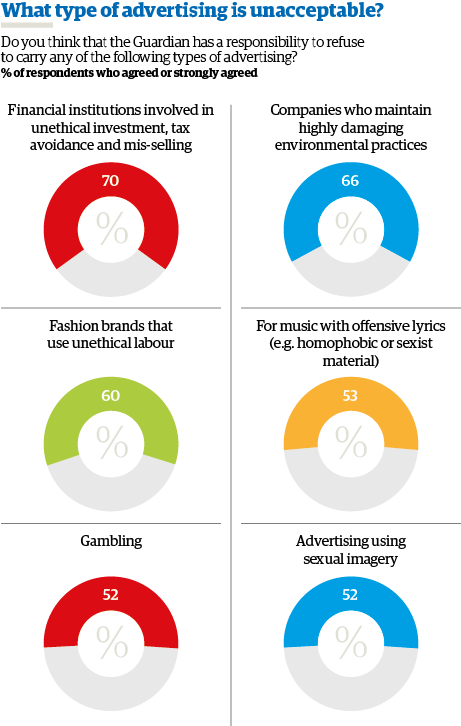
Every year, our survey results show that our audience care about the advertising we carry and they expect us to show due diligence and consideration when we are exploring commercial opportunities. Our online audience is slightly more tolerant of 'controversial' advertising but unethical financial institutions, and companies whose practices damage the environment, remain top of the list of all of our readers' concerns.
The proportion of print readers (Guardian 11%, Observer 10%) who said they would not object to any forms of advertising was lower than in the previous year. Online users have also become less tolerant of 'controversial' advertising; the figure was 21% last year and now stands at 17%.
Q8. Has our coverage influenced our readers' behaviour?
We wanted to know the extent to which our content affects the behaviour of our readers and users. We asked whether they had been influenced to become more active in society as a result of our coverage. We found that what we write about continues to encourage our audience to take positive action. For instance, 75% of digital readers said they had talked to someone about issues raised on the website, while only 12% of our readership said that the Guardian has not prompted them to be more active in society.