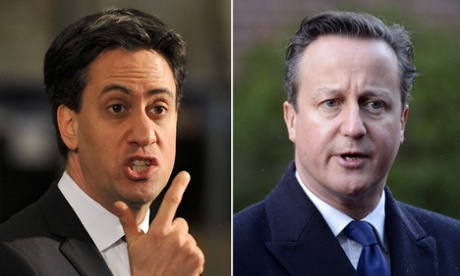
“Could the prime minister please tell the house why waiting time targets in A&E have not been met?”
“To be honest, I’d rather not. The question the leader of the opposition really ought to have asked is why cancer survival rates have improved, so that’s the one I’m going to answer.”
“The prime minister is avoiding the question. He is running scared. I put the question to him again.”
“I’m not scared. You’re scared.”
“Well, you’re a bit rubbish.”
“You’re even more rubbish.”
“Order, order!”
Come Wednesday lunchtime, the weekly hostilities between David Cameron and Ed Miliband at prime minister’s questions will be put on hold for the election. It’s a half-hour of parliamentary time that few will miss, least of all the two main participants. While both men profess to dislike the charmless, public-schoolboy nature of their exchanges, they seldom now manage to rise above them. What began with some purpose when they first squared up to each other more than four and half years ago has long since descended into a punch-drunk pantomime stalemate.
Cameron was delighted when Miliband was elected leader of the opposition. He saw in Ed a man whom he expected to dominate at the dispatch box: to be fair to the prime minister, many on the Labour benches felt the same way. Miliband’s triumph has been to not be as useless as everyone expected. If he has rarely managed to land the killer punch at key moments, he is at least still standing, much to the prime minister’s annoyance.
In the early days, when the economy looked as if it was tanking, Miliband would more often than not lead on the economy. “Where are the jobs?” became a familiar refrain. With the economy doing rather better than predicted, the Labour leader has become less vocal on the subject. These days he prefers to raise questions about the health service and the TV debates. Not that it makes any difference, because Cameron doesn’t answer them anyway. What he wants to answer is a question that invariably hasn’t been asked.
There are the occasional minor victories. Ed bounces up and down on his seat like an overexcited 12-year-old when he thinks he has scored a hit; Cameron turns to his backbenchers and gives a self-satisfied smirk. When under the cosh, Ed suddenly finds Ed Balls an irresistible conversationalist and makes WTF hand-gestures; Cameron just goes red, sulks and tries not to let his inner Bullingdon take control. He doesn’t always succeed; telling Angela Eagle to “calm down, dear” was not his finest hour.
The big untold story of PMQs, though, is one of love. The reason Dave and Ed just can’t land a killer blow on each other is because the bond between them is too strong. They both need the other to look good. When they lock eyes across the House of Commons floor, they see in the other a man who loves them best. In parliament, Dave and Ed’s biggest enemy isn’t in front of them: it’s behind them.