The threat of the lone-wolf attacker has become part of counter-terrorism measures around the world. Germany is once again a grim venue as investigators try to stitch together motives after a driver ploughed a truck into a Christmas market in Berlin, killing 12 on Monday in what German authorities described as a likely “act of terrorism.”
But new data shows European authorities are not only trying to bolster against new plots such as truck used as weapons. They also are concerned about a more conventional threat: illegal firearms that might be increasingly easy to obtain by suspected terror networks.
Criminals turning into terrorism suspects is becoming a more common pattern in Europe, according to the International Center for the Study of Radicalization and Political Violence at King's College London. The research centre recently collected extensive data on 79 recent European militants with criminal pasts. About 80 percent of those involved in recent terrorism plots had criminal convictions.
The researchers fear that extremists with criminal pasts could plan large-scale attacks more easily, because of underworld contacts and previous experience dodging the law. “Because of the changing profiles of terrorists it is easier and cheaper for them to obtain firearms,” said Nils Duquet, senior weapons researcher at the Flemish Peace Institute.
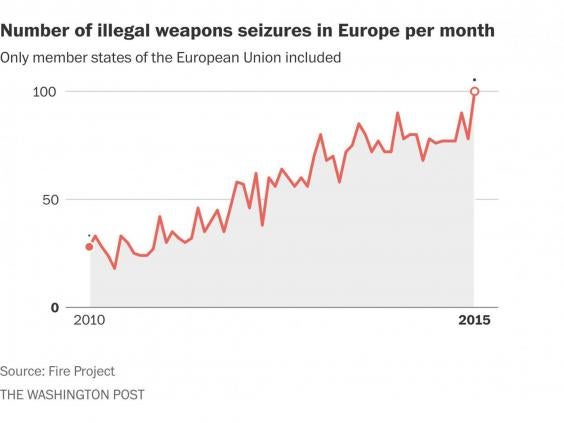
The growing market for firearms has led to an increase in supply - the number of seized illicit firearms in Europe has been on the rise for years.
A European Commission-funded research project has now revealed Europe's vast weapons trafficking network. The “Fire Project” documents all firearms that were seized in the European Union between 2010 and early 2015.
One country in Western Europe stands out among the rest: Belgium. Across the country, thousands of firearms were seized over the last years - many more than in other Western European countries, including France which was struck by some of the bloodiest militant attacks in 2015 and 2016.
Many of the attacks were planned in Belgium's capital, Brussels, where police have raided dozens of homes belonging to suspected Islamic State sympathisers or other militants. Experts, however, say that only a fraction of all illicit firearms which circulate in the small European country were found.
“What authorities focus on is gaining some time,” said Duquet. “The aim is to make sure that terrorists need extra steps to obtain a gun - for instance, one week. Every additional day you win is an extra day for authorities to intervene.”
Most of trafficking takes place on land routes, rather than on ships or planes. Criminals involved in the trafficking business enter the European Union's Schengen area - where there are few border checks - through EU members Slovenia or Croatia.
So how easy is it to cross the border into the Schengen area? A look at the chart below helps explain the answer: very easy, in most cases. So far, few EU citizens are thoroughly screened while entering the Schengen zone from outside. Whereas non-EU citizens are frequently asked to stop and have their vehicles searched, EU citizens are mostly allowed to pass.
This explains why the vast majority of those involved in firearms trafficking on European Union soil are citizens of the union. Many come from Southern Europe.
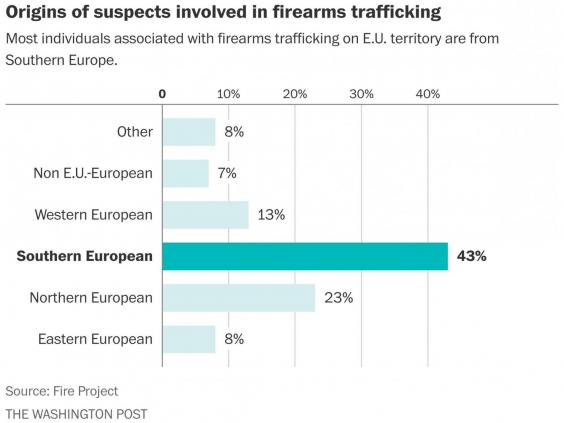
Although the vast majority of weapons smugglers are young and aged between 20 and 34, there is also a surprising number of older criminals who earn money from the business.
The mixed profiles of those offering illicit firearms in Europe is met by an increasingly diverse demand for the weapons on offer.
“Ten years ago you wouldn't have found Kalashnikovs in Western Europe,” said Duquet, referring to an assault rifle developed in the Soviet Union and now widely copied around the world. Tens of thousands of those weapons still circulate on the Balkans where war still raged two decades ago. Many of those weapons are now making their way to Western Europe, often smuggled in small quantities.
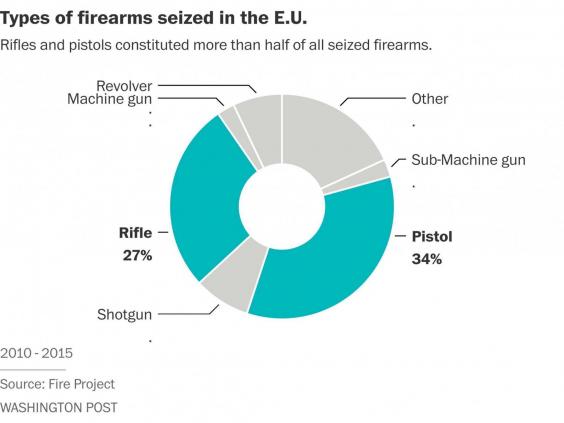
“For criminals, Kalashnikovs are not that interesting. You can't really rob a store with it,” said Duquet. “But for terrorists, Kalashnikovs are ideal. They kill many people in a short time frame.”
The Washington Post