An organ once thought to become unimportant after childhood could actually be key to longer life, according to new research.
The thymus is a small organ located behind the sternum and is known to play a central role in the immune system. It acts as a training ground for the immune system’s T cells, which help the body recognise and fight infections.
It’s generally believed to become largely inactive after puberty as it shrinks with age and produces fewer new T cells. As a result, scientists say, its role in adult health remains less studied.
A new study at Mass General Brigham challenges the theory that the thymus grows unimportant after childhood.
Clinicians used artificial intelligence to review CT X-ray scans and found that adults with healthier thymus tended to live longer, with lower risks of heart disease and cancer.
Another study shows that the health of the thymus affects how well cancer patients respond to a key treatment.
“The thymus has been overlooked for decades and may be a missing piece in explaining why people age differently and why cancer treatments fail in some patients,” Hugo Aerts, an author of one of the two studies published in the journal Nature, said. “Our findings suggest thymic health deserves much more attention and may open new avenues for understanding how to protect the immune system as we age.”
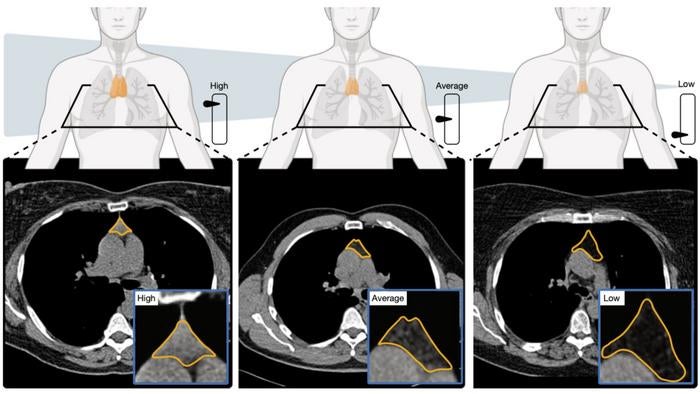
One of the studies analysed data from over 25,000 adults who were part of a national lung cancer screening programme and over 2,500 participants in the Framingham Heart Study, a long-running group of generally healthy individuals.
The thymus of each participant was evaluated by measuring its size, structure and composition, creating a “thymic health” score.
Researchers found those with higher scores had roughly a 50 per cent lower risk of death, a 63 per cent lower risk of dying from heart disease, and a 36 per cent lower risk of developing lung cancer compared to those with lower scores.
These risk reductions held even after accounting for age and other health factors.
When the thymus function declines, researchers suspect the immune system becomes less effective at responding to new threats like cancer. They say chronic inflammation, smoking and higher body weight are linked to poorer thymic health.
The second study corroborates this.
It reviewed CT scans and outcomes from 1,200 patients treated with immunotherapy, a key treatment method for cancer involving the priming of one’s own immune system to fight cancerous cells.
Patients with better thymic health had a 37 per cent lower risk of cancer progression and a 44 per cent lower risk of death, even after adjusting for differences in patients, tumours, and treatments, the study found.
The findings point to a previously under-recognised role for the thymus in determining how patients respond to modern cancer therapies.
More studies are needed to confirm these findings, scientists say, adding that an improved understanding of thymic health can help physicians better assess disease risk and guide treatment decisions.
Eating more fruits and vegetables could put you at risk for this cancer
‘I should have been bonding with my new baby – instead I was fighting for my life’
New pancreatic cancer drug nearly doubles survival time in patients
Science finds surprising link between your marital status and risk of cancer
How one simple menu tweak can cut calories and carbon emissions
Here’s what a shot day looks like before firing one of America’s most powerful lasers