Why update The Government Inspector? David Farr, responsible for this very free version, would doubtless argue that he wants to give Gogol's masterpiece a biting political resonance. But, while his text boasts some bravura passages and his production a couple of outstanding performances, they feel like a suit that doesn't quite fit.
The peculiar genius of Gogol's 1836 play is that it works on both a realistic and mythic level.
At heart it is the story of a humble St Petersburg clerk mistaken for a government inspector; and left wing critics in Gogol's own day saw it as a lethal satire on Tsarist provincial corruption. But later commentators viewed it as a proto-Symbolic work in which the clerk became a phantasmagoric apparition or even the Devil incarnate; and Nabokov famously wrote that the play was the product of Gogol's "private nightmares peopled with his own incomparable goblins".
By updating it, however, Farr dilutes both its realism and its myth. Thus in his version we are in some corrupt, ex-Soviet republic shocked to find that a UN inspector has arrived incognito. This throws the president and his aides, guilty of appropriating IMF funds and of pocketing profits from the sale of public utilities, into a blind panic. It also gives Farr the chance to add some choice details: I liked the idea that the main hospital was staffed entirely by actors from a soap-opera called Ambulance Division.
But, while Farr pins down post-communist mayhem, his adapted plot doesn't hold water. In Gogol's original the mistaken-identity joke depends partly on the total isolation of a civic backwater: in an age of instant communication, you wonder why a Balham estate-agent should be taken for a UN inspector.
And, where Gogol legitimately satirises the credulity of provincial officials, there's something patronising about Farr's assumption that a presidential entourage wouldn't see through the hero's fantasies. When, as here, the hero claims to have written Enduring Love, Our Mutual Friend and The Mill On the Floss, you are reminded that Dickens especially was one of the passions of the old Soviet empire.
By localising Gogol's plot, Farr also robs it of much of its mythic power. There's one extraordinary moment in his production when the walls of the presidential palace are suddenly rendered transparent to reveal the ghostly, clamorous shapes of the dispossessed. But, that aside, his version offers an uneasy mix of the tragic and the comic.
After the powerful symbolic image of hands clawing at the window we go clumsily into a pure piece of Gogolian plotting in which the hero tries to seduce both the president's wife and daughter.
Farr also makes heavy use of a running gag in which the tongue of a female journalist who has sought to expose government corruption is ruthlessly severed. Clearly Farr is seeking some equivalent to grotesque Gogolian humour. But there is nothing inherently funny about state torture; and the sight of the severed tongue being used as a comic prop and treated by the hero as a trophy to show his south London friends simply seems to trivialise the reality of sanctioned cruelty.
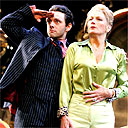
What Farr does do is get fine performances out of his lead actors. Michael Sheen lends Martin Gammon, the dodgy estate agent, a wonderfully manic, pin-striped intensity. And in the scene where he fantasises about his London life ("I was on Big Brother with Harold Pinter," he announces at one point) his pupils dilate as he gets carried away with his own dreams. Sheen, whose recent roles range from Caligula to Jimmy Porter, is expert at portraying dementia. He also makes something unexpectedly touching out of the moment where Gammon suddenly asks, "Why do people need to be liked and respected?" Suddenly you get a glimpse of the hero's shrunken soul.
Kenneth Cranham is also very good as the president: a bloated, baggy, pouched-eyed figure who seems the living embodiment of post-Soviet corruption.
And, amongst the minor roles, there is sterling support from Geoffrey Beevers as an invincibly stupid head of Intelligence, from Elizabeth Bell as a Rosa Kreb-like finance minister whose dowdy exterior betokens her unreconstructed love of the good old communist days and from Geraldine James as the president's sexually voracious wife.
There are also good things in Farr's production: not least Ti Green's set filled with a baroque imperialist nostalgia. But Farr's play veers awkwardly between a paraphrase of Gogol's original and a satire on east European capitalist chaos. In the end, it feels neither one thing nor the other and leaves one hungrily waiting for Gogol.