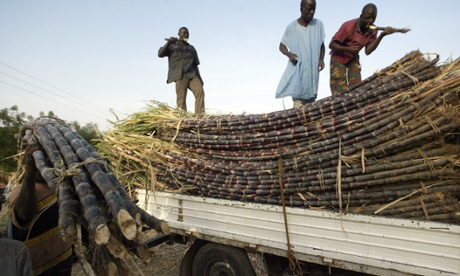
Market stall holder Caroline Muchanga from Zambia works 15 hours a day, seven days a week. At her stall in the town of Mazabuka she sells “White Spoon” bags of sugar, produced at Zambia Sugar’s vast plantation and factory less than a kilometre away. On a good day Caroline makes the equivalent of about £2.61 and will pay around 33% in tax.
Compare this to Zambia Sugar itself – a subsidiary of UK food giant Associated British Foods. Its factory, just outside Caroline’s town of Mazabuka, is the largest sugar mill in Africa. The company makes nine-tenths of the sugar produced in Zambia for domestic consumers and for export to the UK and Europe. According to a report published by Action Aid in 2013, Zambia Sugar Plc annual reports from 2008-2012 showed that annual revenues were more than £130m a year. But Action Aid calculated that since 2007 it had paid on average just 0.5% of pre-tax profits in corporate income tax.
According to ActionAid’s report Sweet Nothings Zambia Sugar – which benefits from Caroline’s sales – paid 90 times less tax than Caroline, relative to their respective incomes. ABF has said: “The reason that no corporate tax is paid in Zambia for the last couple of years is because of our £150m investment building the biggest sugar mill in the country. There are capital allowances available on that, in the same way similar reliefs are available to investors in most countries, including the UK.”
But it is undeniable that an unfair global tax system that forces one woman – living on less than £3 a day – to pay a higher income tax rate than a rich neighbouring business is exactly why the UK and other countries need to take strong steps at a conference in Addis Ababa next week to improve global tax governance. The Third Financing for Development Conference (FFD3) is supposed to deliver a strong financing framework, but unless more world leaders engage with the process and commit to meaningful reforms of the international tax system then Addis won’t meet expectations. And if Addis fails then the key September UN leaders’ summit to set ambitious new development goals, will also be in jeopardy.
During its G8 presidency Britain initiated a valuable dialogue about tax transparency, but to ensure developing countries can benefit from reforms of international tax, the UK needs to help establish an adequately resourced UN intergovernmental tax body at FFD3. This is crucial to redress the balance of power in favour of developing countries so that they have an equal say and power in discussing the issues that are more important to them. Tax transparency is also critical to the UK to improve the way it uses its resources and should be supported by public country reporting by multinationals, public registers of beneficial owners of companies and trusts, and universal use of open data formats. It is also necessary to increase the effectiveness of all financial flows. So while International Development Secretary Justine Greening is set to lead the UK delegation in Addis, British NGOs will be watching to ensure that she gets strong support from across Government especially from the Chancellor George Osborne.
One area where the UK is a leader is aid spending – as the first G7 country to meet this aid target and then enshrine it in law. The UK is in a strong position to urge other countries to help reach a global commitment to 0.7% by 2020. This target was included in early versions of the FFD3 draft outcome document but was diluted during negotiations. Donor countries need to honour aid targets and commit to timetables that show how and when they are going to meet their ODA targets. Half of all ODA should also be given to the Least Developed Countries (LDCs) to reverse the current trend of declining aid to those nations.
The UK Government has achieved a lot to date but now it is time to step up to the plate and support action to change. If we don’t do better on the issues where British influence can make a real difference, Addis will not deliver the financial framework we need to build the world we want. UK NGOs have made further recommendations here.
Join our community of development professionals and humanitarians. Follow@GuardianGDP on Twitter.