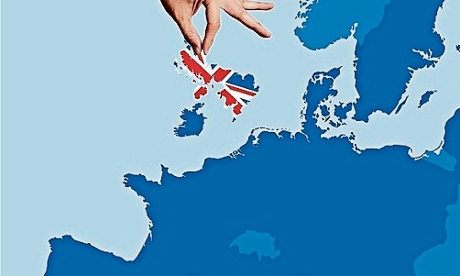
UK membership of the EU is set to be a huge campaigning issue in the run-up to the general election. Cameron has promised a referendum and UKIP are desperate to leave. So could we be heading for an exit? Or would we be better to stay in?
At Thursday’s Guardian Live event, Guardian journalists and members discussed the financial and economic implications of leaving the union. Chaired by Guardian columnist Polly Toynbee, the panel comprised economics editor Larry Elliott, political writer Timothy Garton Ash and columnist Rafael Behr. Here’s what they thought.
On a referendum
There were mixed thoughts on the possibility of a referendum, with a general consensus that an in/out vote was necessary. Timothy Garton Ash said he thought Labour had the most sensible approach: to stay in, then go for a referendum the minute there’s a treaty change. “The best chance the UK has of staying in is to have that referendum in 2017,” he said.
Rafael Behr argued he could see an equivalent route map going in the opposite direction, with Cameron in a minority government, needing to legislate to get a referendum and under enormous pressure to consider the idea of an exit. “It’s not such a great leap to get from there to an ‘unless we get what we want I’m prepared to accept the default position is out’,” he said. Polly Toynbee thought a minority Conservative government two years into extreme austerity would be so unpopular that it would be unlikely to be able to swing votes in favour of Europe against the Redwood faction on the backbenches.
From the audience, Neil Kinnock said he thought the possibility of an in/out referendum in 2017 concluding the argument once and for all was nil. “The boil will never be lanced,” he said. “After the referendum on Scotland, it took 10 minutes for the SNP to say let’s have another one and to ensure Scottish politics will continue to be influenced by the possibility of a pull-out referendum.”
The economics
Larry Elliott said the economic situation might not be as dire as some people liked to predict. “We would survive,” he said. “We’d come to some sort of accommodation with the rest of Europe; it might not be on the terms we’d like but it’d be in the interest of the other European Union states to come to some sort of agreement with us. After all, we import more from them than we export. The idea that we’d be completely cast adrift and lose 3m jobs is nonsense.”
However, he thought we would end up staying in and said a referendum would be helpful to clear the air, but we should be under no illusion that if a referendum was announced in May for 2017, there would be a cost to the UK. “Business investment would certainly shrivel up; there’d be no investment for two years.”
Neil Kinnock said he thought the UK had the best of both worlds “being in the single market, a strongly influential voice in the European Union, without the obligations of the euro.” He added that we should be a force for ending the “stupid and self-destructive” austerity polices operated by the Eurozone.
Emotional ties
But it wasn’t all about the money. Audience member Simon Barrow (formerly of the European Movement advisory council) asked why politicians failed to take a stronger and more emotional line. “This [the EU] is a great, noble idea – when is that said by a British politician?” he said. “It’s all about the counting house. When is the pro-European emotion going to be stated by a British leader?”
Student Kitty Eyre agreed and said she thought politicians underestimated the attachment young people had to the EU. “Young people have no interest in leaving,” she said. “They like people from other cultures; they want to stay in a place where they can go to Europe and have friends from other countries. A referendum would be a defining moment for our generation.”
The audience seemed to broadly agree, as did Timothy Garton Ash, however he didn’t think politicians would get very far with emotional arguments and said they really needed to make an argument from national interest and economic interest except for one thing. “Everybody likes taking the easyJet flight to Lisbon, and I think for an awful lot of people that means something, and to say that’s actually under threat – that might make a difference.”
Rafael Behr went on to argue that the cultural fabric of our society was also at risk. “The stakes are higher because of the immigration debate,” he said. “Farage has brought immigration and Europe together by saying if you are worried about borders, you can’t have it as part of the union. So in defence of the EU, you have to ask what kind of country do you want to live in? You have to make the argument with immigration: historically we do best when we’re open.”
Guardian Live is our series of events, debates, interviews and festivals exclusively for Guardian members. Find out what’s coming up, and more about Guardian Membership.