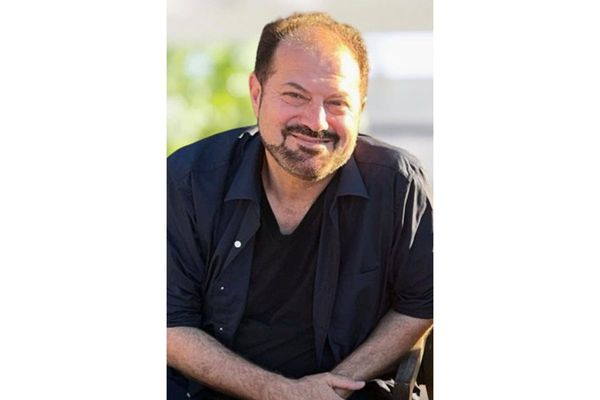
“You, my friend, are fucked.” That’s how monologuist Mike Daisey began his newest production, The Trump Card, at Washington DC’s Woolly Mommoth Theatre on Thursday night. But it might not be how he starts Friday night’s performance, or Saturday’s. Just like Donald Trump himself, Daisey likes to riff on the news of the day and his crowd.
Daisey – who is is an occasional contributor to the Guardian – believes his crowd are a self-selecting bunch. They are, he said, the sort of people that will laugh politely at jokes about their propensity to listen to “nerds” on NPR and cite Mother Jones articles in casual conversation. You know, sort of like the mirror image of the Trump fans who will stand in line for hours to hear him skewer the hated icons of the left, even if they know that he might not be telling the whole truth and nothing but the truth.
The truth Daisey seeks to illuminate with his latest monologue – which, as with The Agony and the Ecstasy of Steve Jobs, he plans to transcribe and release open source to anyone that wishes to stage it themselves – isn’t really about the racism at home or in the Republican party that he says spawned Trump, or about Trump’s propensity to tell people what they want to hear and believe to be true. It isn’t even really about the apathy of America that could conceivably propel the New York real estate celebrity to victory in November, or how he “hacked” journalism by telling lies so bold that watching journalists pick them apart can never eliminate their rhetorical power.
Daisey’s monologue is about how we build our individual realities and how an artful lie illuminates what we believe to be the truth more than any actual accounting of objective reality.
Daisey, whose excerpt from his The Agony and the Ecstasy of Steve Jobs monologue was broadcast on This American Life as journalism and then retracted when it turned out to be, in no small part, art, knows more than a little about when fiction is passed off by reality. His new work references his past more than a few times.
Perhaps it’s because of the intimacy Daisey can establish with an audience or because he acknowledges that performing a truth isn’t the same as telling, but Daisey’s case for forgiveness is persuasive. In fact he’s as forgivable to his liberal audience as Trump’s are to his supporters and you see a bit of Trump in Daisey and, ultimately, a bit of Trump in yourself.