
They say that teamwork makes the dream work, and that was certainly true with what you’re about to read. Last April, I unleashed the top 50 draft prospects list on Touchdown Wire as I’d done before at Yahoo and Sports Illustrated. This year, my esteemed colleague Mark Schofield jumped in and helped make this year’s version the most detailed yet. Here, you’ll find detailed scouting reports on the 50 players we believe are the best in this draft class.
If you want to know who wrote the song, you can generally judge by the singer. Mark wrote the scouting reports for quarterbacks, receivers, tight ends, interior offensive linemen, interior defensive linemen, linebackers, and half of the cornerbacks. I wrote up running backs, offensive tackles, edge rushers, half of the cornerbacks, and the safeties.
Without further ado, here they are — Touchdown Wire’s top 50 players in the 2020 draft class.
50. Jordan Love, QB, Utah State

Height: 6’4″ Weight: 224
40-Yard Dash: 4.74 seconds
Bench Press: N/A
Vertical Jump: 35.5 inches
Broad Jump: 9 feet, 10 inches
3-Cone Drill: 7.21 seconds
20-Yard Shuttle: 4.52 seconds
60-Yard Shuttle: N/A
Bio: A three-star recruit coming out of Liberty High School in Bakersfield, California, Jordan Love did not have many options when it came time to choose a college destination. He selected Utah State over Northern Arizona, Northern Colorado, Eastern Washington and Sacramento State. But he was pressed into action relatively early for the Aggies, starting six games as a redshirt freshman in 2017. He completed 54.9% of his passes for 1,631 yards and eight touchdowns, with six interceptions.
His 2018 campaign was a true breakout season, and it led to many this past summer looking at him as a quarterback who could crash the first round in this draft. As a sophomore, Love completed 64% of his throws for 3,567 yards and 32 touchdowns, with just six interceptions, and he posted 8.5 yards per attempt. But coaching changes and losses on the offensive side of the ball led him to regress last season. He threw 17 interceptions, and while he said all the right things about those plays at the combine and at the Senior Bowl — calling them “teaching moments” — the decision-making he put on film this past year does generate more questions than answers.
Stat to Know: Speaking of those teaching moments, under charting from Pro Football Focus, Love ranked 101st last season in turnover-worthy play rate.
Strengths: Love, even in some of the games Utah State lost last season, puts some of the best throws on film of any quarterback in this class. A prime example is Utah State’s loss at LSU last season, which saw the Aggie QB complete just 15 of 30 passes for 130 yards and three interceptions. But early in that game, Love threw an absolute dime to a receiver in the red zone, which was dropped:
Love actually displayed decent processing speed last season, most notably on quicker route concepts that you would expect to see in a West Coast playbook. On route designs such as Tosser (double slant), Ohio (go/flat) or Omaha (double outs) he showed quick reads and got the ball out on time and in rhythm to his targets. The Utah State playbook also incorporated some Air Raid staples such as Mesh into the design, and he showed good awareness and the ability to work through progression reads on those plays.
Love also has an NFL-ready arm, with the ability to generate velocity to all levels of the field. His arm strength makes him a fit in any offense, and there will be no limitations on him challenging any window in the NFL. He also shows better touch than most collegiate passers who have dominant arm strength, which puts him in a position to attack the middle of the field and between levels of the field when he reaches the NFL.
Weaknesses: The drop in production from 2018 to 2019 is a concern. Yes, there was a coaching change and he lost some of his offensive weapons, but it is something to watch. It also seemed like Love attempted to take on too much last year, trying to throw the Aggies back into games rather than just taking what the defense was giving him. The LSU game was one such example, when he was forcing throws in hopes of generating a comeback with one big play rather than just taking what was available.
Mechanically, there are some inconsistencies that will need to be cleaned up. Generally, mechanics are not an issue when evaluating passers unless they lead to misses on throws, and that is what we see with Love. There are times when the arm is what he relies on, and he fails to properly involve the lower body in the throwing motion, and passes dip and trail off as a result. There are other moments when his mechanics are sloppy, and he will miss on throws that he should hit easily. That is often compounded when he hesitates in the pocket. As a result, he tries to artificially speed things up by accelerating his throwing motion, and that results in sloppy mechanics and misfires.
Conclusion: A bet on Love is a bet on two things: One, that his 2018 season is more in line with his potential as a QB, and two, that your organization has an ability to develop a young quarterback. He will need some work, and is probably not someone that you could point to and state with confidence he can be your Week 1 starter as a rookie. He does project well to an offense rooted in West Coast concepts that still gives him opportunities to hit on deep balls downfield, as his processing speed on those concepts appears ready for the league. But the team that drafts him is going to need some patience. Ideally, he enjoys a Drew Lock type of draft where he falls a bit and as a result is not faced with immediate expectations. Conversely, a team that just acquired a veteran passer but might be looking a year or two down the road would be a good landing spot. Especially if its head coach has a track record of QB development.
Looking at you, Indianapolis.
Comparison: Josh Allen might be too on the nose, but it makes sense for a variety of reasons. I think there is similar play-style between the two, but I also think the team that selects Love is going to have a similar mind to the Buffalo Bills when they selected Allen, also out of the Mountain West Conference. His arm and athleticism are going to help him at the start, and we can fill in the rest around him early in his career.
49. Willie Gay Jr., LB, Mississippi State

Height: 6’1″ Weight: 243
40-Yard Dash: 4.46 seconds
Bench Press: 21 reps
Vertical Jump: 39.5 inches
Broad Jump: 11 feet 4 inches
3-Cone Drill: 7.08 seconds
20-Yard Shuttle: 4.3 seconds
60-Yard Shuttle: N/A
Bio: Willie Gay Jr. was a four-star linebacker for Starkville High School in Starkville, Mississippi. Growing up around the corner from Davis Wade Stadium at Scott Field, it was widely expected that Gay would stay home and play for Mississippi State. While in high school, Gay played both linebacker and at times quarterback, and tallied 83 combined tackles – nine for a loss – as a senior. He entertained offers from LSU and Michigan, but in the end stayed home to play for the Bulldogs.
Playing time was hard to come by for him, thanks to a few team suspensions. But when he was on the field, he shined. His 2018 sophomore campaign was his breakout performance, when he played 455 snaps and notched 31 total tackles.
Stat to Know: Eight. That is how many games Gay missed this season due to suspension.
Strengths: Gay has the kind of athleticism that might make general managers overlook the off-the-field issues. He lit the Lucas Oil Stadium turf on fire, from his 4.46 40-yard dash (99th percentile) to his 39.5 inch vertical leap (96th percentile) through his 11 foot 4 inch broad jump (once more, the 99th percentile). But this athleticism was on full display when he was able to get onto the field. He truly plays sideline-to-sideline against both the run and the pass. He is explosive when blitzing, flying downhill with reckless abandon. He also shows good balance, with the ability to run through cut block attempts that he does not see coming and somehow manage to stay upright. In space he flashes good change-of-direction ability, both when sticking on receivers or in trying to take down ball-carriers in the open field.
Against the run, Gay is generally solid. He has a good nose for the football, and can fight through traffic in front of him and still put his facemask on the ball-carrier. He fits well in the running game, taking his gap responsibility to heart and attacking it with controlled abandon. Gay has the vision to identify threats in the passing game and shows the penchant for keeping one eye on the quarterback and the other on the nearest threat when in zone coverage. He gets into his zones with more fluidity than Murray. When rushing the passer he has a good stutter/hesitation move that has worked for him.
Weaknesses: There are the character issues that teams will need to work through with him. He was suspended for cheating on a test, and was also suspended for punching a teammate in the face. In addition, even when eligible he was just a rotational player for the Bulldogs. Those are questions he will need to answer.
Beyond those issues, Gay can sometimes struggle to stack and shed blockers down near the line of scrimmage. He would rather evade blockers than take them on as a result, which works well in space but limits his effectiveness at times when playing in the box.
Conclusion: With his athleticism and ability to play in space, as well as what he offers in coverage, Gay is going to generate interest from NFL clubs. But the red flags are issues to consider, and one cannot help but wonder how teams are going to feel about drafting him without the ability to work through some of these issues during a final Top 30 visit. Will teams be comfortable enough to use an early pick on him based on what they learned over Zoom? If they are, they’re getting a potential modern linebacker with the ability to still play down near the line of scrimmage, but the questions are real.
Comparison: Athletically, Gay compares favorably to Bobby Wagner. The more you watch Gay play, the more you can see that potential on the field.
48. Kyle Dugger, S, Lenoir-Rhyne

Height: 6’1″ Weight: 217
40-Yard Dash: 4.49 seconds
Bench Press: 17 reps
Vertical Jump: 42.0 inches
Broad Jump: 134 inches
3-Cone Drill: N/A
20-Yard Shuttle: N/A
60-Yard Shuttle: N/A
Bio: A late bloomer out of Decatur, Georgia, Dugger got no offers from major programs and took the one offer he got, from Division II Lenoir-Rhyne University in Hickory, North Carolina. Over five seasons, he totaled 237 tackles, 6.5 tackles for loss, six forced fumbles, 36 passes defensed, and 10 interceptions — mostly against schools like St. Augustine’s, Tusculum, Mars Hill, Limestone, and Catawba.
“The competitor in me definitely wanted more at times but I wouldn’t describe it as boredom,” Dugger said at the combine, when asked if it was tedious to face “lesser” competition. “It was, how am I going to use this situation where I can’t look at everything I do well and say I’m so great. I’d really dive into the details of what I’m doing and see if I’m doing what I’m supposed to do, or is it me getting away with it because of the level of the competition.”
Stat to Know: There isn’t a lot of charting off of Lenior-Rhyne tape, but during the week of Senior Bowl practice, Dugger forced two incompletions and had an interception in five one-on-one reps.
Strengths: Feisty intermediate defender with range for days and a good sense of where he’s going with it. Explodes to the ballcarrier when he needs to, but Dugger can also be patient to force the stop or turnover. Can run trail bail coverage as a deep defender, tracking receivers while reading the backfield. Wrap tackler who can catch up with ballcarriers out of his assignment as easily as he tracks people over the middle. Sifts fearlessly through blockers. Running a slant or a drag in his area can be a painful experience.
Weaknesses: Dugger did his best to allay any fears about strength of competition during his Senior Bowl week, but there’s no way to erase a litany of relatively weak opponents. As such, his evaluation of clouded by a lack of “like-as-like” competition. Will need to expand his recognition against more complex offense, and better players executing them. Too many times in college, he got away with being bigger and faster. Struggled with zone landmarks at times during Senior Bowl week.
Conclusion: Senior Bowl week is more crucial for small-school players than it is for anybody else, because it’s the one time NFL decision-makers can see how those players go up against what might be superior athletic talent if the player in question doesn’t show up as he would like. Dugger threw out the question marks and proved his worth at the highest level, and though there are things that make him developmental at this point, he has the potential to become a top-notch box defender and occasional deep safety at the next level.
NFL Comparison: Kam Chancellor. Dugger has more range than Chancellor did — there were those who thought Chancellor should be a linebacker when he came out of Virginia Tech. But Chancellor landed in the perfect spot — Pete Carroll’s Cover-1/Cover-3 defense — and became the Legion of Boom’s shot-caller and enforcer. Dugger shows the same toughness and competitive temperament. It will be fascinating to see how he adapts to the NFL, but the building blocks are certainly there.
47. Denzel Mims, WR, Baylor

Height: 6’3″ Weight: 207
40-Yard Dash: 4.38 seconds
Bench Press: 16 reps
Vertical Jump: 38.5 inches
Broad Jump: 10 feet 11 inches
3-Cone Drill: 6.66 seconds
20-Yard Shuttle: 4.43 seconds
60-Yard Shuttle: N/A
Bio: We often hear about the dynamic “three-sport athlete” in high school, who chose to focus on the gridiron but could have been an impact athlete in any number of collegiate sports. Denzel Mims is the rare “four-sport athlete,” who lettered in track, basketball, football and baseball. A three-star recruit coming out of Daingerfield High School in Texas, the only big programs to offer him a football scholarship were Texas Tech and Baylor. Mims headed to Waco, and broke out with a huge sophomore season that saw him haul in 61 passes for 1,087 yards and eight touchdowns, averaging 17.8 yards per reception.
He failed to match those numbers as a junior, and his production slid to just 55 catches for 794 yards and eight more TDs. Pro Football Focus charted him with 11 drops on 66 catchable passes, and his hands will be a focus of discussion in a few minutes. But last year Mims rebounded a bit, posting a career-high 66 receptions for 1,015 yards and a career-best 12 touchdowns.
Stat to Know: Issues at the catch point were not isolated to 2018. PFF charted Mims with 18 drops on 139 catchable passes, a 12.9% drop rate.
Strengths: Given his background in basketball and track, it should not be surprised that Mims is an explosive receiver who can make the spectacular catch look routine, and often goes up to get the football on passes that seem destined to be overthrows or land near the cheerleaders. Mims is an expert at the back shoulder catch, and is adept at adjusting to throws downfield either by twisting his body towards the sideline, or tracking the football down over his shoulder.
Mims is also a tough receiver, willing to work over the middle of the field and make the tough catch in traffic.
As a route-runner, he flashes good pace with his releases, and does a decent job at setting defenders up for double moves or sudden breaks. He is also a savvy player when the ball is in the air who will use his off arm to maintain space, while not doing enough to draw a flag for pass interference. Mims also has great feel for getting “into the blind spot” of a cornerback, before making a cut or releasing vertically. In the red zone, his catch radius and ability to play above the rim truly stands out.
Additionally, books might be written about his pre-draft process. After Baylor’s bowl game Mims headed to Mobile for the Senior Bowl and looked like the best receiver down in Alabama. He showed a great connection with quarterback Jalen Hurts and looked every bit the part of an NFL deep threat. Then Mims went to Indianapolis and made Lucas Oil Field his playground. His testing at the Combine truly turned heads, and his eventual draft position will be largely influenced with how he handled his opportunities leading up to the draft. If you consider that teams want to see how prospects take care of business on their own during this part of the calendar, Mims truly aced this portion of the test.
Weaknesses: Mims ran a limited route tree at Baylor. The routes he did run, such a curls, hitches, go routes and slants, he ran well, but the team that drafts him will need to ease him into the entire playbook. He also is limited after the catch, and averaged just 2.8 yards after the catch last season according to PFF, which tied him for 318th among collegiate receivers. If you are looking for a threat in the screen game, hopefully you are looking for a blocker. Mims had just one – yes one – screen reception last year and was held to no gain. More often Baylor would use him as the blocker on screen plays, which is a job he can handle. Then there is the drop issue. Mims had seven drops in 2019, and there are moments when he will drop the easy throw, such as a slant route, and will then make a spectacular catch. Some, such as Benjamin Solak from The Draft Network, have posited that it is a concentration issue with Mims: “Drops come when he gets lazy – doesn’t reach full extension, claps as he looks to turn upfield too early, or is running a shallow cross or slant or something similarly boring.” This is an issue of concern to watch as he transitions to the NFL.
Conclusion: Ultimately, Mims has the kind of raw traits, athleticism, and yes pre-draft process that is going to attract teams in a few weeks. His potential is a huge positive working in his favor, and he enters the draft on a huge upswing given what he did down in Mobile and at the Combine. He will need to expand his route diversity, and the drops are an issue he will need to contend with, but players of his size and explosiveness are not exactly a dime a dozen. You can see him taking on a rotational role immediately at either X or even the “Z” receiver spot, depending on the offense, and as he develops more diversity to his routes he can become that featured wideout by his second season.
Comparison: We can go old school here and talk about Willie Gault. Mims is a few inches taller, but both were track stars who became vertical threats in the NFL. Gault was a feared player down the field, keeping defenses honest while also dealing with the running game led by Walter Payton. Putting Mims on a play-action heavy team, like perhaps Baltimore, would be a nightmare for opposing defenses.
46. Jordan Elliott, DI, Missouri

Height: 6’4″ Weight: 302
40-Yard Dash: 5.02 seconds
Bench Press: 24 reps
Vertical Jump: 27.5 inches
Broad Jump: N/A
3-Cone Drill: N/A
20-Yard Shuttle: 4.73 seconds
60-Yard Shuttle: N/A
Bio: Jordan Elliott was a four-star recruit from the Houston area, playing his prep ball at Westside High School in Texas. He originally signed to play at the University of Michigan, but de-committed to stay in-state and play for the University of Texas. He played just 89 snaps as a true freshman and then decided to transfer to Missouri. Elliott sat out the 2017 season due to transfer rules, and slid into a rotational role for the 2018 season. Last year was his first and only as a full-time contributor and he made the opportunity count, notching four sacks, 21 quarterback hurries and 22 run stops.
Stat to Know: As mentioned in the discussion of Javon Kinlaw, Elliott led interior defenders with a pass-rush win rate of 18.7% according to Pro Football Focus.
Strengths: Elliott does not quit on a play, whether as a pass rusher or a run stopper. He keeps his feet and hands working until the whistle and forces his blocker to counter his every move. He can push the pocket with power and strength, or he can use a good swim move to win those one-on-one situations. But he has a more complete toolkit as a pass rusher, and he flashed a great rip move in his game against Kentucky. When left singled up, that is when he is at his best. When his initial move is taken away and he is forced to counter he often turns to brute strength, relying on a bull rush power move.
While his defense did not ask him to slant as much as say Ross Blacklock did for TCU, Elliott flashes a quick first step and some impressive lateral quickness when he is asked to penetrate a gap.
Weaknesses: There are moments when Elliott is slow to get off the line or fire his hands, and that lead to instances where his array of rushing moves are left in the holster and he simply fights with strength. While Blacklock seems to love getting doubled, Elliott was not a fan of those moments. Rather than drop the anchor – and certainly rather than seek them out – Elliott would keep fighting against them, losing ground in the process. There is also the issue that he has just the one season of full-time production, but that could work in his favor if you view it through the most optimistic, “he has room to grow,” lens.
Conclusion: Some of those negatives might cause him to slide down into the later parts of Day Two. That might make him an intriguing option for a team looking for a rotational contributor as a rookie. Elliott has the athleticism and frame to be a stout interior defender, and while he might not do some of the things that others in this class do, he will not quit on a play and has a well-rounded set of pass rushing moves that will serve him well in the league. Teams that miss out on the top tier guys will love what they find in a Plan B like him.
Comparison: Athletically, Elliott reminds one of Sharif Floyd, the former defensive tackle from the University of Florida. Both players combined effort, violent hands and the ability to shoot gaps into a solid package at the defensive tackle position.
45. Isaiah Wilson, OT, Georgia

Height: 6’6″ Weight: 350
40-Yard Dash: 5.32 seconds
Bench Press: 26 reps
Vertical Jump: 29 inches
Broad Jump: 110 inches
3-Cone Drill: 8.26 seconds
20-Yard Shuttle: 5.07 seconds
60-Yard Shuttle: N/A
Bio: Alabama, Florida State and Michigan were hot on Wilson’s trail before he decided on Auburn, and he excelled after a redshirt season, picking up Freshman All-American and SEC All-Freshman nods. An ankle injury limited him to 10 starts in 2019, but he still made second-team Associated Press All-American. Perhaps most notably, Wilson’s love for SpongeBob SquarePants was listed by the New Yorker as the 37th reason to love New York back when Wilson was in high school.
“Because the No. 2 College-Football Recruit in the Country Is From Canarsie and Wears a SpongeBob Backpack,” it read.
“I studied Trent Brown a lot because I want to be like him,” Wilson said at the combine about his football influences. “The punch he has, it’s a vicious punch. Tyron Smith is another one. He’s a monster out there; fast, athletic, strong. I watched Joe Thomas when I was younger. I always tried to emulate him and the athletic kick that he had. That was special. I’d like to know how he does it. I’m gonna have to ask him if I ever meet him. It’s special to watch Ronnie Stanley, it’s fun to watch Orlando Brown. It’s fun to watch all the big ballers, all the big athletic guys. I definitely look up to people like that.”
Stat to Know: Over the last two seasons, running backs averaged 2.8 yards per carry before contact, and 7.6 yards per carry overall, when running to Wilson’s gap. Wilson also allowed just two sacks, five quarterback hits, and 17 quarterback hurries in 758 pass-blocking snaps over the last two seasons.
Strengths: Carries his weight in a proportional sense — doesn’t look out of place in any aspect of his play. As you’d expect from a player his size, Wilson can absolutely dominate in the run game with a fearsome drive block and the ability to wall defenders off to either side. Doesn’t present an ideal kick through the arc, but manages to make it work with a “catch-and-latch” style in which defenders move into his area and are enveloped. Outside linebacker-sized edge rushers risk looking like high-school backups as he throws them around. Can work in space better than you’d imagine.
Weaknesses: Works defenders through the arc more with girth and arms than consistent footwork. Can be fooled by defenders crossing his face. If he gives up speed around the pocket, it’s tough for him to recover. Needs to work on pad level to optimize his natural strength.
Conclusion: With just two seasons as a starter at the collegiate level, Wilson has some things he needs to perfect before he’ll be able to negate NFL-level edge-rushers as he did in the SEC. But the buzz around Wilson’s name is no fluke — any team looking for a career right tackle who can work with power and surprising agility might find Wilson to be their man in the middle rounds.
NFL Comparison: Trent Brown. We’ll go with Wilson’s own first comparison here. Selected in the seventh round of the 2015 draft by the 49ers, the 6-foot-8, 355-pound Brown overcame concerns about his size/agility mix and lack of collegiate experience to become a solid player for the 49ers (2017), Patriots (2018), and Raiders (2019) in consecutive seasons.
44. Cesar Ruiz, IOL, Michigan

Height: 6’3″ Weight: 307
40-Yard Dash: 5.08 seconds
Bench Press: 28 reps
Vertical Jump: 33 inches
Broad Jump: 9 feet 6 inches
3-Cone Drill: 7.91 seconds
20-Yard Shuttle: 4.64 seconds
60-Yard Shuttle: N/A
Bio: Cesar Ruiz was the top center prospect in the country coming out of IMG Academy, and had no list of suitors. Ruiz joined IMG Academy after starting his high school career in Camden, growing up in a very tough neighborhood. Almost 30 schools gave Ruiz a scholarship offer, including Florida, Auburn and North Carolina, but he chose to play for Michigan.
Ruiz was pressed into action early, starting in Week 10 of his freshman year and finishing the season as the Wolverines’ starting right guard. He was moved to center for the 2018 season and started every game for Michigan that season. He locked down that spot for the Wolverines again last season.
Ruiz’s story is also one of personal tragedy. His father passed away in December of 2007, when Cesar was only eight years old. His father, Cesar Edwin Ruiz, had pulled over to the side of the road to help another driver with a flat tire. A driver then collided with both the elder Ruiz and the stranded motorist, killing Ruiz’s father. It was two years later that Ruiz turned to the sport of football, putting him on a path towards the NFL. As he told the media during the Scouting Combine, everything he does, he does with his father on his mind.
Stat to Know: Ruiz allowed just three sacks on 2,116 snaps while at Michigan.
Strengths: Ruiz is a versatile offensive lineman, given his experience at both guard and center. On film he displays good lateral quickness with fast hands, and he is usually the first to initiate contact in pass protection and starts with the advantage as a result. His athleticism is something to behold, as his impressive 20-yard shuttle (95th percentile) illustrates. He is quick when asked to long pull to the outside, and shows the athleticism, footwork and vision to consistently climb to the second level and take on linebackers.
In pass protection, Ruiz is extremely aware, constantly scanning for loopers or twisters and if uncovered, he is always looking for work. He displays good awareness and recognition of blitzers, whether early or late in the snap, and he is adept at handling/passing off interior stunts and twists. He also maintains control of the situation when a defensive lineman attempts a secondary pass rushing move, and is able to counter those attempts with ease. He also fights hard to maintain his anchor, or reanchor his base, against slanting bull rushers who have a leverage advantage pre-snap.
Ruiz is also a finisher. He will block his assignment until the whistle – or a little longer if he wants to – and loves to get his guy to the turf. Ruiz does a solid job of continuing to chug his feet post-contact, leading to his reputation as a finisher. He also has what you can describe as textbook “secondary” technique. For example on some zone running schemes he uses a rip technique of his own to counter the initial contact from the defender and get himself to the outside.
Weaknesses: Ruiz tends to drop his eyes before contact, which leads to some whiffs either at the point of contact or in space when he is pulling or working to the outside on a zone running design. There are questions about his athleticism, and therefore his ability to fit in a zone-heavy scheme, but on film he displayed to me the athleticism and technique to operate in such an offense.
Conclusion: Ruiz has the experience, athleticism, strength and mental approach to be a stout interior offensive lineman in any NFL system. He uses his hands and feet well, he wants to finish plays on every snap, he is always looking for work and fights to the whistle every chance he gets. Set to turn 21 this summer, the sky could be the limit for this Michigan offensive lineman.
Comparison: Pro Football Focus compared him to Maurkice Pouncey, and that seems apt given what Ruiz offers as a prospect. There are some flaws but he is a very complete player.
43. Clyde Edwards-Helaire, RB, LSU

Height: 5’7″ Weight: 207
40-Yard Dash: 4.6 seconds
Bench Press: 15 reps
Vertical Jump: 39.5 inches
Broad Jump: 123.0 inches
3-Cone Drill: N/A
20-Yard Shuttle: N/A
60-Yard Shuttle: N/A
Bio: While Joe Burrow was obviously the headliner of Joe Brady’s championship LSU offense with his 60 touchdown passes, it could easily be argued that Edwards-Helaire was the second most important component, and he comes into this draft class with an intriguing argument to the “running backs don’t matter” truthers. In 2019, Edwards-Helaire enjoyed a serious breakout season, gaining 1,414 rushing yards and scoring 16 rushing touchdowns on 215 carries, adding 55 catches for 453 yards. With 1,867 total yards and 17 total touchdowns, Edwards-Helaire is an optimal back for any multi-faceted offense with his well-rounded skill set.
“As a player, I’ll say I’m exclusive,” he said at the scouting combine. “That’s the noun that I’m going with. That’s the adjective that I’m going with. Ultimately, I’m going to stand by that 100%. I feel like everything I do is something that can’t be matched. I feel like I’m kind of, not really, making my own category. But I feel like in this instance, I’m making my own category and doing the things that I need to do to separate me from the bunch.”
Edwards-Helaire has also worked on his pass protection, with help from former Patriots running back and current LSU running backs coach Kevin Faulk.
“When Kevin came on staff two years ago, I asked him about pass pro. … He blocked for Tom Brady – one of the greatest quarterbacks in the history of the football league. And that’s something I pride myself on also. As soon as he came in, we hopped on it. He’s kinda the guy that helped me along the lines with it and then ultimately just the way he ran the ball and everything else from his height standpoint, my height standpoint, we were seeing eye to eye on a lot of things.”
Stat to Know: In 2019, per Pro Football Focus’ wins above average (WAA), Edwards-Helaire was the 13th-most valuable player regardless of position, and third-most valuable non-quarterback. This had a lot to do with the monumental steps forward he took as a receiver.
Strengths: Edwards-Helaire is a “Muscle Hamster” running back who jumps and cuts quickly and decisively to find the open hole, and he’s better at getting through contact than his size indicates. Has a great sense of how to right himself after contact, and he doesn’t panic at the first hit. Can shake defenders out of their shoes in the open field. Presents a favorable target to the quarterback as a receiver, and is particularly good with Texas (angle) routes and motion screens. LSU split him out in 2019, and his NFL team should do the same. Forced 71 missed tackles and had 21 runs of 15 or more yards last season.
Weaknesses: More quick than straight-line fast in the open field. Pass protection is a work in progress. Tough runner, but with his size, he’s not going to beat up any defensive tackles. Had his one great season as his quarterback (Burrow) was throwing touchdown passes at an insane rate and had every defense playing on its heels. Faced a loaded box on just 12% of his carries in 2019.
Conclusion: As he said, Edwards-Helaire is doing a lot to define his own category and separate himself from the bunch. He might not be a bell-cow running back at the NFL level, but how many of those backs exist for more than a couple of years anymore? He’ll be an immediate asset to any team that defines its passing game with screens and RPOs, and his underrated power combined with his quickness makes him an intriguing complementary back.
NFL Comparison: Michael Bennett. Not the longtime edge rusher, but the former Wisconsin running back selected in the first round of the 2001 draft by the Vikings. Like Bennett, Edwards-Helaire can be a big play waiting to happen as both a runner and receiver. His commitment to becoming a complete back augurs well for his NFL future.
42. A.J. Terrell, CB, Clemson

Height: 6’1″ Weight: 195
40-Yard Dash: 4.42 seconds
Bench Press: 15 seconds
Vertical Jump: 34.5 inches
Broad Jump: 129.0 inches
3-Cone Drill: N/A
20-Yard Shuttle: N/A
60-Yard Shuttle: N/A
Bio: A two-year starter for the Tigers in 2018 and 2019, Terrell put up 107 tackles, 3.5 tackles for loss, six interceptions, and 26 passes defensed in his collegiate career. But what he’s most remembered for is his performance against LSU in the 2019 College Football Championship, in which he allowed five receptions for 143 yards and two touchdowns, per Pro Football Focus. Thus, recency bias has taken some of the sheen off what was otherwise a very good tenure in a high-profile defense. LSU receiver Ja’Marr Chase presented nightmare fuel for Terrell, over and over.
“Just great competition,” Terrell said of that game, when quizzed about it at the combine. “We started off strong and he got the best of me on some plays and it went back and forth. Every time we lined up, I couldn’t take a play off.
“Just knowing that there was a whole second half (to play). For me, it was just me being able to understand what happened and that game wasn’t over and having short-term memory at the position of cornerback was key. You can put your head down for too long, you just have to play the next play.”
Stat to Know: Take out his disaster against LSU, and Terrell allowed just 18 catches for 249 yards, one touchdown and two interceptions in the rest of the season.
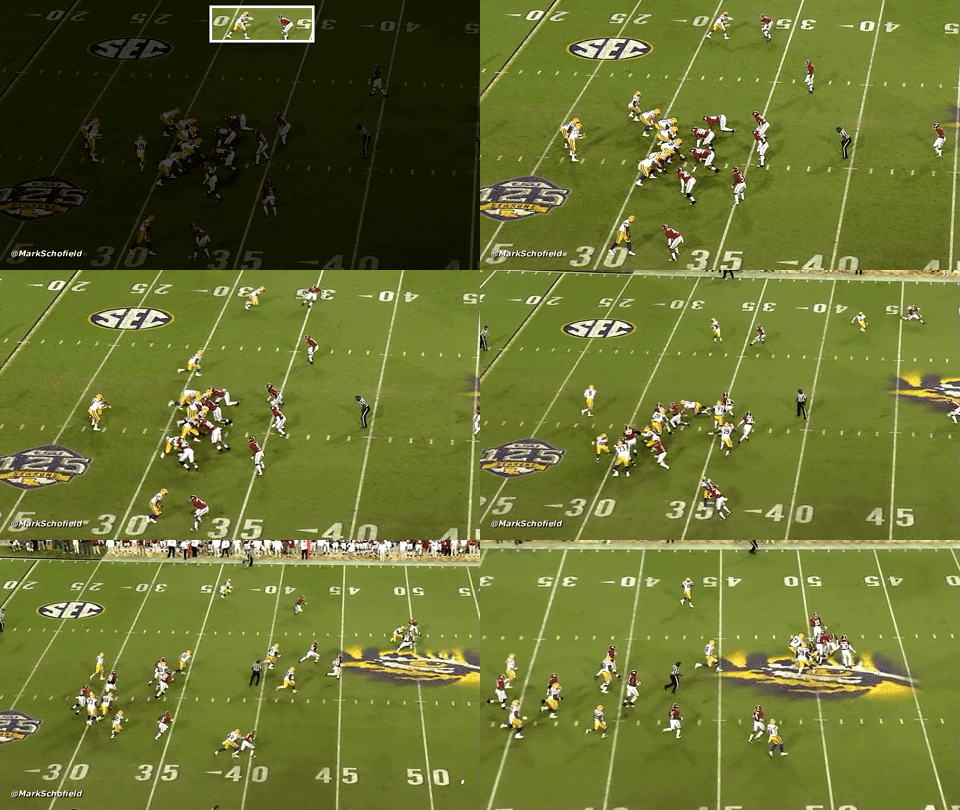
Strengths: Yes, LSU did highlight a few concerns with Terrell, but in large part this is an NFL cornerback who has the movement skills, size and speed to be a man coverage corner to excel. Terrell has the background of playing in a scheme-diverse defensive system, and some of his biggest plays have come in zone coverage settings. His interception of Tua Tagovailoa in the National Championship Game two seasons ago is a great example of his awareness in zone coverage. He reads the eyes of the quarterback, peels off his initial threat and jumps the secondary route, and houses it for the opening score of the game.
Terrell also has ideal length and movement skills for the position. Those both showed up early against LSU, on this play against Chase on an in-breaking route:
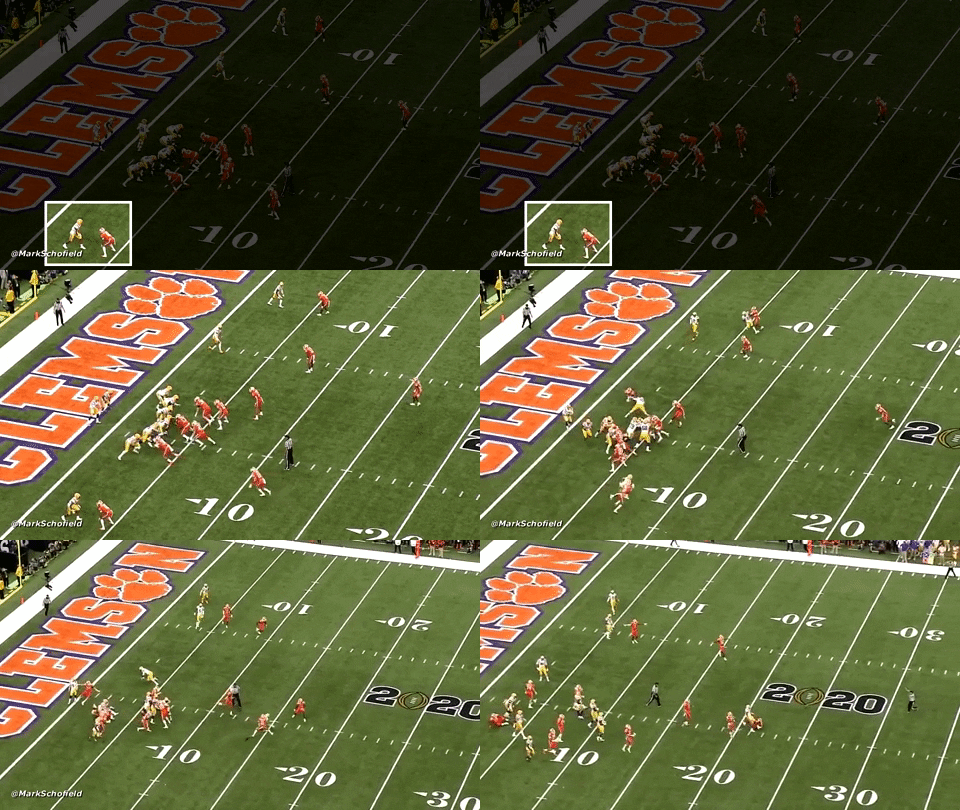
Terrell’s wingspan enables him to get into the jam of Chase off the line of scrimmage, and then he is able to wrap around the receiver to disrupt the play at the catch point.
The movement skills are also impressive. Terrell can maintain his relationship with receivers all over the field, regardless of where the breaks take place in the route stem.
Weaknesses: While the matchup with Chase is perhaps overblown, and an example of recency bias when it comes to studying a player, it does highlight an issue for him: Physicality. Some of those plays that Chase made in the title game came at the catch point, where Terrell sometimes seems to lose on routes. The lack of physicality and strength also showed up on the first touchdown to Chase. The receiver – perhaps with the aid of a pushoff – was able to extend his separation and Terrell simply could not recover. He could also do a better job at tracking the football in flight. The big slot fade route from Joe Burrow to Chase early in the second quarter saw Terrell lose the football. He tried to make a play at the catch point but again, his physicality let him down.
Conclusion: Despite the struggles in the title game, Terrell is still a very solid cornerback. His awareness in zone coverage and ability to change directions well will serve him in the NFL. The play against Alabama is emblematic of hi mat his best: Playing in off coverage or zone technique, reading the quarterback and breaking on the throw. Defensive coordinators who like to matchup their cornerbacks to receivers will love his combination of length and long speed. He could be used on X receivers who are vertical threats.
Comparison: Terrell’s technique and ability to thrive playing off coverage is very similar to Darius Slay.
41. Tee Higgins, WR, Clemson

Height: 6’4″ Weight: 205
40-Yard Dash: N/A
Bench Press: N/A
Vertical Jump: N/A
Broad Jump: N/A
3-Cone Drill: N/A
20-Yard Shuttle: N/A
60-Yard Shuttle: N/A
Bio: Most followers of the college game expected Tee Higgins to stay close to home and play for the University of Tennessee. The Oak Ridge, Tennessee product originally committed to play for the Volunteers, but changed course and announced he was enrolling at Clemson in a well-produced, pyrotechnics-laden announcement video that was posted to Bleacher Report on the Fourth of July.
He played sparingly as a true freshman in 2017, but took on a bigger role each of the past two seasons. In 2018 he caught 59 passes for 936 yards and 12 touchdowns, and last season he caught 59 passes for 1,167 yards – averaging an impressive 19.8 yards per reception – for 13 touchdowns. Higgins is knows for his ability to “play above the rim,” something that we should have expected given what he did on the hardwood at Oak Ridge High School. He averaged 15 points and 6.6 rebounds per game as a junior at Oak Ridge, and led his team to a 20-2 record his final year in high school.
Stat to Know: Higgins is a true weapon in the downfield passing game. He had 565 “deep receiving yards” charted by Pro Football Focus (defined as yards created on throws 20 yards or more in the air), which was eighth-most among receivers in FBS a year ago.
Strengths: Higgins is your prototypical “X” receiver. A player who can win on the outside against press coverage, stress defenses down the field, and win at the catch point and in contested catch situations. If you want an example of how Higgins can still beat defenders with minimal separation, watch this reception against Syracuse from 2019:

Higgins runs a “Circle 7” route, stemming initially to the inside before working back towards the sideline on the diagonal. He handles the press coverage well, working inside the defender and threatening his leverage towards the middle of the field, then breaking back to the corner and high-pointing the ball to come down with the reception. Also note his hands on the release, how he is able to prevent the cornerback from getting into his chest or frame. This is what he displays on film, and those who question how he will handle press coverage in the NFL would be wise to watch this game, as he saw a ton of press from the Syracuse secondary.
For a bigger receiver, Higgins moves well both in his routes and after the catch. He shows the ability to create after the reception, both with his change-of-direction ability and the strength to break tackles. PFF credited him with ten or more broken tackles in each of the past two seasons.
Higgins also has a huge catch radius, as you might have expected from that clip against Syracuse. You see that show up on this three-play clip (which ends with the Syracuse reception):
Higgins also does a good job along the sideline with his feet, and will quickly make the adjustment to the NFL rules of getting both feet down in the field of play. He has confidence in this hands, consistently extending the arms to snatch the football from the sky rather than letting the football get into his frame.
Another thing that Higgins does well is how he handles his nearest defender when he is not involved in the play. He will vary his approach on blocking assignments. Sometimes he will show a route rather than immediately looking to block the cornerback, other times he will quickly stalk and mirror the DB. On a Trevor Lawrence red zone touchdown run against the Orangemen, Higgins even faked a fade route – jumping for the imaginary throw – to keep his defender guessing.
Weaknesses: Higgins was a darling of early draft boards at the WR position, but has faded in the post-season, pre-draft part of the calendar. It began in the National Semifinal Game against Ohio State, when he managed just four receptions for 33 yards in a matchup against Jeff Okudah. Then in the National Championship Game, LSU’s secondary held him to just three receptions for 52 yards.
Then Higgins decided not to run any of the drills at the Combine, waiting for the Clemson Pro Day. What did he do there, where prospects often improve on their numbers with the home field advantage? A 31 inch vertical, a 4.53 20-yard shuttle, a broad jump of 10 feet three inches, and a 4.54 40-yard dash. Not exactly numbers to write home about. That, perhaps coupled with the work Denzel Mims has done before the draft, has many considering Mims as the better “X” receiver option.
However, if you watch those two playoff games, you will still see Higgins beating press coverage at times, enough to make you believe that he can beat press at the next level. His film during the regular season backs up the notion that he can be a good-to-great “X” receiver in the NFL as well. He might need to run crisper routes, and could improve at getting consistent separation, but with what he brings to the table right now, he is a solid prospect.
Conclusion: Teams that need that consistent, ball-winning “X” receiver would be wise to look to Higgins early in the draft. On film he is what you want at the position: Someone who can beat press coverage at the line of scrimmage – and is experienced at doing so against great competition – and can win the football at the catch point and make his quarterback look good in the process. Avoid overthinking the process, trust the tape, and get your QB a new security blanket.
Comparison: Studying Higgins, I see a potential A.J. Green. That might be more of his ceiling, but his vertical ability, ball-winning and movement after the catch is reminiscent of the Cincinnati Bengals standout.
40. Marlon Davidson, DL, Auburn

Height: 6’3″ Weight: 303
40-Yard Dash: 5.04
Bench Press: 21 reps
Vertical Jump: N/A
Broad Jump: N/A
3-Cone Drill: N/A
20-Yard Shuttle: N/A
60-Yard Shuttle: N/A
Bio: A four-star recruit, Davidson chose Auburn over Alabama in his home state and saw action as a true freshman with 38 tackles, six tackles for loss, and 2.5 sacks. He could have left Auburn for the NFL after his junior season in 2018, but kept a promise to his late mother that he would finish school and get his degree. It was a wise move in more ways than one, as Davidson topped out with 11.5 tackles for loss and 6.5 sacks.
“Naw, man,” Davidson said at the combine, when asked if his rookie year in the NFL would be like freshman year at Auburn. “Because of the way I approach the film room. It’s totally different. I study my opponent before my opponent even knows it. Take details from that details from coaching tendencies. There is always the 10-play rule. The first 10 are always going to be off the wall no matter what. Then they will get back to who there are. At the end of the day, coaches are going to have tendencies, favorite formations. Just learn them.”
Stat to Know: Last season, Davidson played six snaps over the A-gap, 62 over the B-gap, 114 over the tackle, and 406 outside the tackle.
Strengths: Has no issue lining up everywhere along the defensive line, and attacks different gaps with different tools. Brings a fearsome bull-rush, active hands, and nice balance on the edge. Inside, he adds a really nice ability to stack and shed blockers with his upper-body strength and sustaining ability through the play. Accelerates to the back half of the pocket once he gets going. Didn’t take major reps on run downs last season (51%, per NFL.com) but has the power and short-area closing speed to be an excellent run defender over time.
Weaknesses: For a guy with his upper-body strength, Davidson could be even tougher to deal with if he learned to play consistently with a wide base and adjust his feet with his movement. Finds himself on the ground too often on the outside; he’s not a naturally agile mover. Doesn’t yet show the arm-over and rip moves that would make a guy with his body type into a more consistent weapon. Isn’t going to work the arc — there’s not a lot of dip-and-rip here. Davidson is going to get to the pocket straight on. Benefited from Derrick Brown’s presence a lot.
Conclusion: You hear less and less in today’s NFL about “tweeners,” players who aren’t quite adept enough at one position, but don’t fit into any other in a definitive sense. The new need for positional versatility has coaches and coordinators working harder to make such players into productive assets. But Davidson could find himself as a true tweener if he’s asked to work too much at end.
NFL Comparison: Javon Hargrave. The Steelers took Hargrave out of South Carolina State in the third round of the 2016 draft, put him inside the tackles for the most part, and were rewarded with an underrated disruptive weapon. Davidson could be a similar force if he bulks up a bit and works from the center’s outside shoulder to the tackle’s inside shoulder.
39. Jonathan Taylor, RB, Wisconsin

Height: 5’10” Weight: 226
40-Yard Dash: 4.39 seconds
Bench Press: 17 reps
Vertical Jump: 36.0 inches
Broad Jump: 123.0 inches
3-Cone Drill: 7.01 seconds
20-Yard Shuttle: 4.24 seconds
60-Yard Shuttle: N/A
Bio: Taylor is trying to become the fourth Wisconsin running back selected in the first round of the draft in the new millennium, following Ron Dayne (2000), Michael Bennett (2001) and Melvin Gordon (2015). He’s certainly been as prolific as any of them. The South Jersey Offensive Player of the Year as a high-school senior, Taylor gained 1,977 yards and scored 13 rushing touchdowns on 299 carries as a true freshman in 2017, and followed that up with two straight 2,000-yard seasons in 2018 (2,194 yards) and 2019 (2,003 yards). His 2018 total ranks seventh in NCAA history since 1956, and his two-year total is the third-best in college annals behind Gordon in 2013-2014 and Iowa’s Troy Davis in 1995-1996. Only Taylor and Davis have the distinction of consecutive 2,000-yard seasons. In 2019, Taylor also became more valuable as a receiver, catching 26 passes for 252 yards and five touchdowns.
“Really, I think it’s my consistency,” Taylor said at the scouting combine when asked what makes him the best back in this class, at least in his mind. “I mean, if you look at the next level, what separates the great backs from the elite backs is really them playing on an elite level day in and day out every Sunday. I think that’s one of the biggest things that separates me is my ability to be consistent year in and year out.”
Stat to Know: Taylor totaled 6,174 rushing yards and 50 touchdowns in
926 collegiate rushing attempts over three seasons, and averaged 4.24 yards after contact per attempt. In 2019 alone, he forced 87 missed tackles in 320 rushing attempts.
Strengths: Blasts through gaps with outstanding speed and leverage; has an innate understanding of how to pick up that extra yard by falling forward after contact. Reads the defense well to ascertain the ideal gap. Has a nice second gear to make the most of every opportunity — Taylor had 30 carries of 15 or more yards last season. When he hits the hole decisively, he’s an absolute tank to deal with — keeps his legs churning through contact and can bust through for second- and third-level gains. Has experience in zone and gap schemes, but is especially attuned to both inside and outside zone. Made his athleticism very clear at the scouting combine with outstanding work in the drills.
Weaknesses: Needs a lot of work as a receiver; had eight drops on 50 catchable passes during his time at Wisconsin. Not yet a natural pass-protector. Will occasionally run right into contact without a plan; he’s not always a one-gap runner and needs to be more decisive at times. Eighteen career fumbles points to a ball-security problem. Heavily reliant on excellent offensive lines.
Conclusion: When Taylor runs with assertiveness and confidence, he’s as good and consistent a back as you’ll see in this class. His two games against Ohio State in 2019 encapsulated the occasional frustration with his overall style — he gained 52 yards on 20 carries in October in the regular season, and 148 yards on 20 carries in the Big Ten Championship Game less than two months later. The difference with Taylor is the ability to use his speed and power to dictate to the defense. As long as he maintains that, he’ll be a plus NFL runner. Without it, he could get lost in the shuffle.
NFL Comparison: Shaun Alexander. Like the 2005 NFL MVP, Taylor is able to make big plays consistently despite a running style that occasionally has him dancing behind the line of scrimmage when he should be attacking the gap. It’s a workable issue, as are Taylor’s issues in the passing game, but it could be too soon to categorize him as an every-down back.
38. Kenneth Murray, LB, Oklahoma

Height: 6’2″ Weight: 241
40-Yard Dash: 4.52 seconds
Bench Press: 21 reps
Vertical Jump: 38 inches
Broad Jump: 10 feet 9 inches
3-Cone Drill: N/A
20-Yard Shuttle: N/A
60-Yard Shuttle: N/A
Bio: Kenneth Murray was viewed as a three-star recruit coming out of Elkins High School in Missouri City, Texas. According to his biography on the University of Oklahoma website, Murray played all 11 positions on the defensive side of the football in high school before settling on middle linebacker. He notched 104 tackles, four sacks and six pass breakups as a senior. Murray entertained offers from Baylor, Texas and Michigan, but chose to head to Norman and the Sooners.
Murray was immediately inserted into the starting lineup as a true freshman, and endured some bumps along the way during his first season. But as a sophomore in 2018 he took a big step forward, tallying a career-high 104 total tackles. Last year was another solid campaign for Murray, as he tallied 78 total tackles and recorded a career-high coverage grade of 80.6 from Pro Football Focus.
Stat to Know: The athleticism that Murray showed on tape was reflected in how he tested at the Combine. He was in the 91st percentile or better in everything but the bench press. Murray’s 40-yard dash was in the 96th percentile among linebackers, his vertical jump was in the 91st percentile, and his broad jump was in the 97th percentile.
Strengths: Murray is a guided missile on the football field. He is a very aggressive player that thrives being down near the line of scrimmage. Oklahoma let him play downhill often, allowing him to be aggressive and attack towards the football. He is stout against the run, with the ability to read designs, blow up lead blockers and stop the play at or near the line of scrimmage. His run fits are generally solid. Murray shows good feel for reading run schemes and fitting into the right gap. He is good in the open field, and does not fall for jukes or hesitation moves from the ball-carrier. He does a solid job of breaking down and getting into position, often in a near-textbook fashion. Murray can be devastating on screen plays, as he is here against TCU:
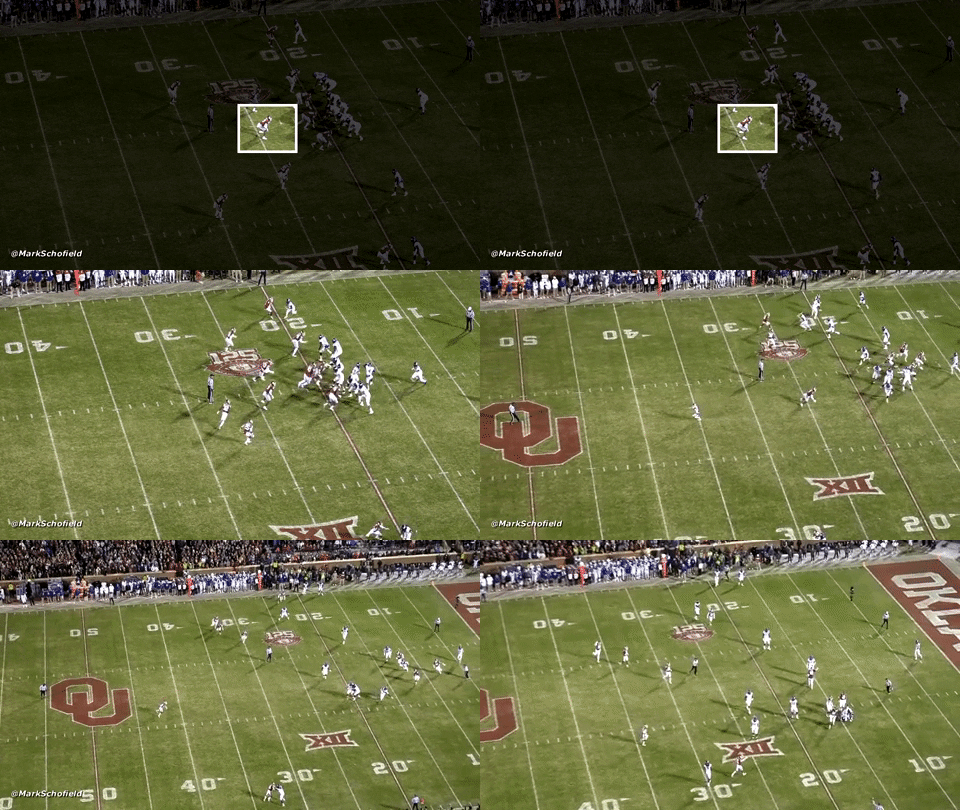
It is hard to read a screen play better than that (although there is another linebacker in this class who does this just as well. More on him in a moment).
Murray is used often as a blitzer. He can put some shots on the quarterback, and when asked to serve as a pure pass rusher off the edge his speed and athleticism puts him on solid footing against most offensive tackles.
Weaknesses: Scheme fit is going to be a huge question with him. Oklahoma let him play downhill as much as possible, often using him as a blitzer in passing situations. So his ability to play in coverage is a bit of a question mark. He is a bit slower to recognize threats to his zone than others in this class. He does not always get to his landmark when spot dropping. He is slower to get to underneath zones when recovering after play-action fakes. He wants to be playing in attack mode towards the line of scrimmage, rather than working back away from the football in coverage. There is certainly a plus to what he brings to the table, but he might not be for everyone. In their draft guide Pro Football Focus wrote of Murray that his “…success at the next level is going to rely heavily on usage. He’s not Mr. Do-it-all. He’s a hunter in the middle of the field who will limit YAC and make plays in the opposing backfield.” If used that way, he can flourish. If not, well…
Conclusion: Look, there is always a way to utilize someone who is a heat-seeking missile on the defensive side of the football. If implemented as a strong-side linebacker with the freedom to flow downhill as much as possible and just make plays, he can be an impact player at the next level. Think of Jamie Collins. When used properly as such a player, he was successful. But when tasked with making reads and reacting, rather than just playing, he struggled. The NFL can always find a home for aggressive, explosive linebackers, but he might not be the player you rely on to run with receivers or operate underneath in complex zone schemes. At least, not immediately as a rookie.
Comparison: Having just mentioned him, we can roll with Collins. The former New England Patriot is at his best when attacking the pocket and flowing towards the football. Dropping into coverage and making plays in underneath zones was not him at his best.
37. Troy Dye, LB, Oregon

Height: 6’4″ Weight: 224
40-Yard Dash: N/A
Bench Press: N/A
Vertical Jump: N/A
Broad Jump: N/A
3-Cone Drill: N/A
20-Yard Shuttle: N/A
60-Yard Shuttle: N/A
Bio: Troy Dye was a three-star safety recruit coming out of Norco High School in Norco, California. Only a handful of schools expressed interest in him, mostly Pac-12 schools like Colorado and Washington State. He decided to enroll early with Oregon in January 2016, and has been a force on the Ducks’ defense ever since. He has played over 700 defensive snaps in all four of his seasons in Oregon, notching 386 career tackles during his time on campus.
Stat to Know: Dye was a stud, plain and simple, in 2018. He played 926 snaps, a career-high, and tallied 92 total tackles.
Strengths: During each draft cycle there are players that you watch on tape, and at a point you know just who they are as a prospect. But yet you keep watching, because the experience of studying them and seeing what they can do is too enjoyable to end. That was my experience with Dye. His experience comes through on every single play. He is always patient and focused, and does not over-react to misdirection plays, play-action designs, or really anything. He led off his season by staying patient on a misdirection design from Auburn, stacking and shedding a pulling guard in space, and making a tackle on a misdirection jet sweep.
His entire season was like that.
Some might point to what he does against the run – at his size – and find problems. But I am of a different mindset. I think Dye can handle the run defense responsibilities just as well as any other linebacker in this group. He is solid with his run fits. He is strong enough to play lead blockers/pullers/trappers to a stalemate in the hole and then scrape off them at the right time to make the tackle. Dye has a great feel for navigating traffic at the line of scrimmage against the run, getting to the ball carrier and making tackles at or near the line of scrimmage.
I mean, are we really concerned about what he can do against the run when he makes plays like this:
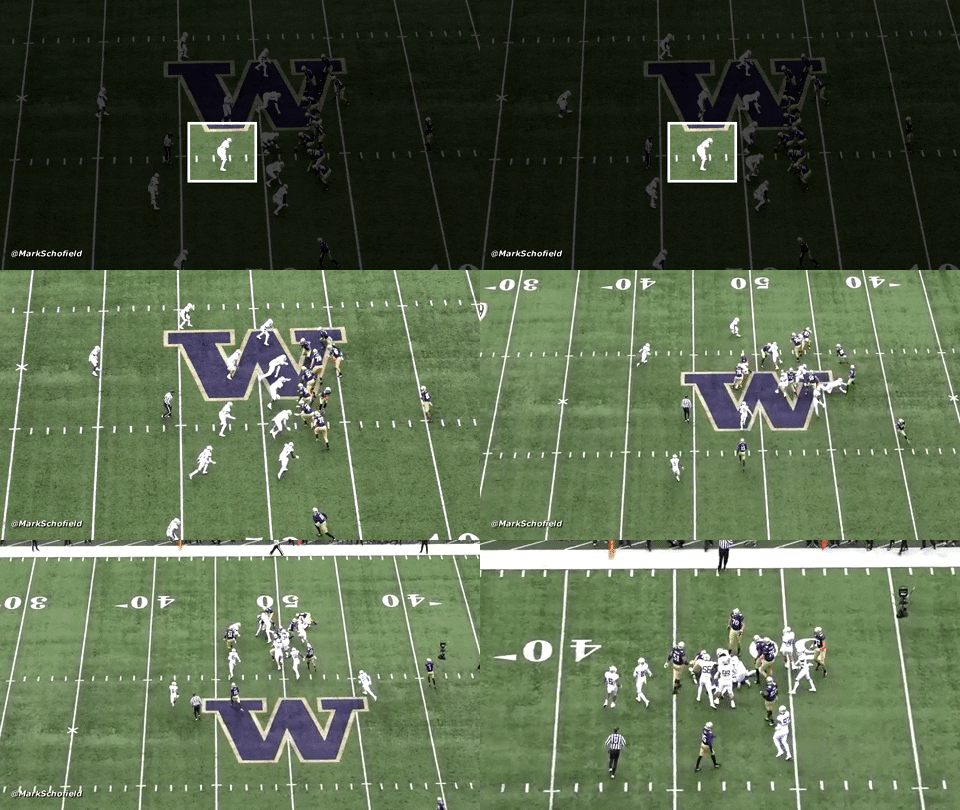
As I wrote in my notes, “[a]re we really worried about him against the run when he can evade, seek and destroy like this working down the line of scrimmage?” He evades a pair of blockers and still gets to the football, stopping this for a minimal gain from the backside.
Dye does some of his best work in the coverage game. Again, his level of experience helps him a great deal in this aspect of the position. He has good feel for zone coverage situations, always peeling off at the right time and not getting baited by routes in front of his face when he knows there is likely something a bit deeper that is more of a threat. He had a great play against Hunter Bryant at the catch point, breaking back to help on a crossing route and raking up through the pocket like a cornerback taught by Matt Patricia. (You can watch Patricia’s clinic presentation on defense for a deeper understanding of this point). He gets jams on defenders if they come through his zone, and reads route concepts extremely well. Dye also has the athleticism to run with most routes and with most receivers and tight ends he is tasked with covering.
When tasked with blitzing, he does so without any care for his physical well-being. He will take on blockers and run through them, he will throw himself at the quarterback if he has to, but he is going to disrupt the pocket.
Weaknesses: Again, others view what he does against the run as a liability, but I am higher on him in that part of the game. He could be a better tackler in space, he gave up a touchdown on a speed option play against Washington when he missed the tackle on the running back. Simmons and others might have more athleticism, but he makes up for a lack of burst and explosiveness with how he reads and reacts to plays as they unfold.
Conclusion: Again, my thoughts on the future of the position were laid out at the start. With where offenses are trending, I value athleticism at the position more than how people traditionally view the linebacker position, and the rankings reflect that. That being said, Dye was one of the true joys I have had this draft cycle, studying him on film and seeing what he can do. He is a modern NFL linebacker, built for today’s game. But he also has the heart of an old school LB inside him, with the ability to seek and destroy against the run. I will gladly bang the table for him and think that today’s crop of defensive coordinators will do the same. He can be a three-down linebacker who handles what matters most in the modern game – defending the pass – extremely well.
Comparison: Given that I am high on him, the comparison is going to be to a solid player. But I see some Jaylon Smith in Dye. The athletic profile matches, and I believe that Dye has that three-down potential at the next level, including the ability to play down near the line of scrimmage.
36. Ross Blacklock, DI, TCU

Height: 6’3″ Weight: 290
40-Yard Dash: 4.9 seconds
Bench Press: N/A
Vertical Jump: 29 inches
Broad Jump: 8 feet 11 inches
3-Cone Drill: 7.77 seconds
20-Yard Shuttle: 4.67 seconds
60-Yard Shuttle: N/A
Bio: Given his upbringing, it is a surprise that Ross Blacklock is finding his way on the gridiron, and not the hardcourt. His father Jimmy Blacklock was a basketball player for first the University of Texas and then the Harlem Globetrotters, and he now coaches the legendary basketball team. But the younger Blacklock chose a path on the football field, and was a four-star recruit coming out of Elkins High School in Texas.
Blacklock chose TCU over schools like Alabama and Texas A&M, and despite some injury struggles (he missed the entire 2018 season) he still has two solid years of production and film to put on his resume. Last year was his best on campus, as he notched three sacks, 24 quarterback hurries and 20 run stops.
Stat to Know: Of his 40 total tackles last season, an impressive nine of those were for a loss.
Strengths: At the outset Blacklock is an important reminder that as evaluators, it is imperative to “scout the traits not the scheme.” In TCU’s defensive system, the defensive linemen are tasked with a lot of stunts, slants and twists up front. TCU head coach Gary Patterson gave a tremendous presentation on his defense back in 2015, and if you read through that clinic you will see just how big the emphasis on slanting up front was in that system. Which means that a lot of Blacklock’s production was due to this aggressive, one-gap penetration scheme. Meaning what he can do on his own, or in a different system, is a bit of a projection.
But to fit in such a defense, you need to be athletic. Blacklock checks those boxes well for an interior offensive lineman. He displays solid lateral quickness and has a tremendous first step, as you might expect given Patterson’s philosophy. He can get upfield and penetrate against any run design, including zone blocking schemes. His lateral quickness allows him to string such plays out and force the running back to cut in the backfield, and it also allows him to be a pass rushing force when stunting or twisting.
He is also not afraid to do the dirty work of an interior offensive lineman. While some of the players in this class hate getting double-teamed, Blacklock thrives in those moments. Perhaps one of my favorite plays of any player in this group is this play against Oklahoma State:
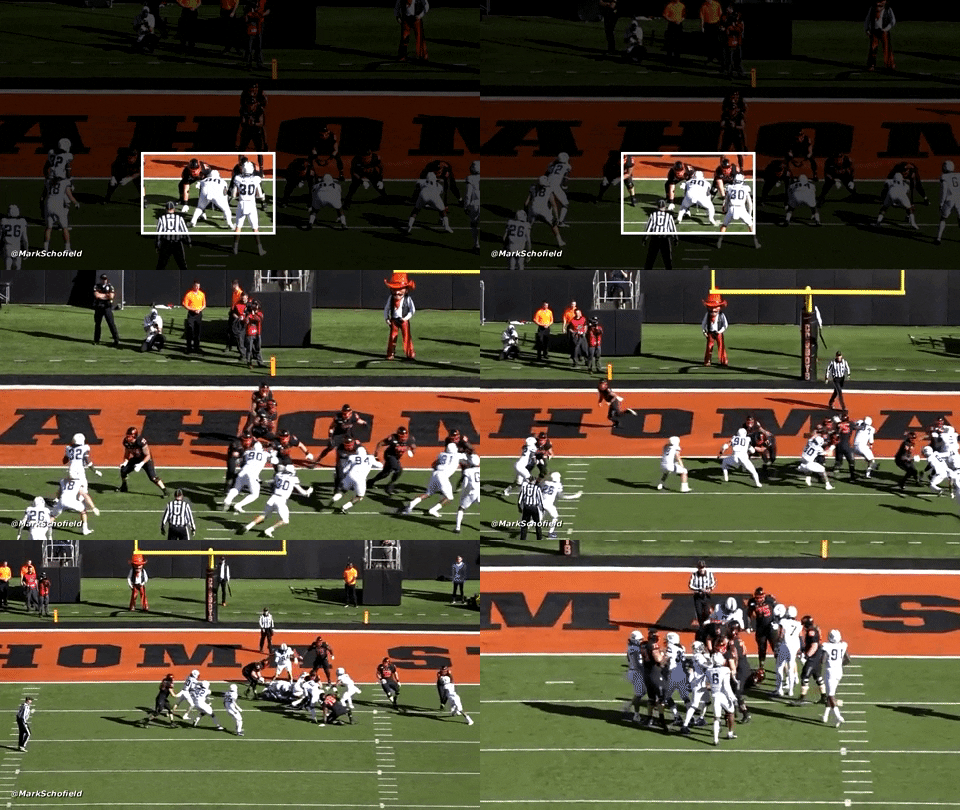
Blacklock sees the outside zone scheme headed to his right. Seeing this, he engages the right guard and then tries to reach the center with his big right arm, grabbing at the center’s right shoulder to try and prevent him from getting to the next level. While doing so, he manages to beat the guard and get to the ball-carrier to stop this play at the line of scrimmage.
Weaknesses: Returning to the scheme for a moment, Blacklock might not be for every system. While not to many defenses these days rely heavily on two-gap defenders, he is best suited as a one-gap penetrator given his experience and quickness up front. Since his game is quickness, there are times when he struggles to anchor at the point of attack or against double-teams. Additionally, he relies on quickness and burst – as well as scheme – to generate pressure. He will need to develop an array of pass rushing moves as he transitions to the NFL.
Conclusion: His athleticism and quick first step make him very enticing. Disruption on the interior is not something you can get every play, but Blacklock brings that potential to an NFL team. His effort and motor will endear him to his defensive line coach, and his willingness, or even his desire, to attract double-teams will endear him to the linebackers flowing to the football from behind him. The scheme fit piece will be a big component, but in the right environment he can be a disruptive force for a defensive front.
Comparison: Michael Kist from Bleeding Green Nation and Bleeding Green Radio told me that he saw a lot of Timmy Jernigan in Blacklock, and that is a comparison I cannot get out of my head. The quick step, the ability to swallow doubles on the inside, and the potential all make sense.
35. Ashtyn Davis, S, Cal

Height: 6’1″ Weight: 202
40-Yard Dash: N/A
Bench Press: 14 reps
Vertical Jump: N/A
Broad Jump: N/A
3-Cone Drill: N/A
20-Yard Shuttle: N/A
60-Yard Shuttle: N/A
Bio: A small-school, small-time prospect at Santa Cruz High School in Santa Cruz, California, Davis had no football offers and had to walk on to the Cal track team, at which point he overwhelmed the Bears’ football staff with entreaties to be part of the team. He got on as a redshirt in 2015, and turned himself into a full-time starter by the 2018 and 2019 seasons. In four seasons on the field, Davis put up 171 tackles, 2.5 sacks, three forced fumbles, 19 passes defensed, and seven interceptions.
Davis also became one of the better readers of quarterbacks in the NCAA, and he easily broke down this interception of Oregon’s Justin Herbert when asked about it at the scouting combine.
“Yeah, so we were in pattern match Cover-3, and I didn’t get an outside stem or anything so I knew kind of where he was running. I knew I had a post safety, followed him to my safety and undercut the route. It worked out. I actually train with him down in Proactive [Sports at the Marke] and I bug him about that every day.”

Stat to Know: You want Davis on that wall when it comes to single-high safety coverage, but as much as he was effective in his 409 snaps at free safety, he also had 120 snaps in the box, and 112 in the slot.
Strengths: Natural single-high and two-high safety who patrols the deep third with speed and transitional movement. Backpedal and hip turn check out. As a slot defender, has the quick turn and change-of-direction skills to hang with quicker receivers through different route concepts. Can scream into the box pre-snap with good body control. Closes to the ballcarrier quickly with the right mentality to limit big plays that originate outside his area. Has the raw ball skills and frame to create contested catches and force incompletions.
Weaknesses: Davis’ relative lack of experience shows up at times when his recognition skills falter, and his speed compounds the problem because he’s so quick to get where he’s going, and it’s not always the right place. Hits run fits with little in the way of GPS. Loses his way against play-action and misdirection. At times, he’s too tentative as he waits to diagnose. Will find himself a gap off in diagnosis too often.
Conclusion: There are NFL teams with defenses in various states of disarray solely because they don’t have a legitimate deep safety who can patrol the field and reduce the potential for big plays. Not everyone can acquire and develop an Earl Thomas or Anthony Harris, but the potential for such a player is also the potential to take one’s defense from the scrapheap to near the top. And in that narrow window, Davis should get a lot of first-round interest. He’s still learning, but his interception against Herbert detailed above puts him as a natural fit in a league where man and match concepts are becoming the order of the day.
NFL Comparison: Darnell Savage. When I watched Savage, the Maryland alum who the Packers selected with the 21st pick in the 2019 draft, I saw a similar player to what I now see in Davis in that Savage mixed an ascending skill set with a kamikaze playing style that needed a bit of seasoning before he was always going to be in the right place. But Savage’s potential was obvious, and so is Davis’. I compared Savage to Bob Sanders, and Davis has some elements of Sanders’ excellent play, as well.
34. Trevon Diggs, CB, Alabama

Height: 6’1″ Weight: 205
40-Yard Dash: N/A
Bench Press: N/A
Vertical Jump: N/A
Broad Jump: N/A
3-Cone Drill: N/A
20-Yard Shuttle: N/A
60-Yard Shuttle: N/A
Bio: The younger brother of former Vikings and current Bills receiver Stefon Diggs, Trevon Diggs logged time as a receiver, defensive back, and returner in high school. After he chose the Crimson Tide, Diggs caught 11 passes for 88 yards and a touchdown in his freshman year of 2016 before committing fully to cornerback. Diggs was scheduled to become a full-time starter in 2018, and did start six games before a foot injury shut him down. Diggs came back well in 2019 with 37 tackles, three interceptions, and 11 passes defensed.
“He’s like my dad, honestly,” Diggs said of his brother, when asked at the combine what he’s learned from him. “He was there for me when my father passed, so he has always taken care of me. I always ask him everything, no matter what. Two o’clock in the morning, I’m asking him questions. I called him last night, every day, about this process and how he managed it.”
The elder Diggs also told his brother to focus on the bad plays, so they don’t happen again.
“He always critiques me. We don’t always talk about the good things. We talk about the bad things, the things we can do to get better. He always gives me tips and little cues to work on my game. I’m blessed to have that. I don’t have someone patting me on the back all the time and telling me I’m doing good. I’ve got someone who’s telling me, ‘Let’s get to work.’”
Stat to Know: Diggs’ man coverage rate dropped from 80% in 2018 to 47% in 2019. His opponent passer rating allowed also dropped — from 85.8 to 44.5.
Strengths: Big, long-legged cornerback with a massive wingspan. Aggressive press defender who forces receivers to redirect. Can run upfield in bail coverage, and can trail receivers with inside release up the boundary. Stays in his receiver’s hip pocket for the most part with good straight-line speed and hand-checking. Switched from a zone-heavy diet to more of a balanced system (including match coverage) in 2019 with good results. Boxes out the receiver and has the ball skills to make quarterbacks pay. Smart enough to wait in the weeds and bait quarterbacks. Receiver background shows up in his route awareness. Though press is his primary coverage, he’s quick and adept enough to maintain contact through the route in off coverage.
Weaknesses: Movement skills are average, as one might expect from a bigger cornerback. Vulnerable to quick angles in the short and intermediate game. Needs to maintain lockdown mentality through the entire route — can be suckered throughout by double moves and late movement and leverage. Could struggle in the NFL against receivers who know how to exploit his rudimentary ability to flip his hips. More a runner than a transition player.
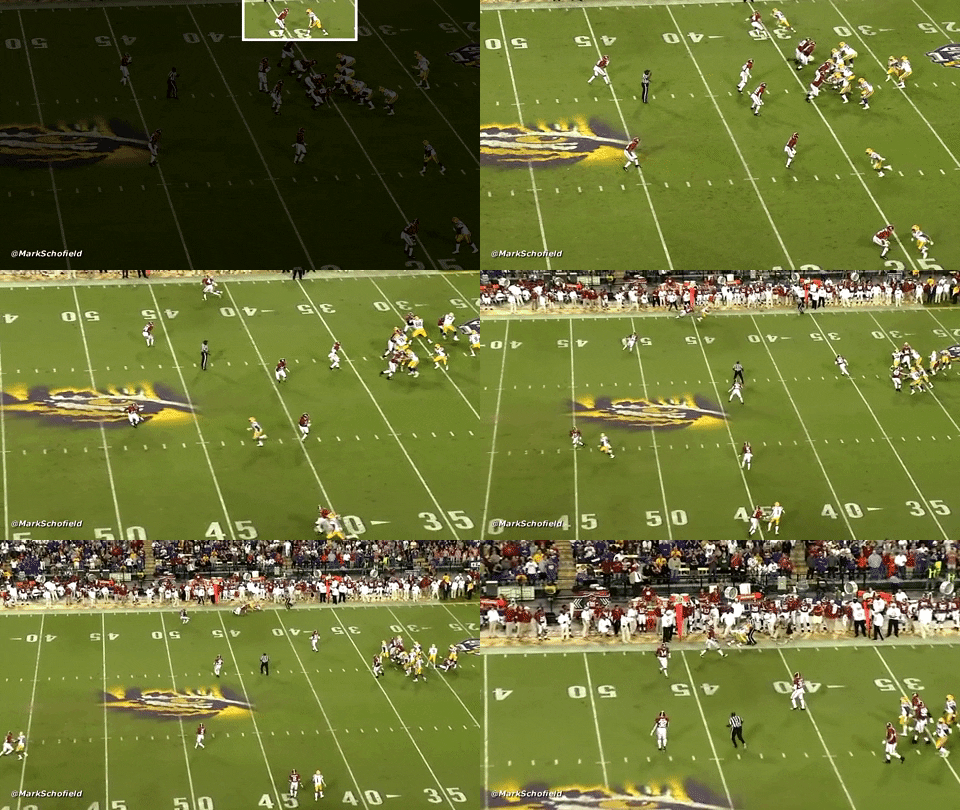
This adjustment to Ja’Marr Chase in the 2019 Alabama-LSU game was not ideal. This is the kind of stuff Diggs needs to watch out for. Chase makes huckleberries out of most of the cornerbacks he faces, but Diggs will see more of this at the NFL level.

Conclusion: Last season, per Sports Info Solutions, Diggs allowed just 15 catches on 50 targets for 266 yards, one touchdown, three interceptions and an opponent passer rating of just 16.3. That means opposing quarterbacks would have been twice as efficient throwing the ball into the stands on every snap. No matter which statistical service you subscribe to, Diggs sets himself up as a great eraser cornerback in any system in which his aggressiveness and route awareness are featured.
NFL Comparison: Richard Sherman. When Sherman came into the NFL as a fifth-round pick of the Seahawks in 2011, he had a few rough moments early on. But over time, Sherman used his insane competitive demeanor, on-field intelligence, and physical attributes to become a true old-school lockdown cornerback. Diggs absolutely has all the tools to become that type of player. Whether you see Sherman, or Aqib Talib, or Jalen Ramsey when you watch Diggs, that’s pretty much the prototype.
33. Jordan Jefferson, WR, LSU

Height: 6’1″ Weight: 202
40-Yard Dash: 4.43 seconds
Bench Press: N/A
Vertical Jump: 37.5 inches
Broad Jump: 10 feet 6 inches
3-Cone Drill: N/A
20-Yard Shuttle: N/A
60-Yard Shuttle: N/A
Bio: A three-star recruit coming out of Destrehan High School in Destrehan, Louisiana where he was a two-way player for their football team, Justin Jefferson followed his older brothers to LSU. He was used sparingly in 2017 as a true freshman, but earned a starting wide receiver spot as a sophomore in 2018. That season he played nearly 700 offensive snaps – the bulk of them as an outside receiver – and caught 54 passes for 875 yards and six touchdowns in an offensive that relied heavily on the rushing attack.
Last year the Tigers reinvented their passing game under the direction of passing game coordinator Joe Brady, and Jefferson shifted into the slot for the high-flying LSU offense. He caught 111 passes on on 134 targets for a massive 1,540 yards and 18 touchdowns, averaging 13.9 yards per reception.
Jefferson built on the solid production for the Tigers with a stellar performance at the Combine, which has many analysts considering him a first-round lock.
Stat to Know: LSU quarterbacks had a passer rating of 121.4 when targeting Jefferson in 2018, the season he played 553 of his 697 snaps along the boundary. We will return to that in a minute.
Strengths: Truthfully, Jefferson should have been in the first-round discussion even before his performance in Indianapolis. This past season LSU used him on a ton of routes working across the middle, and Jefferson is fearless attacking that area of the field. He willingly puts himself into harm’s way but does not let that impact how he goes and gets the football between the hashmarks. He is deadly working over the middle against zone coverage, and has demonstrated a consistent ability to find the soft spots in zone schemes and make himself available for his quarterback. This would make him almost a perfect fit in an offense like Minnesota’s, where so much of their passing game is built off of outside zone play-action plays where the quarterback rolls out.
Jefferson also has supreme confidence in his hands, and almost every reception — regardless of where he is on the field — is made with his hands fully extended from his frame. It is rare to see him let the football into his chest. He is also a master of contested catch situations. According to charting data from Pro Football Focus, Jefferson owned the best contested catch conversion rate of any receiver in this draft class.
Jefferson also is adept at working in scramble drill situations. Sure, it helped to have a quarterback like Joe Burrow who excelled in that area, but he shows great awareness of space, maintains a solid relationship with his QB and keeps working until the whistle to give his quarterback a downfield option in those moments.
Not that blocking is a huge part of playing the wide receiver position, but as a blocker Jefferson wants to punch you in the mouth until the whistle blows. He plays with a chip on his shoulder when asked to block, and some of my favorite reps of his come when he is blocking downfield.
Weaknesses: Many list of weaknesses regarding Jefferson begin with the idea that he is simply a slot receiver and when considering using a first-round selection on him, there is better value to be had in the draft. Of his 937 snaps in 2019, a staggering 870 of those came from the slot. PFF charted him with just five snaps on the outside. As a result, most of his production this season – his huge breakout year – came when he was working from the slot, against off coverage, and with a “two-way go” in space.
But let’s return to that “Stat to Know” for a second. Back in 2018, when LSU was more of a run-first offense and Jefferson played the majority of his snaps outside, passers had a QB rating of 121.4 when targeting him when he aligned to the boundary. When you watch film of him from 2018 – and expect this to be the subject of a much deeper analysis – you see him doing the things you want from an outside WR.
Like selling the cornerback on the vertical route before snapping inside on a Bang 8 post route from an outside alignment, plus some yardage after the catch in traffic:
Or running a textbook stop route against press alignment:
If your concerns about Jefferson are of the “he is a slot receiver only” variety, then if you look at his 2018 film you will see examples of him doing what you want boundary receivers to do, with production numbers to back up his tape.
If there are areas he could clean up, he tends to get knocked off routes at times due to contact, and he might need to add some size to his frame. That could slow him down a bit, making his speed and change-of-direction ability less of an advantage.
Conclusion: Jefferson has two seasons of solid production and tape where he was used in completely different roles. That should work in his favor, but instead many seem willing to view him as purely a slot receiver. Again, he has shown the ability to operate along the boundary and as such, teams should view him as a versatile receiver who can fill multiple spots in a passing game. Sure, he can operate from the slot and has he displayed in 2019, be very effective. But if put along the outside as a Z receiver, Jefferson can also beat press coverage and create separation on his own, without relying on scheme or design. Consider this: Great teams like the New England Patriots often ask the right question when it comes to evaluating pro or college prospects. That question is “What can he do?” Other teams tend to dwell on the negative, and wonder “What can’t he do?” Teams that take the more negative approach with Jefferson and isolate him as purely a slot receiver, are going to regret passing on him.
Comparison: Watching Jefferson I see a lot of JuJu Smith-Schuster. A player who might begin his career inside and may ultimately be best used as a slot receiver, but someone with the skillset to play on the boundary as well.
32. D’Andre Swift, RB, Georgia

Height: 5’8″ Weight: 212
40-Yard Dash: 4.48
Bench Press: N/A
Vertical Jump: 35.5
Broad Jump: 121.0
3-Cone Drill: N/A
20-Yard Shuttle: N/A
60-Yard Shuttle: N/A
Bio: Swift had to wait for Sony Michel and Nick Chubb to get out of town before he could be a starter, but he still made an impact as a freshman with 618 rushing yards and three rushing touchdowns on just 81 carries. He saw his workload increase over each of the next two seasons, and Swift capped out with 1,218 rushing yards and seven touchdowns on 196 carries. He averaged 6.6 yards per carry in his collegiate career, adding 76 receptions for 666 yards and five touchdowns from 2017-2019.
Stat to Know: Swift never saw the field for more than 500 snaps in a season for the Bulldogs, but he made the most of his opportunities. He averaged 6.6 yards per carry in his collegiate career, 31% of his carries produced first downs, and he dropped just three catchable passes in 76 targets.
Strengths: One-cut runner with sudden, churning feet he uses to respond to open gaps along the line. Excellent vision and acceleration. Responds quickly to what he sees, but also has the patience to wait for things to happen. Good on draws and delays because of that patience. Bounces off tackles well and has an array of moves to make himself more elusive — his spin move against Auburn was a nice surprise. Not afraid of contact at all — he’ll dip his shoulder into a defender. Above-average receiver on everything from quick pitches and screens to intermediate stuff up the seam. Could excel in the slot at the next level. Ran a very diverse scheme at Georgia with equal parts inside and outside zone, as well as gap. Not an obviously great blocker, but has the mentality to become one.
Weaknesses: Swift isn’t a natural “plus” tackle-breaker — while he runs in rhythm well, you would like to see more plays in which he transcends the efforts of great defenses to pick up more yards. Really needs open gaps to rack up big gains. Doesn’t have a third gear he can use to blast away from everyone — his running style is more smooth and rhythmic than explosive and violent. Ran against a heavy box on 21% of his carries in 2019, which is not the ideal recipe for him.
Conclusion: Swift is one of the most pro-ready running backs in this class because he’s been asked to do everything in a three-down sense at a high level, and he’s responded very well. This isn’t the guy you want if you’re looking for a back to move defenses, but he’ll give you maximum performance in every kind of run, in the passing game, and as a blocker on the rise. A natural fit for any pass-heavy team.
NFL Comparison: Giovani Bernard. One doesn’t want to put a Darren Sproles comparison on Swift just yet, but he has that potential if he works with more power and expands his role in the passing game. Like Bernard, the North Carolina alum selected by the Bengals in the second round of the 2013 draft, he can be a great complementary force despite obvious size concerns.
31. K’Lavon Chaisson, EDGE, LSU

Height: 6’3″ Weight: 254
40-Yard Dash: N/A
Bench Press: N/A
Vertical Jump: N/A
Broad Jump: N/A
3-Cone Drill: N/A
20-Yard Shuttle: N/A
60-Yard Shuttle:N/A
Bio: Chaisson slipped in and out of football in high school, but was offered a scholarship from LSU at a recruiting camp, and after considering offers from Alabama and other schools, that was that. He had starred for North Shore High in Houston when he did play, and the Tigers were clearly intrigued by his athleticism. A two-year starter at LSU, Chaisson earned multiple on-field and off-field awards (he’s put his name on the SEC Academic Honor Roll three times). On the field, things really came together for him in 2019, when he racked up 60 tackles, 6.5 sacks, and 13.5 tackles for loss. He was also a team captain, and was awarded the jersey number 18, which is given to the LSU player who “does all the right things.”
“It’s obvious,” Chaisson said at the scouting combine, when asked what separated him from every other edge-rusher in this draft class. “I’m going to be honest. I’m actually the most valuable player in the draft, when it comes to it. We all know that. When you hire someone do you want to hire someone who speaks one language, or do you want to hire someone that speaks three languages? I speak three languages. I do pass rush. I can drop in coverage and cover anybody you want me to cover. I can play the run. And no offensive lineman has ever just moved me off the ball or bullied me. So, I feel like that’s what makes me more dimensional. And a more valuable player than anybody else in the draft.”
Well… Georgia’s Andrew Thomas might disagree with the “no offensive lineman has ever just moved me off the ball or bullied me” part, but Chaisson does have a lot of value as a pass-rusher. He just needs to be more conversant in those languages.
Stat to Know: Chaisson had four or more pressures in each of his last four college games, but his overall production (51 total pressures over three seasons, and 35 pressures in 370 pass-rushing snaps in 2019) carries a bit of “buyer beware” with it.
Strengths: Shoots off the snap with speed and authority. When he latches on to tackles, Chaisson has a surprising and impressive bull-rush he enhances with long-arm moves. Can win consistently when he throws the first punch. Weird slap move to get free could be developed into an excellent rip technique. Has the 360-degree athleticism to chase to the sidelines and in space, with nascent coverage potential.
Weaknesses: Faces disadvantages in power situations as detailed by the Andrew Thomas clips above. Had the same basic issues against Alabama’s line — can get one-armed and buried against stronger, bigger tackles. If his swats or pushes don’t work, Chaisson doesn’t have any other moves to speak of — another reason he can be easily negated. Needs to be an off-ball player or edge-rusher — doesn’t bring a lot aligned inside.
Conclusion: Chaisson is one of the more intriguing, yet frustrating, evaluations in this class. There are times when he puts it all together and looks like one of the top three edge defenders in this class, but there are far too many instances at this point where he just gets bulldozed by blockers, and it’s not just against the better NCAA tackles. I’ve seen him get shoveled by average tight ends, and the overall rawness of his game makes me struggle when trying to give him a first-round grade. It’s the rare college pass-rusher who’s developed enough to allay any issues with his future development, but in Chaisson’s case, there’s a long way to go.
NFL Comparison: Danielle Hunter. Like Chaisson, Hunter came out of LSU with stupid-good athleticism, and almost nothing resembling a pass-rush plan. Over time, and used to his own benefit in a Vikings defensive front in which he could use his speed to the quarterback as he expanded everything else, Hunter become one of the NFL’s best pass-rushers. Chaisson has the same level of raw ability, and a similar developmental curve. It will be crucial to that development that he’s not asked to do too much, too soon.
30. Josh Jones, OT, Houston

Height: 6’5″ Weight: 319
40-Yard Dash: 5.27 seconds
Bench Press: 24 reps
Vertical Jump: 28.5 inches
Broad Jump: 109 inches
3-Cone Drill: N/A
20-Yard Shuttle: N/A
60-Yard Shuttle: N/A
Bio: A basketball and football star at George Bush High School
in Richmond, Texas, Jones first committed to Oklahoma State before switching to Houston over the offers of Nebraska and Missouri. He excelled for the Cougars in 2017 and 2018, but took things to a different level in terms of performance in 2019, and now is seen as a legitimate first-round talent.
“Those corners and linebackers, they see a 300-pound man running at them, they gotta make decisions,” Jones said at the combine about his play mentality. “Get out of the way, duck, whatever they gotta do. But that just opens up lanes and pathways for running backs and receivers.”
Stat to Know: Per Sports Info Solutions, Jones didn’t have a single blown block in the passing game in 2019. Houston’s running backs, who averaged 5.3 yards per carry in zone schemes and 4.9 yards per carry in gap schemes, averaged 6.7 yards per carry, and 3.3 yards per carry before contact, when running to his gap.
Strengths: Athletic technician with most of the assets you’d want in a tackle in a high-rep passing game with zone running concepts. Natural mover on sweeps and pulls; this could be an plus at the NFL level right away. Kick-step is a work in progress, but when he is smooth with it, and buries an edge-rusher to the middle of the pocket, that’s the kind of progress you want to see. Works easily to the second level in movement and hitting his targets. Showed marked improvement over the 2019 season.
Weaknesses: Has the natural athleticism to take seamless kick-steps, but has a tendency to get wide-legged against quicker edge-rushers to adapt to that speed. Needs to work on both core strength and latching through the snap as a drive-blocker. Aggressive with his hands, but needs more of a plan with it.
Conclusion: Jones is still a work in progress in many areas, but the growth he showed in the 2019 season is highly encouraging. If your NFL team is pass-first and you need a guy who can block that over and over, and show top-level athleticism in all areas, give Jones to your offensive line coach for a season, and you might just be rewarded with Pro Bowl potential.
NFL Comparison: Andre Dillard. Like the former Washington State standout, who was selected 23rd overall by the Eagles in the 2019 draft, Jones has some refinements to make, but presents as an ideal linchpin from an athletic and developmental standpoint. Power and core strength might be issues in the short term.
29. Grant Delpit, S, LSU

Height: 6’2″ Weight: 213
40-Yard Dash: N/A
Bench Press: N/A
Vertical Jump: N/A
Broad Jump: N/A
3-Cone Drill: N/A
20-Yard Shuttle: N/A
60-Yard Shuttle: N/A
Bio: Delpit, a New Orleans native, saw his family uprooted and relocated to Texas in the wake of Hurricane Katrina. He was a five-foot-6, 130-pound defensive back as a freshman, but he wound up at the prestigious IMG Academy in Bradenton, Florida as a senior, and earned Under Armour All-American status. Delpit had chosen LSU before his IMG track. Delpit won the Thorpe Award as the nation’s top defensive back in 2019, and over three seasons with the Tigers, he totaled 199 tackles, 17.5 tackles for loss, seven sacks, two forced fumbles, 32 passes defensed, and eight interceptions.
One of the more versatile defenders in this draft class, Delpit played 385 snaps at free safety, 316 snaps in the slot and 149 snaps in the box last season, per Pro Football Focus. In 2019, he allowed 14 receptions on 22 targets for an opponent passer rating of 71.1.
“See, that’s what I pride myself on,” he said at the scouting combine. “I think I’m a very versatile player. I think that’s probably my biggest strength on the defensive side. I’ll play anywhere in the secondary. This year I played more free safety because that’s what the team needed, so I played a lot of percent of my snaps in the middle of the field. We went 15-0, so I could never complain. But watch my sophomore tape, freshman tape, I played all over the box. So, I think I can do it all.”
Stat to Know: Delpit is versatile, but there’s one thing he’s going to have to clean up. He had 20 missed tackles last season, and 44 over three seasons at LSU.
Strengths: Outstanding range to all parts of the field — Delpit can roam from the deep third to the box pre-snap with control and coverage sense. Legitimate full-field defender who moves easily from the middle of the field to the seam to the boundary. Defensive shot-caller who understands routes well enough to break with definitive speed to the receiver late in the down. As a slot defender, can play high and off against inside receivers with good closing speed and awareness. Backpedal and hip-flip are ideal for a deep safety. A bit gangly, but keeps his body under control (except for the whole tackling thing). Has legitimate man/match/mirror abilities against receivers even when he’s not pressing them through the route. Has the ball skills to trap anything near him.
Weaknesses: While Delpit’s tackling issues are obvious, they don’t spring from a constant unwillingness to face up to a ballcarrier. On the contrary, Delpit incorporates a weird combination of frenetic motion and a shot-play mentality that has him hurtling his body at opponents with a rudimentary understanding of wrap tackling. He also has an odd inclination to throw his body at a ballcarrier’s feet, and his arm tackles wouldn’t bust a grape. One hopes this can be corrected by the right NFL coaching staff. Delpit’s physical nature trails off when he’s asked to take on blockers; at that point, he’s looking to get around an opponent as opposed to taking him on.
Conclusion: Of all the players I’ve watched in this draft class, Delpit may have the widest range between his assets and his liabilities — outside of Boise State offensive tackle Ezra Cleveland in his pass-blocking (great) vs. his run-blocking (eek). There is absolutely no question about his abilities to play as a space defender, whether it’s against a slot guy up the seam, or taking care of business against a deep post. The problem is, there are certain elements of his play style that are so anarchic and hard to control, and these types of players tend to get exposed even more when they hit the NFL — and the NFL hits back. Delpit could be a top defensive in the league over time, but he’ll require a patient coaching staff that will work with the weird parts and understand that he may allow a big play for every one he prevents for a while.
NFL Comparison: Kenny Vaccaro. Like the Texas alum, who was selected 15th overall in the 2013 draft, Delpit presents total positional versatility in coverage, but the frenetic on-field demeanor is going to cause a few blips. Delpit is quicker than Vaccaro, which makes the need for consistency and body control even more glaring.
28. Kristian Fulton, CB, LSU

Height: 6’0″ Weight: 197
40-Yard Dash: 4.46 seconds
Bench Press: N/A
Vertical Jump: 35.5 inches
Broad Jump: 123.0 inches
3-Cone Drill: 6.94 seconds
20-Yard Shuttle: 4.36 seconds
60-Yard Shuttle: N/A
Bio: Fulton was the top-ranked high-school player in the state of Louisiana as a senior, and the third-ranked cornerback in the entire country. Alabama was his ideal landing spot, but Nick Saban didn’t present an offer until two weeks before his signing day, and by that time, Fulton had already narrowed his choices, and decided to stay in-state. He was suspended for the entire 2017 season after he was caught using somebody else’s urine in a drug test, but still managed to carve out a starting role in 2018 and 2019 after backing up Tre’Davious White and Donte Jackson in 2016. In his collegiate career, Fulton amassed 65 tackles, two tackles for loss, one forced fumble, 25 passes defensed, and two interceptions. Not only did he go up against the best the SEC had to offer, he also had nightmare fuel every day in practice from LSU’s impossible cadre of receivers.
“You can look and tell me who’s put up numbers on me,” Fulton said at the scouting combine. “I feel like that’s what really separates me. I mean, like you said, it’s a great cornerback class, but I don’t feel like nobody’s technique is as sound as mine. And I just get the job done every Saturday I feel like.”
Fulton also attributed his calm in coverage to the guys he has to deal with on his own team.
“I say practice. With the guys we go up against everyday, Ja’Marr (Chase), you got Justin (Jefferson), you got Terrace (Marshall), Racey (McMath), those guys, they put you in a tough situation every day. You got to come to work every day, so I feel like that I take everything I learned during the week and just bring it to Saturdays.”
Stat to Know: Against passes of 20 or more air yards in which he was the primary target last season, Fulton allowed just five receptions and one touchdown on 18 targets.
Strengths: Fulton is patient when in press alignment with both his hands and his feet. He waits for the receiver to declare and then works his hands into their frame with his jam. When he misses, Fulton has the presence of mind not to panic, but to recover and fight to the catch point. This play against Alabama is a perfect example of that trait:
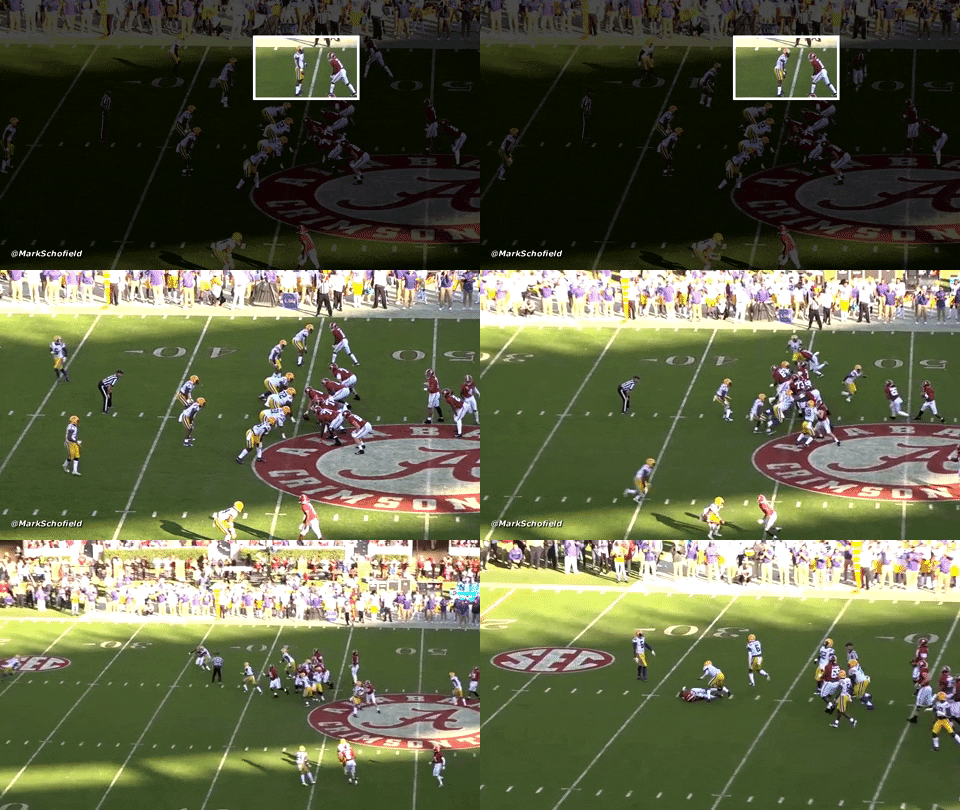
The receiver gets inside of Fulton’s initial jam attempt, and appears to get separation on this route. (Alabama is running a run/pass option here, and the route being run is technically as a “break to daylight” route. For more on Alabama’s RPO schemes you can watch this great breakdown of them from their offensive coordinator Steve Sarkisian). But Fulton does not panic. He recovers well, breaks up the throw and prevents the completion.
Oh, and the route was being run by Henry Ruggs III, the fastest receiver in the draft and a surefire first-round selection.
Fulton also shows on film the ability to win at the catch point, as we saw on this play. Over his past two seasons he broke up 20 passes, a very impressive number. He is a sticky man coverage cornerback, and that ability translates easily to the NFL. His press coverage skills are more technically sound than others in this class. Where Jaylon Johnson might rely on brute force at the line, Fulton relies on his technique.
Weaknesses: Fulton’s suspension is not a recent red flag, but something to keep in mind. Fulton changes directions well on film and his 6.94 three-cone time is a decent mark, but there were moments on film when he got tripped up on breaks and needed to recover in a hurry. On the first play against Alabama, for example, he got crossed up with his feet and fell to the turf. Twice. Fulton also is fast, as the 4.46 40-yard dash illustrates, but some receivers are going to be faster than him. There are times when you can see receivers extending their separation from him as routes get into the deeper areas of the field. Quarterbacks with time, vision and arm strength (think Patrick Mahomes) will have opportunities against him downfield.
Conclusion: Here’s the thing: You do not become a top-flight cornerback in the SEC, going up against the kind of talent Fulton saw week in and week out, without having skills that translate to the next level. Fulton’s press technique, recovery skills and ability at the catch point are must-haves for the position. He might give up a big play here and there, but all cornerbacks do. For the vast majority of plays, Fulton is everything you want in your CB.
Comparison: New Denver Bronco A.J. Bouye is a valid comparison. When he was coming out of UCF, Bouye ran a 4.55 at his Pro Day, so the long-speed was a concern. But he made up for that with technique and his press coverage abilities, traits that he carries to the field now in the NFL.
27. Justin Madubuike, DL, Texas A&M

Height: 6’5″ Weight: 326
40-Yard Dash: 5.16 seconds
Bench Press: 28 reps
Vertical Jump: 27 inches
Broad Jump: 9 feet
3-Cone Drill: 8.22 seconds
20-Yard Shuttle: 4.79 seconds
60-Yard Shuttle: N/A
Bio: Justin Madubuike was another top-flight recruit coming out of high school, ranked as a four-star player as a defensive lineman for McKinney North High School in Texas. With offers in hand from Alabama, Auburn and Baylor, among others, he chose to play for the Aggies at Texas A&M. Madubuike was a multi-sport athlete at McKinney North, starring as a defensive lineman (16.5 sacks as a senior) but also contributing on the hardwood and in track-and-field.
He took to the field as a redshirt freshman in 2017, and increased his role for the 2018 campaign. That redshirt sophomore season was probably his best statistically, as he notched eight sacks and 11 quarterback hits. His numbers dropped a bit last season, but he also played fewer snaps and had more tackles in the run game than he did in 2018.
Stat to Know: Madubuike had seven pressure in his game against Mississippi, which highlights his ability to take a game over when he gets going.
Strengths: Turn on his game against Clemson and you will see him making an impact very early. On the first play from scrimmage Madubuike uses a push-pull into a rip combination move to pressure Trevor Lawrence and flush the Clemson passer from the pocket. (Of course, Lawrence still manages to complete the throw, as he is wont to do). Madubuike can be a force as a pass rusher, with good burst and a nearly-full compliment of pass rushing moves. His ability to string pass rushing moves together is perhaps the best in this class, as he demonstrates here from that outing against Ole Miss:
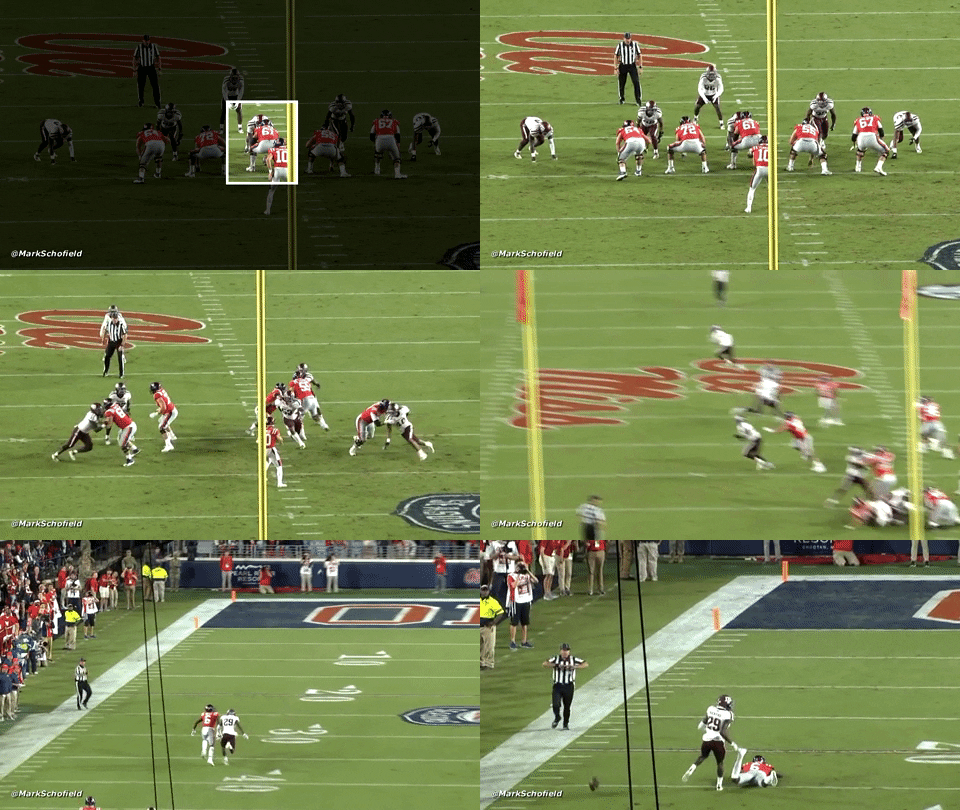
Madubuike uses a two-armed hand swipe to beat the center’s initial punch, then immediately transitions to a rip move to knife past the attempted counter from the blocker. From there he bursts into the chest of the quarterback, preventing him from stepping into this throw and perhaps completing a long TD throw. Texas A&M often used him as the sole down lineman in their “Radar” alignment, with every other defender in a two-point stance flowing freely until just before the snap. Think of how the New England Patriots employed Trey Flowers at times during the 2018 campaign.
Against the run he shows violent power at the point of attack, with the ability to long-arm trap blockers and fight the half man, enabling him to make some plays behind the line of scrimmage. He has powerful hands at the strike point against singles or doubles, and is able to maintain his balance when knocked from the side, allowing him to stay effective in a variety of scenarios.
Weaknesses: While his hands are powerful, he could be quicker to engage them after the snap. At times whether against the pass or the run the offensive lineman “fires first,” giving them the advantage at the outset. He is an average athlete for the position, good enough to be effective against a variety of designs but he will not blow you away with how he can contribute sideline-to-sideline. There are also moments where he seems to disappear on film, and might lack the effort and motor that both Javon Kinlaw and Derrick Brown showed during 2019.
Conclusion: Even with some of those weaknesses and inconsistent moments, he provides his NFL team with an array of moves and game-changing ability on the inside. On nights like the one he had against Ole Miss, you’re watching a pure force on the defensive of the football. Maybe you will not get that for each game of a 16-game slate, but you’ll take it every chance you get.
Comparison: Over at NFL.com Lance Zierlein equated Madubuike to Davon Godchaux, and it is hard to find a better comparison for the Oklahoma defender.
26. A.J. Epenesa, EDGE, Iowa

Height: 6’5″ Weight: 275
40-Yard Dash: 5.04 seconds
Bench Press: 17 reps
Vertical Jump: 32.5 inches
Broad Jump: 117.0 inches
3-Cone Drill: 7.34 seconds
20-Yard Shuttle: 4.46 seconds
60-Yard Shuttle: N/A
Bio: Epenesa was the top-ranked defensive end recruit coming out of high school and chose Iowa over a host of interested schools. Though he was a starter for just one season with the Hawkeyes, he saw action as a true freshman, amassing 5.5 tackles for loss and 4.5 sacks. Overall in three seasons, Epenesa totaled 101 tackles, 36 tackles for loss, and 26.5 sacks while lining up all over the formation.
“I guess D-line play really has all the same basics and fundamentals and it’s just kind of sticking to the fundamentals and football is always football,” Epenesa said at the combine about playing different positions along the defensive line. “But there’s different techniques and everything, so I’m just looking for someone to kind of teach me that way. Someone to show me the ropes just to get me started and get my feet running and I can take it from there and learn on my own. I never played in the inside with significant reps, just in pass rush situations, but I feel like the more reps I get, the better I can be.”
Stat to Know: Last season, Epenesa played just 92 snaps inside the tackles, and 669 outside. He managed 11.5 sacks, 14 quarterback hits, and 31 quarterback hurries in 450 pass-rushing snaps.
Strengths: Moves to the tackle with a head of steam and nasty intentions, using his hands to prevent latches from blockers and consistently disengage. Impressively stubborn when it comes to losing strength battles; Epenesa seems to take that as a personal affront. Uses excellent footwork to feint tackles out of a solid base. Natural grappler who enjoys contact and knows how to generate power with his hands and upper body. Has the diagnostic ability to shake loose from blocks and move to the run game.
Weaknesses: Epenesa isn’t really inherently quick in any aspect of his game — he accelerates off the snap as opposed to exploding off it, he gets to the pocket with awareness as opposed to velocity, and he needs a plan against mobile quarterbacks as they’re bailing the pocket, or he’ll get left behind.
Conclusion: While I like Epenesa as a power-based end with some similarities to Frank Clark, I think his power, nastiness, and ability to dislodge from contact make him a natural fit as an inside/outside hybrid rusher. Epenesa doesn’t explode off the tape as you might expect from a top edge-rusher, but given the extent to which multi-gap defenders are valued in today’s NFL, teams might find him more valuable than those who are sitting around waiting for highlights.
NFL Comparison: Trey Flowers. When Flowers played with the Patriots and turned himself into the type of defender who could earn a five-year, $90 million contract from the Lions, he did so by becoming an equal force on either side of the tackles. Epenesa will be highly-regarded by coaches and defensive coordinators who value positional flexibility and workable tools over raw athletic gifts.
25. Zack Moss, RB, Utah

Height: 5’9″ Weight: 223
40-Yard Dash: 4.65
Bench Press: 19
Vertical Jump: 33.0
Broad Jump: N/A
3-Cone Drill: N/A
20-Yard Shuttle: 4.37
60-Yard Shuttle: N/A
Bio: A cousin of former NFL players Santana and Sinorice Moss, Zack Moss originally planned to follow in their footsteps at the University of Miami but then decided to make his own way at Utah, where he would have the opportunity to start as a true freshman. He got 84 carries and two rushing touchdowns for 342 yards in 2016, ramping that up to 1,173 yards and 10 touchdowns on 214 carries as a sophomore. Moss had three straight seasons of more than 1,000 rushing yards and at least 10 touchdowns despite injuries that limited him to just nine games in 2018. Moss is leaving Utah for the NFL following his finest collegiate season — 1,416 yards and 15 rushing touchdowns on 235 attempts, and 388 yards and two more touchdowns on 28 receptions.
RELATED: The next Marshawn Lynch? Watching tape with Zack Moss
“Unfinished business came from what I wanted to do with the team,” Moss recently told me regarding his decision to return for his senior season. “We lost our last two games that year [the Pac-12 Championship against Washington, and the Holiday Bowl], I got injured, and our quarterback [Tyler Huntley] went down, too. We felt that we were a very talented group, and we showed that this last year. We came up short in the Pac-12 Championship game again this last year [losing to Oregon], but that’s pretty much where the whole ‘unfinished business’ thing came from.”
There isn’t much Moss left on the table after his four years with the Utes.
Stat to Know: If you’re going to tackle Moss, you’d better do it with perfect form, and you should probably bring friends. Last season, he forced 89 missed tackles and gained 1,042 yards after contact on just 235 rushing attempts.
Strengths: Moss presents a level of power, attitude and short-level agility that is unrivaled in this class. Solo tacklers work at a very low success rate. Seems to be empowered by first contact. He combines contact balance and quick cuts in space to be a very dangerous individual in the open field — he had 21 carries of 15 or more yards last season. Has a spin move at the line of scrimmage he’s used to take defensive linemen right out of the play. Diagnoses defensive fronts on the fly and is outstanding at moving multiple gaps for the open hole. Improved as a receiver for the 2019 season, and broke 33 tackles on 66 catches in his career. Anytime you have a 50% broken tackle rate, you’re on the right track. Has the ability to right himself on the fly and bash into more defenders for more yards. Falls forward and into contact. Total red zone weapon.
Weaknesses: Concerns about Moss’ second- and third-level speed are a bit exaggerated, but it’s true that he won’t run right past a safety most of the time. Of course, that safety has to tackle him at some point. His running style could lead to injury issues down the road, but that hasn’t been a major issue so far.
Conclusion: Some might look at Moss as a one-dimensional power back based solely on the ways he’s able to make collegiate defenders look like sixth-grade kids, but there’s more to his game than that. He’s both sudden and patient at the line of scrimmage, has several different strategies to extend his plays, and has the potential to be an every-down back.
NFL Comparison: Marshawn Lynch. It’s a lofty comparison, but Moss meets it with his combination of violence and elusiveness. Plug him into your offense and watch defenders get just a bit more nervous.
24. Justin Herbert, QB, Oregon

Height: 6’6″ Weight: 236
40-Yard Dash: 4.68 seconds
Bench Press: N/A
Vertical Jump: 35.5 inches
Broad Jump: 10 feet, 3 inches
3-Cone Drill: 7.06 seconds
20-Yard Shuttle: 4.46 seconds
60-Yard Shuttle: N/A
Bio: It was no surprise when Justin Herbert committed to the University of Oregon in October 2015. Herbert was a three-star recruit coming out of Sheldon High School in Oregon and a varsity athlete in football, basketball and baseball. He turned down offers from Montana State, Nevada and Portland State to enroll at the school he grew up rooting for as a kid.
Herbert became the starting quarterback early in his college career, posting eight starts as a true freshman. His sophomore campaign put him on the map, when he completed 67.5% of his passes for 1,983 yards and 15 touchdowns, with just five interceptions. However, whether due to a coaching change or other reasons, Herbert never truly matched what he did as a sophomore, although he did produce solid numbers last year, completing 66.8% of his throws for 3,471 yards and 32 touchdowns, against just six interceptions. But on yards per attempt, for example, Herbert never quite matched the 9.6 mark he posted as a sophomore. Furthermore, Oregon had a chance to put itself in the national championship picture last year, but the Ducks suffered losses against Auburn (early) and Arizona State (late), and the QB did not fare well in those contests.
Stat to Know: Something to keep in mind with Herbert is this: Despite his size and massive hands (they measured 10 inches at the combine), Herbert has 26 career fumbles in 43 starts.
Strengths: The first thing that catches your eye with Herbert is his arm strength. He has very easy velocity and can make eye-popping throws to all levels of the field. An area where Herbert truly stands out is his ability to read and attack the leverage of the nearest defenders almost anywhere on the field. Take, for example, this read and throw against Cal during the 2018 campaign:
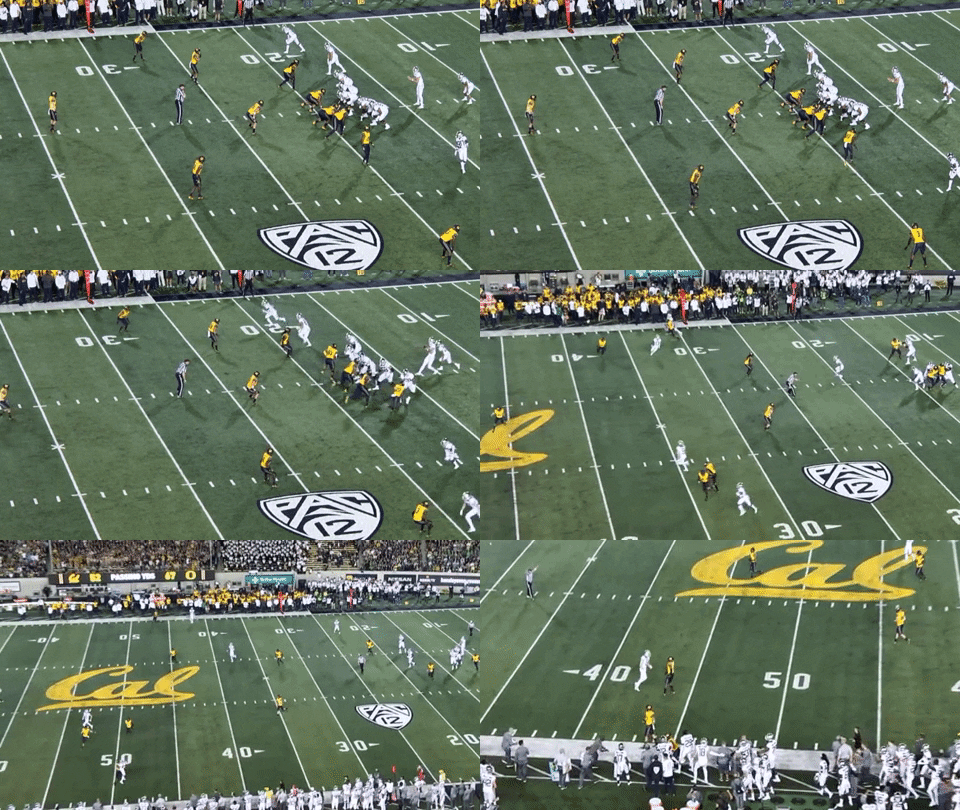
The Ducks have twins to the left and run a switch vertical concept, with the inside receiver running a vertical route along the boundary while the outside receiver works inside and then up the seam. Herbert sees the man coverage and sees that the defenders do not switch their responsibilities in coverage, meaning the inside defender has to work toward the outside to cover the boundary vertical route. Seeing this, Herbert throws this ball to the outside, almost making a back-shoulder throw 40 yards downfield.
Impressive.
Herbert is also athletic enough to be a true weapon in the running game. He might not be Kyler Murray, but he is able to keep defenses honest, particularly on the edge on zone-read designs.
The offense he was operating at Oregon, however, did not do him or his evaluation any favors. The bulk of his throws were made to the outside or near the line of scrimmage, and the Ducks used a lot of tunnel or bubble screens. He was not asked to read the middle of the field much, and when he did, it was more of an adventure than NFL teams might like. That is why his experience at the Senior Bowl, in Zac Taylor’s offense, was huge for him. During that week of practice, he showed more of an ability to attack the middle of the field and manipulate defenders with his eyes.
Weaknesses: Did he peak his sophomore year? It sounds like a harsh question, but NFL scouts are going to wonder why he did not continue to grow after what he showed in 2017. Now, development is not exactly linear — especially at the quarterback position — and coaching changes might have played a part.
Herbert also struggled on those occasions when he was able to attack the middle of the field. It seemed at times as if he was unable to figure out how to layer or feather throws in that area of the field, when he needed to drop the ball behind linebackers and in front of safeties. That is an acquired taste for quarterbacks, and Josh Allen is a recent example of a quarterback who might have lacked that ability in college but who is learning it on the fly in the NFL.
Finally, Herbert faces some criticism about how he fared in Oregon’s big games. Many point to the loss at Arizona State as an example of Herbert coming up short. But even in that game you see glimpses of what he can be in the NFL — but what he could also be if things go poorly. He threw interceptions in that game where it seemed like he was doing his best Shane Falco imitation, falling prey to quicksand.
But he also put this drive together (turn volume up for video breakdown):
Conclusion: Despite the weaknesses and Herbert’s offensive system, there is a talented quarterback inside who is waiting to be unlocked by consistent coaching and development. His arm strength and ability to attack leverage with well-placed throws to all areas of the field will be his calling card early in the league, as will his athleticism. If placed into a spread-based offense that looks to attack downfield off play-action, but also incorporates some West Coast elements for him, he would be in a spot to succeed. Some offensive systems, however, such as New England’s, would require more of a developmental curve.
Comparison: The team that drafts Herbert hopes to get someone in line with Ryan Tannehill, which is likely the top end of his spectrum. That team probably fears that he is more in line with his potential NFL floor, which looks more like Blaine Gabbert.
23. Terrell Lewis, EDGE, Alabama

Height: 6’5″ Weight: 262
40-Yard Dash: N/A
Bench Press: N/A
Vertical Jump: 37.0 inches
Broad Jump: 124.0 inches
3-Cone Drill: N/A
20-Yard Shuttle: N/A
60-Yard Shuttle: N/A
Bio: A top recruit in the Washington, D.C. area, Lewis took a path taken by a lot of top recruits to the Crimson Tide. He had eight pressures in 34 pass-rushing snaps as a true freshman in 2016 in a defense that has generally proved impossible for true freshmen to crack. Building on that in 2017 was tough due to an arm injury that caused him to miss 10 games, but he still amassed 10 total pressures on just 84 pass-rushing snaps. Lewis then missed the entire 2018 season with a torn ACL and was only able to flash his true potential in his final collegiate season of 2019, when he put up all kinds of pressure.
“To basically cherish everything,” Lewis said at the combine, about what he learned through all the injuries. “Cherish everything that you’re going through. Going through things like that, it kind of takes your focus away from the game, to the point where you cherish other aspects in life. Cherish your faith, cherish your family time when you get it. And also just as far as the game, you learn so much from a different perspective as far as being able to watch things from a coaches perspective.
“My coaches did a good job of still keeping me in the game and around my teammates, to the point where I don’t lose my football IQ. And I can see things from their eyes and watch film with them, and see what they see and sit with them. So then by the time I come back playing football, I know what to expect. I can see things. I’m basically like a coach on the field. Like, I’ll see a motion happen and I’m like, okay, I know what’s coming. I see the situation. They really teach you how to watch film and watch football from a distance.”
Stat to Know: Finally healthy in 2019, Lewis had six sacks, seven quarterback hits, and 35 quarterback hurries in just 259 pass-rushing snaps. His pressure rate of 19.8% ranked third among edge rushers with 100 or more pass-rushing opportunities.
Strengths: Long-limbed movement end who stalks the quarterback with an intriguing mix of short-area quickness and the ability to eat a ton of turf in a big hurry. Explodes off the snap at times, and when he does, it’s very hard for blockers to catch up. Incredibly bendy for a guy his size — can work under blockers and through the hoop at the end of the pocket very well. Has the athleticism and backpedal ability to work short and intermediate as a flat defender. Stabs with his long arms to create spatial advantages he can exploit with quickness to either side. Has an inside counter with plus potential.
Weaknesses: Wins with speed and quickness more than power — saw himself rag-dolled at times by more powerful offensive tackles. Works too high off the snap at times and can be erased if he’s not careful with his pad level. Loses balance battles. Needs the benefit of an NFL weight room. Probably won’t ever present a bull-rush, or any other pure strength moves. Must add to his technique palette to win against more advanced tackles. Some off-ball potential, but he’s probably a one-gap guy.
Conclusion: Given the time he’s missed, Lewis brings a lot of nuance to his game. When he talks about watching film and thinking like a coach, it shows up. Factor that in to the ways in which he showed dominant traits in 2019, and it’s easy to project him as a first-round talent. The injury history is the great unknown, and will likely drop him down boards, but he’s worth the risk.
NFL Comparison: Chandler Jones. One could compare Lewis to any number of “Basketball player as edge-rusher” body types, but he resembles Jones in his quickness to the quarterback, wingspan and movement, and relative lack of power. Durability concerns are obvious, but when he’s healthy, Lewis is an ideal chase-and-catch weakside end.
22. Jeff Gladney, CB, TCU

Height: 5’10” Weight: 191
40-Yard Dash: 4.48 seconds
Bench Press: 17 reps
Vertical Jump: 37.5 inches
Broad Jump: 124.0 inches
3-Cone Drill: 7.26 seconds
20-Yard Shuttle: N/A
60-Yard Shuttle: N/A
Bio: A three-star recruit out of New Boston High School in Texas, Gladney got offers from TCU and Arkansas, and chose the Horned Frogs. The high school star in football, basketball, and track, who doubled up at receiver and cornerback back then, became the stalwart at left cornerback in Gary Patterson’s advanced schemes. In four seasons, he amassed 146 tackles, six tackles for loss, 1.5 sacks, 43 passes defensed, and five interceptions. As Dane Brugler of The Athletic pointed out, Gladney had more passes defenses than starts (42), and he and Amik Robertson of Louisiana Tech are the only FBS cornerbacks with at least 15 passes defensed in each of the last two seasons.
“Very physical,” Gladney said at the scouting combine of his play style. “I go 110 the whole game. I don’t play like most corners. I like to stick my nose in everything. I’m just not a cover corner. I like to hit, too. I feel like I’m the biggest sleeper. They talk about my size a lot, but everyone knows I’m a speed demon and physical.”
Stat to Know: Over the past two seasons, per Pro Football Focus, Gladney has forced tight coverage on 79.5% of his targets 10-plus yards downfield, which is the sixth-best rate in the nation and nearly 20 percentage points above the FBS average. On 46 contested targets over that time, Gladney allowed 10 catches and forced 27 incompletions.
Strengths: Gladney works through the first and second stems of routs with impressive matching footwork. Route anticipation is obvious. Has the body control to make easy catches difficult for receivers, and this is where a lot of his contested-catch success originates. Receivers find it very hard to out-leverage him in the first parts of routes — he’ll hang and stack with them all day. Sticky from the snap to the seam or boundary. Uses his hands well to track targets through the route. Not the biggest guys, but an aggressive tackler who brings the right mentality to blitz packages.
Weaknesses: Gladney is a bit slow in his transitional steps when he needs to up his backpedal speed and flip his hips. This leads to his tendency to give a bit too much cushion on some quicker angular routes. He also gets a lost at times when receivers break late — he seems to be so fixated on his landmarks, it’s tough for him to adjust. Needs his footwork to be on point, because he’s not going to beat anyone in press coverage. Will lose battles to bigger, more practiced receivers. Needs to track the ball in flight instead of playing the receiver as much as he does.
Conclusion: In 2018, I wrote a three-part series about the importance of match coverage in the NFL today, and when you play match, you need defensive backs with the route awareness, foot speed, and intelligent aggressiveness to mirror receivers through their routes and shut down the kind of plays some defenses make far too easy with passive coverage. Whether you’re talking about match or man coverage, NFL teams specializing in those concepts should see Gladney as an appealing addition. He brings all the athletic and competitive attributes to coverage concepts that become more crucial in the pros every season.
NFL Comparison: Byron Murphy. When I wrote Murphy up last year, it was clear to me that the Washington alum, selected by the Cardinals with the 33rd overall pick, was an ideal press cornerback who needed to be with his receiver through the route, and would work well in any environment where he was asked to play a lot of man and match coverage. If you were to superimpose Murphy’s 2018 tape with Gladney’s 2019 tape, the similarities would be illuminating.
21. Yetur Gross-Matos, EDGE, Penn State

Height: 6’5″ Weight: 266
40-Yard Dash: N/A
Bench Press: 20 reps
Vertical Jump: 34.0 inches
Broad Jump: 120.0 inches
3-Cone Drill: N/A
20-Yard Shuttle: N/A
60-Yard Shuttle: N/A
Bio: A basketball, track, and football guy in high school, Gross-Matos chose Penn State over Alabama, Clemson, Virginia and Virginia Tech, and Tennessee among others and amassed 11 tackles, 36.5 tackles for loss, and 18.5 sacks through three seasons (the last two as a primary participant).
Gross-Matos has withstood multiple family tragedies in his young life. Michael Gross, his biological father, died at age 29 after he and 2-year old Yetur fell off a boat into the Chesapeake Bay in May, 2000. Yetur was saved by his grandfather, but Yetur’s father drowned. Chelal, Yetur’s older brother died at age 12 in June, 2009 after he was struck by lightning at a Little League baseball field. Yetur added the name of his stepfather, Rob Matos, after his mother Sakinah remarried and Rob adopted Yetur and his siblings.
“They just asked me about what’s the hardest thing I ever went through,” Gross-Matos said at the combine, when asked what NFL teams were trying to bring out of him. “Obviously for me, that was losing my older brother at a young age. And my dad. Just dealing with that. I want to do something better for my family and my mother and that’s kind of how I approached it. That’s the reality of it.
“My mother, Sakinah, she’s a phenomenal, phenomenal woman. And she sacrificed a lot. She lost a lot. And she just keeps positive. She’s the most positive person I know. I’ve got endless love for my mother. She’s the best woman I know.
“My adopted father, I don’t call him my stepdad. He’s just my dad because he’s been a father to me my whole life. Obviously, it sucks not knowing your biological father, but I’ve always had a father as far as I can remember. So, he’s treated me just like his son and I’m eternally grateful for him.”
Stat to Know: In 2019, Gross-Matos lined up 19 snaps in the A-gap, 60 in the B-gap, 19 over the tackle, and 469 outside the tackle. He had 38 total pressures in just 330 pass-rushing snaps.
Strengths: Smooth mover with impressive power from the first step through the snap. Has the capacity to rag-doll blockers out of the way. When he keeps his pad level low, can spring with strength to force blockers off their plan. Length/speed combination gives him an inherent advantage when closing the pocket. Easily and readily works into the interior post-snap to provide inside pressure. Inside move with a rip can be highly effective against tackles. Asjusts well to run plays on the fly, and has a good sense of pocket space to make plays behind the line of scrimmage. Diagnoses well to the ball in mush-rush situations. Looks comfortable along the defensive line — not a one-gap player at the next level.
Weaknesses: Like a lot of collegiate defensive linemen, Gross-Matos hasn’t yet developed his hand movement and technique to the point where it’s an asset. Spends too much time wrestling when he should be attacking. Can be taken out by blocks to his side — smoothness can also fall into a lack of urgency at times.
Conclusion: Defensive linemen with Gross-Matos’ ability to move along the line and win in a “positionless” fashion are more desirable than ever. There’s a lot to like about his game, and if he’s able to become more sudden, he could be a multi-front weapon for a long time at the NFL level. He’d look great as a 3-4 end back when teams had 3-4 ends; now, he can work to either end of the offensive tackle in stalwart fashion.
NFL Comparison: Preston Smith. Like the Mississippi State alum, selected by the Redskins in the second round of the 2015 draft, Gross-Matos combines a lot of desirable natural movement and strength skills, but could use more urgency and violence in his play, especially when dealing with blockers in close hand-fighting.
20. Laviska Shenault Jr., WR, Colorado

Height: 6’1″ Weight: 227
40-Yard Dash: 4.58 seconds
Bench Press: 17 reps
Vertical Jump: N/A
Broad Jump: N/A
3-Cone Drill: N/A
20-Yard Shuttle: N/A
60-Yard Shuttle: N/A
Bio: At DeSoto High in Texas, Laviska Shenault was a do-it-all player who saw time at tight end, slot receiver, outside receiver and even at H-Back. His prowess and versatility on the gridiron had many of the top programs, such as Alabama, Oklahoma State and LSU recruiting him, but he chose to head to the Pac-12 and Colorado.
As a true freshman, Shenault saw minimal playing time but produced some big plays, catching seven passes for a stunning 168 yards, an average of 24 yards per reception. In 2018 he became a starter, and caught 87 passes for 1,019 yards and six touchdowns, despite a toe injury that sidelined him for a few games and a torn labrum in his shoulder that he played through at the end of the year. Last year his production dipped a bit, perhaps due to the attention defenses were showing him, but he still caught 56 passes for 76 yards and four touchdowns, averaging 13.6 yards per catch.
Stat to Know: If you want someone who can make defenders miss in space, Sheault is your guy. He caused 44 missed tackles over the past two seasons according to Pro Football Focus, the most in this class of receivers.
Strengths: Today’s NFL is a matchup-based game. Offensive coordinators spend hours each week coming up with ways to get their best players into favorable matchup situations and then hope they can exploit those situations once the game begins. Shenault is that type of player that can be used all over the field, and he was exactly that at Colorado. The Buffaloes aligned him at running back, at quarterback, in the slot, in the wing, on the boundary and even at tight end, and he was able to contribute from all of those spots on the field.
Shenault is also a player whose competitive toughness shows up on film. Every draft cycle there are plays that stick with you as an evaluator, those proverbial “put the pen down” moments when you feel like you do not need to see anything else, this is a guy you will go to bat for come draft time. This, for me, was one of those moments:
That is a wide receiver running over a linebacker on a short-yardage situation in a tie game. One of those “gotta have it” moments. Also think about this play in this way: On a 4th-and-1 situation, Colorado’s offensive staff thought their best call was to hand the football to Shenault on a jet sweep.
Shenault is also an explosive player in the passing game, and someone who can be a threat first with his route, and then after the catch with his explosiveness. Take this touchdown against Air Force:
Shenault knows he has off coverage to work against, and makes himself and his frame available to his quarterback on this slant route. But then he is a pinball after the catch, who makes himself small and low, bounces off the would-be tacklers and turns what should have been a six-yard gain into a touchdown thanks to his power and contact balance. This shows his ability to transition from receiver to runner in a blink of an eye.
As a pure wide receiver, Shenault has shown the ability to threaten defensive backs with his routes, with a good knack for threatening their frame as well as beating press coverage off the line of scrimmage. He can use a dead leg move at times both off the line of scrimmage as well as in his breaks, that can be effective at both beating press coverage as well as getting separation on his breaks. He is a problem for defensive backs on routes working back down the stem, such as curls, hitches and comebacks, because his ability to threaten the vertical route gets him a great deal of separation working back towards the QB when he hits the breaks and lets the DB fly right by.
Weaknesses: You have to start with the injury history when it comes to Shenault. In addition to the injuries he suffered in 2018, he endured a groin injury this year that hampered him at the Combine (perhaps leading to his slow 40-yard time) and required surgery this offseason. If the injury history is any indication, this could add up to a big red flag. In an environment when medical examinations are tough to conduct for each individual team, Sheanult could slide down boards as a result.
While some of his routes are dangerous, he could use some refinement on routes such as out patterns, digs, and other situations when he needs to break off at a 90 degree angle. He tends to drift on those, and that technique could be cleaned up. At times he shows the awareness to find grass versus zone coverage, but he could stand to improve on that as well. Shenault also shows a willingness to contribute as a blocker, but often his to-go move in that regard is a simple shoulder into the half-man, rather than squaring up and taking a player on.
Conclusion: Shenault checks a lot of boxes for the modern NFL offense, and in a system with a creative play-designer he could be an immediate impact player as a rookie. He has a proven track record of being able to stress a defense from a variety of positions, and you can envision an offense using him as part of a tempo package and getting an advantage with however the defense chooses to play. If they stay in a small package, he could be used as a big slot or even a running back against defensive backs. If the defense stays in a base package, he could line up against linebackers.
The problem becomes how he can be used outside of that. Teams might not trust him to purely line up at receiver and win consistently. There are some routes where you can trust him to do that as a rookie, but perhaps not the entire playbook. If drafted by a team with a vision for him, he could be a true boom-type player as a rookie, but in some offensive with a more traditional approach, he might fail to reach his potential. Of course, all of this is dependent on the health question, which is one we cannot answer right now.
Comparison: Mike Renner from PFF had perhaps the most creative comparison for any player in this class, when he equated Shenault with Saquon Barkley. Different positions to be sure, but you can see how Shenault’s play-style and willingness to run defenders over fits with the New York Giants’ running back. Another popular comparison for him that fits, identified by Lance Zierlein of NFL.com, is Sammy Watkins.
19. Patrick Queen, LB, LSU

Height: 6’0″ Weight: 229
40-Yard Dash: 4.5 seconds
Bench Press: 18 reps
Vertical Jump: 35 inches
Broad Jump: 10 feet 5 inches
3-Cone Drill: N/A
20-Yard Shuttle: N/A
60-Yard Shuttle: N/A
Bio: Patrick Queen was a four-star recruit coming out of Livonia High School in Livonia, Louisiana. He played both linebacker and running back, and ran for over 1,400 yards and 19 touchdowns as a senior along with 66 tackles and six passes defended. He was given offers from schools such as Indiana, Nebraska and Tulane, but chose to stay in-state and play for the Tigers.
Queen did not crack the starting lineup until three games into the 2019 season, but instantly became a core component of LSU’s defense. He notched 67 tackles this season, along with a single interception. But that interception came at a critical moment, as Queen picked off Tua Tagovailoa shortly before halftime of the huge LSU-Alabama tilt, leading to an LSU touchdown in the closing seconds of the first half.
Stat to Know: Last season, Queen played 702 snaps in the box, 41 in the slot, 25 on the defensive line, four at outside cornerback, and seven at free safety.
Strengths: Queen displays fantastic explosiveness to all levels of the field. Once he makes his read on a play he bursts like a shot out of a cannon. He flashes pure sideline-to-sideline ability and athleticism, both against the run and in coverage. Pass coverage is his strength as a linebacker. He has a good understanding of route concepts and has a great internal clock for zone coverage situations. He knows exactly when to peel off a receiver and break on the next threat. Queen gets good depth on his backpedal when tasked with dropping into a deeper zone or into a Tampa 2 intermediate hook zone.
Against the run he is more than willing to fit his gap, take on blockers and shed them at the point of attack. He can track and scrape down the line of scrimmage well, as he does on this play against the Clemson Tigers in the National Championship Game:
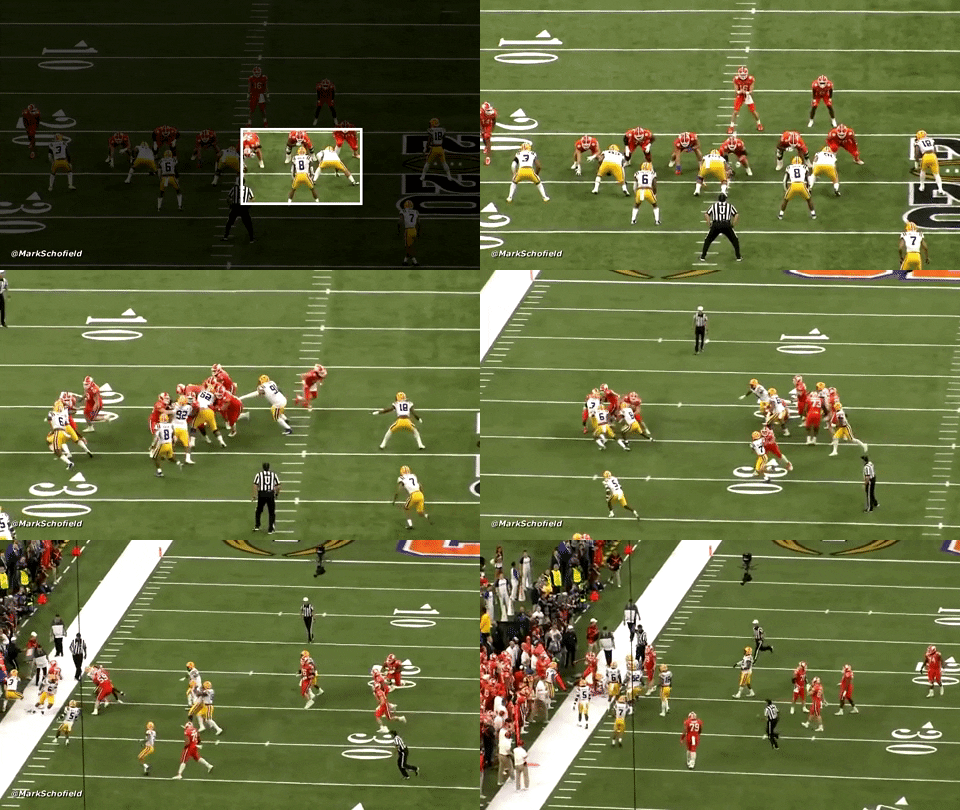
Queen slides down the line of scrimmage perfectly under control, and by filling the hole he forces the running back to try and bounce this run into the boundary. When the RB runs out of real estate, Queen closes the gap and slams into him, driving him to the turf and out of bounds for no gain.
Queen is impressive playing down in traffic. He does a good job at sifting through the bodies in front of him, finding the ball-carrier, and putting him to the turf. When tasked with blitzing or stunting he is equally adept at slicing through the traffic and getting into the pocket.
His athleticism shines in a few different ways. He was able to chase down speedy Alabama wide receiver Jaylen Waddle on a jet sweep early in LSU’s win over the Crimson Tide, but he also shows good change-of-direction ability in the open field when running with receivers or tracking ball-carriers in space. His footwork when dropping into zones is more reminiscent of a cornerback than a linebacker.
Weaknesses: Queen is built more like a safety than a linebacker, and that does cause some problems. He can get swallowed up by offensive linemen at times and struggle to disengage. He sometimes tries to load up in space and deliver a shot, and that can lead to missed tackles. In the National Championship Game he tried to bring the wood to Trevor Lawrence in the open field, dropped his eyes, and caught nothing but turf as the Clemson QB danced by him. Queen also can take some poor angles in pursuit, and while sometimes his athleticism keeps him in position to make a play, sometimes it does not.
Conclusion: Similar to Isaiah Simmons, for where the game is trending Queen seems like the perfect linebacker. A decade or so ago he would be viewed as more of a strong safety, but with the prevalence of sub packages and athletic linebackers in today’s NFL Queen is perhaps the prototype at the position. His ability in coverage, in both zone and man situations, makes him a three-down linebacker. But it is his ability against the run that will make defensive coordinators value him highly. He needs to perhaps show more awareness against play-action, but for the most part, he is as solid as it gets.
Comparison: Over at NFL.com, Lance Zierlein brought out the Thomas Davis comparison, and it is hard to come up with a better answer to this question.
18. Mekhi Becton, OT, Louisville

Height: 6’7″ Weight: 364
40-Yard Dash: 5.1 seconds
Bench Press: 23 reps
Vertical Jump: N/A
Broad Jump: N/A
3-Cone Drill: N/A
20-Yard Shuttle: N/A
60-Yard Shuttle: N/A
Bio: Becton played right and left tackle, as well as center on the basketball team, at Virginia’s Highland Springs High School. He then chose Louisville over more than 25 other schools, including Michigan, Georgia, and Oregon. Over the last three seasons, he’s learned to thrive in a pro-style offense with varied blocking schemes.
“I take a whole lot of pride in it,” Becton said at the combine of zone blocking in particular. “I love outside zone and inside zone. It’s just fun running a man out of the play taking him where I want him to go… [People] don’t expect a person like me to move that well. So I think I surprised a lot of people.
Bu does he prefer a certain scheme?
“Nah, just run behind me. It don’t really matter what we run, as long as you’re running behind me.”
Stat to Know: Becton was indeed involved in a lot of zone blocking in 2019 — the Cardinals moved up from a 42% zone rate in 2018 to 81% in 2019. Last season, running backs running behind him averaged 2.9 yards per carry before contact and 5.6 yards per carry overall.
Strengths: Becton’s size makes itself readily apparent in several positive ways — when he squares to a defender, that defender tends to disappear for a second. Can absolutely erase pass-rushers as they move through the arc or when he’s blocking in space. Has more agility than you have a right to expect for a guy his size — he’s not Joe Thomas, but he makes it work with a good fundamental kick-step through the arc. Has a finishing mentality as a run-blocker, and there are examples of almost comical strength in which he just throws defenders aside. Massive wingspan allows him to correct his mistakes on the fly. Good enough at facing up against counters where this won’t be a major issue at the next level.
Weaknesses: Becton’s ability to rely on size and power can also be an issue — there are times when he wants to just throw edge-rushers aside instead of mirroring them through the down. That could present major issues at the next level against more advanced, practiced edge-rushers. He also needs to work on finishing with his drive blocks instead of just throwing himself at defenders.
Conclusion: Becton is the ultimate distillation of Bill Parcells’ “Planet Theory” in this draft class, in that there are only so many people on the planet who are this big and can be this agile, and you’d better get that guy when he comes around. Becton is by no means a perfect prospect, and if you’re looking for the next 310-pound blindside protector, he obviously isn’t your guy. But he is also far more than just a fat guy who moves around a lot — Becton has the athletic potential to be a dominant tackle at the next level, as long as he’s willing to expand his technique beyond the advantages his body gives him.
NFL Comparison: Bryant McKinnie. The 6-foot-8, 360-pound Miami alum was selected seventh overall in the 2002 draft by the Vikings, and played at a very high level for Minnesota and Baltimore over a 12-year career. Becton profiles similarly in his combination of unusual size and traits for the left tackle position.
17. Jaylon Johnson, CB, Utah

Height: 6’0″ Weight: 193
40-Yard Dash: 4.5 seconds
Bench Press: 15 reps
Vertical Jump: 36.5 inches
Broad Jump: 124.0 inches
3-Cone Drill: 7.01 seconds
20-Yard Shuttle: 4.13 seconds
60-Yard Shuttle: N/A
Bio: For a while in high school, it was a toss-up as to whether Johnson would focus entirely on his potential as a point guard in basketball, but he decided to commit to a future in football as a highly-regarded receiver and defensive back. He originally committed to USC, backed out over a coaching change, and then chose Utah over offers from Michigan and Oklahoma. In three seasons with the Utes, Johnson totaled 102 tackles, three tackles for loss, one sack, 28 passes defensed, and seven interceptions.
“Confidence, swagger, toughness, you name it,” Johnson said, when asked the mentality required to play press-man coverage. “It’s just about having kind of that dog mentality and having that will to win and just always wanting to compete and get better and kind of just impose your will on the receiver.
“I would prefer man, just because we played more man at Utah and that’s just what I’m used to and accustomed to doing. I have no problem playing zone. I make plays in zone coverage as well, but I’m used to playing man more.”
Stat to Know: In 1,258 coverage snaps over three seasons for the Utes, Johnson allowed just three total touchdowns (two in 2018, one in 2019) and never gave up an opponent passer rating larger than 57.6 (2018).
Strengths: Johnson is another scheme-diverse cornerback, with the ability and experience to play in both zone- and man-heavy systems. But he also brings to the table some alignment diversity. Utah was not afraid to put him in the slot, and that could make him valuable in the eyes of NFL decision-makers. Johnson is also a willing player in run support, who is likely to help set the edge, stack a blocker and scrape off to help on the tackle. Johnson can be violent and explosive with his jams at the line of scrimmage. He got into Laviska Shenault on one play in Utah’s game against Colorado and barely let him release into his route. Johnson also has the quickness to recover if he gets beaten on a move. He does not panic when tasked with zone coverage, he will continue to read the quarterback’s eyes and click-and-close in an instant.
There is also this:
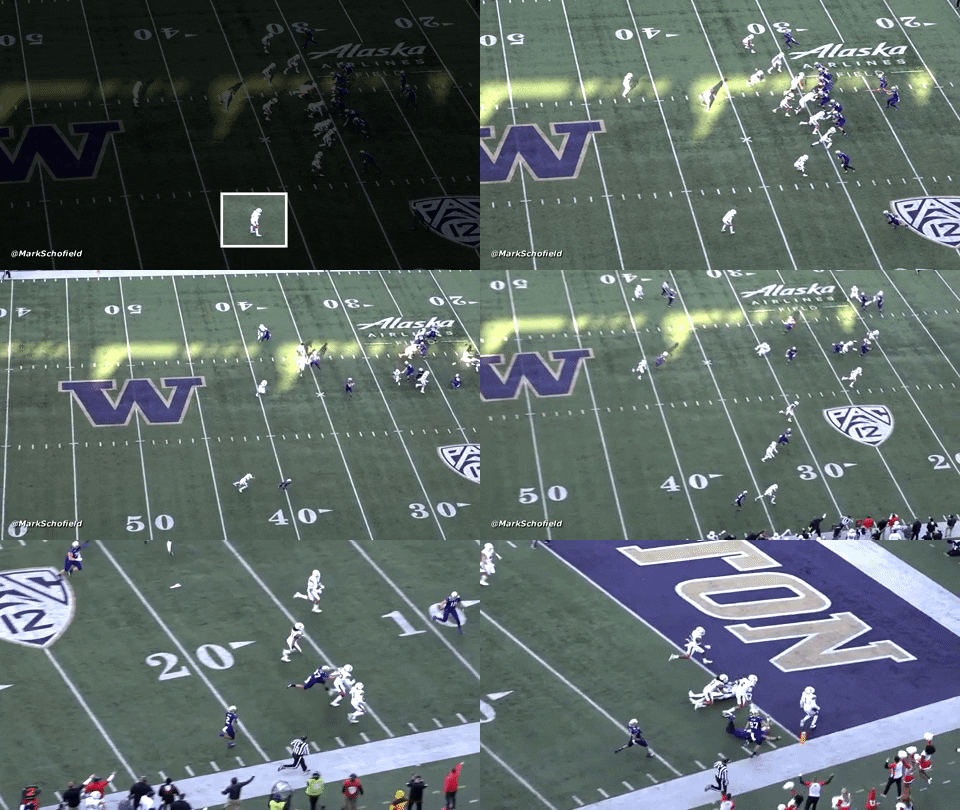
This critical pick six flashes that click-and-close ability, but consider what Johnson told Pro Football Focus after the play: “For me, this is just big film study…it was something I watched all week.” Johnson seems to be a student of the game, and his work in the film room is going to be huge for him going forward. That is something he highlighted in this very insightful discussion with Erik Turner of Cover1.net.
Weaknesses: Johnson is sometimes almost too patient, letting receivers get the better of him out of breaks and relying on his ability to close or drive on routes to make a play on the football. That will work on Saturdays, but it might not work on Sundays. While he can be violent when in press coverage as discussed, his footwork as well as his technique with his hands could use refinement. Johnson relies on brute force rather than solid technique. His hips are also a bit stiffer, and he is not as fluid a mover as the other two corners above him in this group. Something that was reflected in his slower three-cone drill.
Conclusion: Johnson might lack some of the polish and fluidity of Okudah and Henderson, but he offers pro-ready traits with even some room for improvement. His ability to play in a variety of coverage schemes is a plus, as is his experience in handling routes from the slot. Given that teams might view him as undersized (according to Mockdraftable.com his physical profile is basically middle of the pack) he could find a role in the slot, even with his change-of-direction issues. But Johnson’s work ethic off the field, his physicality at the line of scrimmage and his play-making ability are going to make him a difference-maker wherever he lines up.
Comparison: According to Mockdraftable.com, Johnson is almost a perfect match for cornerback Kendall Sheffield, who was drafted in the fourth round by the Atlanta Falcons last year out of Ohio State. In terms of his play style, Johnson reminds some of William Jackson III, the current Cincinnati Bengals’ cornerback. Like Johnson, Jackson was also known for his ability to click-and-close on a route breaking in front of him.
16. Tristan Wirfs, OT, Iowa

Height: 6’5″ Weight: 320
40-Yard Dash: 4.85
Bench Press: 24 reps
Vertical Jump: 36.5 inches
Broad Jump: 121 inches
3-Cone Drill: 7.65 seconds
20-Yard Shuttle: 4.68 seconds
60-Yard Shuttle: N/A
Bio: Iowa’s Class 2A Offensive Lineman of the Year at Mount Vernon High School, Wirfs was the fourth Iowa male athlete ever to win consecutive shot put and discus titles, and he was the first true freshman ever to start on Kirk Ferentz’s Iowa offensive lines. Given the level of complexity Ferentz puts into his line schemes, that’s no small feat. A plus athlete at just about everything, Wirfs has become a weightlifting freak and was also a state wrestling champion in his senior year of high school. He played both left and right tackle for Ferentz through three seasons, showing improvement in all areas throughout his time there.
“Wrestling, it’s a big pretty big thing in Iowa,” Wirfs said at the scouting combine. ” I think there are two big things you can take away from wrestling that translate over to football: body control and an awareness [of] hand movement. Being able to do that I think shows teams, one, how competitive I am. It takes a lot to be a wrestler, especially people from Iowa will attest that and [it’s an] individual sports so it’s just you versus another guy. Like, I hate losing, so I’m not going to let another man beat me. I’m going to do everything I can to stop it. You’ve got to do the same thing on the offensive line.”
However he got there, Wirfs has become an obvious technician with plus strength who will be an immediate asset at the next level.
Stat to Know: Wirfs didn’t allow a single sack in 428 pass-blocking snaps in 2018, and gave up just two sacks, two quarterback hits, and three quarterback hurries in 481 pass-blocking snaps last season.
Strengths: Played in a complex and varied scheme that will translate well to whatever he does in the NFL. Excellent counter defender — Wirfs can re-set quickly from one defender to another with little lunging and loss of technique or strength. When he does extend and latch on, has a tendency to make people move away from the ballcarrier. Can push people out of his frame easily. When he drive-blocks with the right pad level, it’s a problem for defenders. Aggressive in looking for work on combo blocks and to the second level. Has a smooth kick-step in pass pro that allows him to extend and adjust to the rusher and be aggressive with his hands. Will not give up power when he’s set. Decent runner on the move and has a good sense of his targets in space. More of a zone than gap player, but has the attributes to do either very well.
Weaknesses: Wirfs loses play strength when on the move because he loses his leverage on high blocks. Needs to maintain his ideal level when he’s not in the octagon. Has a tendency to exacerbate this by playing on his toes in zone slide, and this is when he can get rocked back. Hidden to a point by heavy tight end usage to his side; hasn’t blocked in space as often as other tackles in this class.
Conclusion: Some believe that Wirfs is an automatic switch to guard at the NFL level; I think he has the abilities to stay at right tackle in the pros at a Pro Bowl level as long as he’s able to work a few technical things out and expand on his ability to block in space. I think it would be a mistake to move him to left tackle on a full-time basis, but he looks like a natural right tackle in an NFL where the position has grown in importance, and the required traits are more complex.
NFL Comparison: Isaiah Wynn. In college, Wynn was a plus athlete with great play strength who projected well at tackle or guard. Wirfs has a similar athletic demeanor, though Wynn was a bit more fluid and exact on the move.
15. Xavier McKinney, S, Alabama

Height: 6’0″ Weight: 201
40-Yard Dash: 4.63 seconds
Bench Press: 19 reps
Vertical Jump: 36.0 inches
Broad Jump: 122.0 inches
3-Cone Drill: N/A
20-Yard Shuttle: N/A
60-Yard Shuttle: N/A
Bio: A four-star recruit out of Roswell, Georgia, McKinney committed to Alabama in his junior year of high school, backed out, and then re-committed to the Crimson Tide after considering Ohio State, Clemson, and Georgia. 2018 was his first year as a full-time starter, and he ended that season as the Defensive MVP of the Orange Bowl. Over three seasons, McKinney totaled 176 tackles, 13 tackles for loss, six sacks, five forced fumbles, 20 passes defensed, and five interceptions. Moreover, he did it all over the field.
“I’m the type of guy that I want to impact the game in every way that I can. If I think I’m able to have an effect in blitzing and covering or whatever it is, I’ll always mention it to coach, and say, ‘Hey, I can do this. Maybe we should try this.’ There have been times where I’ve done that. But they also know what I can do and my ability so they try their best to put me in the best situation and the best possible situation to have a good result.”
Stat to Know: Versatile, indeed. In 2019, McKinney played 285 snaps in the box, 272 snaps at free safety, and 227 snaps in the slot. He also had 34 snaps as a pass-rusher.
Strengths: As a free safety, McKinney brings good pre-snap diagnostics and a smooth backpedal to the position. Played well in both single-high and two-deep looks. Versatility forces opposing offenses to pay attention when he fakes lurk looks from the deep third. As a slot defender, McKinney has the spatial awareness to work against quick inside receivers and can trail speed receivers up the seam. Intent on reading quarterbacks wherever he’s aligned. Can turn and burn against post receivers as a single-high safety. Excellent blitzer who also looks to make people pay for going over the middle. Good ball skills in intermediate to deep stuff. Has an excellent sense of the transition between short and deep coverage.
Weaknesses: A little tight in the hips, which leads to abrupt turns in coverage at times. Recovery speed isn’t great, and he’ll occasionally lose leverage to quicker receivers on two-way concepts, especially against receivers who know how to fake their moves to one side. This issue could be magnified at the NFL level. Works coverage up the chute more out of a bail alignment at times to adjust.
Conclusion: The “jack-of-all-trades, master of none” tag does not apply to McKinney in any way. It is unusual for a player to be as effective at three different positions as he is, even in this era of versatility, and even in a defense where such versatility has been prized and developed. Though I would use him more as a true safety at the second and third levels of a defense, McKinney has legitimate starter potential just about everywhere on the field — and that will make him a very dangerous weapon in the hands of the right defensive coordinator.
NFL Comparison: Minkah Fitzpatrick. Like McKinney, Fitzpatrick played multiple defensive back positions for Nick Saban before the Dolphins took him 11th overall in the 2018 draft. Fitzpatrick took that versatility to Miami where he became, among other things, one of the NFL’s most effective slot cornerbacks. But when the Steelers traded for him in 2019, they turned him into more of a pure free safety, where Fitzpatrick also excelled due to his athletic gifts. Similarly, I think as much as McKinney could be a Swiss army knife at the next level, he also has the potential to increase his time at free safety in the NFL. It all depends on what his coaching staff wants him to do.
14. Derrick Brown, DI, Auburn

Height: 6’5″ Weight: 326
40-Yard Dash:5.16 seconds
Bench Press: 28 reps
Vertical Jump: 27 inches
Broad Jump: 9 feet
3-Cone Drill: 8.22 seconds
20-Yard Shuttle: 4.79 seconds
60-Yard Shuttle: N/A
Bio: In contrast to Javon Kinlaw, who went the JUCO route, Derrick Brown was one of the top recruits in the nation coming out of Lanier High School in Georgia. He was considered the top prospect in the state, and had offers from Georgia, Alabama, Tennessee, Missisippi State and countless others as a five-star recruit. Brown chose Auburn, in large part due to a relationship he forged with Tigers’ defensive line coach Rodney Garner.
He was a rotational player along Auburn’s defensive line as a freshman, playing 243 snaps for the Tigers. Brown became a starter his sophomore season, and has held down a starting job ever since. He has been productive against the run and the pass, and was largely viewed as the most complete interior defensive lineman in this class until the rise of Kinlaw.
Stat to Know: Pro Football Focus charted him with just five missed tackles over his entire career. Given the amount of time he played, that is darn impressive.
Strengths: Where to begin? Brown is a beast on the inside, with a high motor and active hands from snap to whistle. His hands are impressive, as he gets into the blockers on every play and has a chance to control them at the point of attack as a result. He gets double-teamed a ton, but is willing to not just eat those but will keep fighting through them to remain disruptive even when he is the focal point of the protection or blocking scheme. He also brings to the table a vast array of pass rushing moves, from rip moves to swim moves to bull rushes and everything in-between.
A fascinating game of his to study is Auburn’s game against LSU. The Auburn defense employed a lot of 3-man “Tite” fronts, leaving him as a nose tackle. In this game he had an almost Aaron Donald-like impact on the field. He commanded every single double-team in this alignment, creating a host of one-on-one opportunities for his teammates.
Then there are times when he just wrecks worlds.
Like he does here:
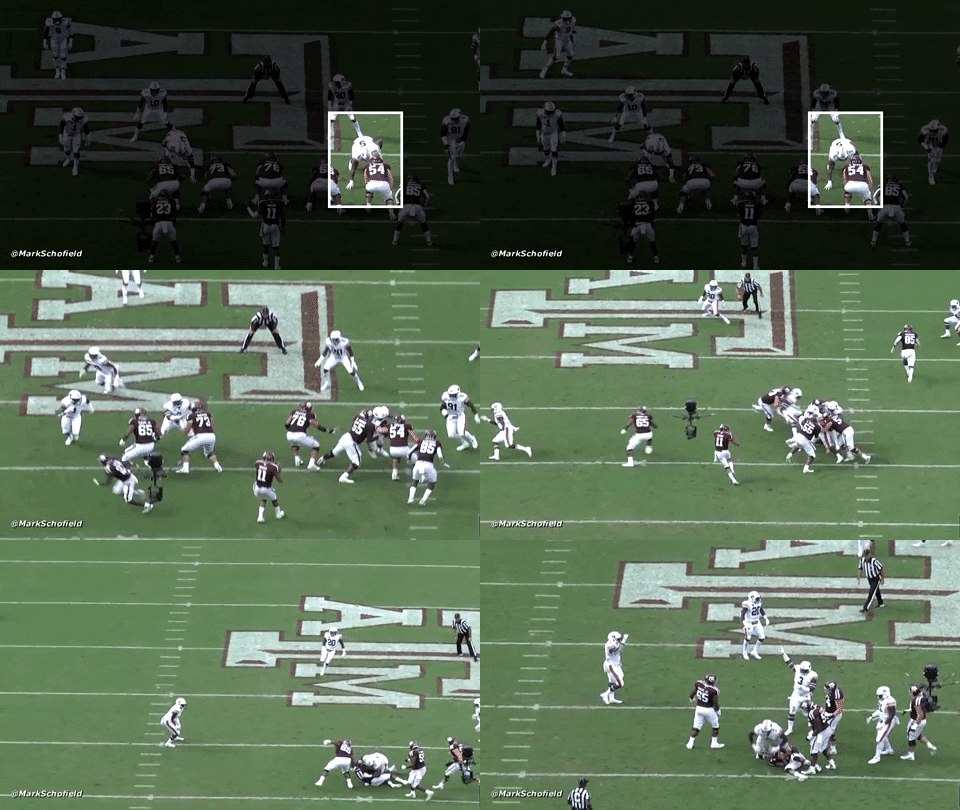
On this “tackle/end exchange” or TEX stunt, Brown loops to the outside to occupy two blockers, to free up the defensive end cutting inside. But viewing the job as “half-done,” the big DT fights through the double-team and gets the sack himself.
Weaknesses: There are times when Brown plays too high with his pad level, exposing his chest to blockers and creating situations where he can be washed out by the play. As his Combine testing showed, he is not the greatest athlete, so his best plays come when he is moving north/south. He struggles at times to make an impact on outside runs or wide zone plays unless he gets immediate penetration.
Conclusion: The bottom line is pretty simple. If you are intrigued by a disruptive, pocket-pushing defensive tackle who can swallow double-teams, pressure the passer and be a stopper against the run on the inside, then you’ll love Brown. He lacks the ceiling that Kinlaw has, given the South Carolina product’s incredible combination of size, length and athleticism, but it is easy to see Brown having the higher floor to him.
Conclusion: Picture Ndamukong Suh without the nasty streak, and that is what you are getting in Brown. Many have compared him to the former Nebraska standout, and Brown’s floor, disruption in the interior and ability to stuff the run makes it a reasonable juxtaposition.
13. C. J. Henderson, CB, Florida

Height: 6’1″ Weight: 204
40-Yard Dash: 4.39 seconds
Bench Press: 20 reps
Vertical Jump: 37.5 inches
Broad Jump: 127.0 inches
3-Cone Drill: N/A
20-Yard Shuttle: N/A
60-Yard Shuttle: N/A
Bio: A top recruit at both running back and cornerback out of Christopher Columbus High School in Miami, Henderson committed to Florida after originally signing on with Miami. He made the Freshman All-SEC team as a freshman in 2017 with four interceptions and eight passes defensed, and put up 93 tackles, eight tackles for loss, four sacks, two forced fumbles, 28 passes defensed, and six interceptions in his three-year collegiate career.
“I’m very comfortable,” Henderson said at the combine about man coverage. “We played that a lot back Florida. Press was our main go-to. So that’s something I’m very comfortable with. [Todd Grantham] mixed up a lot of coverages. So it was very different for us, compared to freshman year, mostly one coverage. So, it was very different. I think it helps out a lot, me being versatile and being able to work out of different coverages.”
Stat to Know: Henderson saw his man coverage rate drop from 60% In 2018 to 33% in 2019. He also saw his allowed completion rate rise from 38% to 51%, and his yards per target nearly double from 5.3 to 10.1. You know what to do, defensive coordinators.
Strengths: Similar to Jeff Okudah, Henderson is a potential NFL press-coverage cornerback with great man coverage skills. Given his experience, he is very patient when in press alignment, both with his feet and with his hands. He is often delibrate to fire his hands into his jams, but when he does he is efficient at re-routing most receivers. Henderson is also patient in terms of how he plays receivers. Whether in press at the line or playing off coverage, he is content with playing off the back hip, almost baiting the quarterback into throwing his way. Take this play from 2018 – a season which is worth studying to perhaps see him at his best – where he plays in off technique but reads the eyes of Drew Lock:
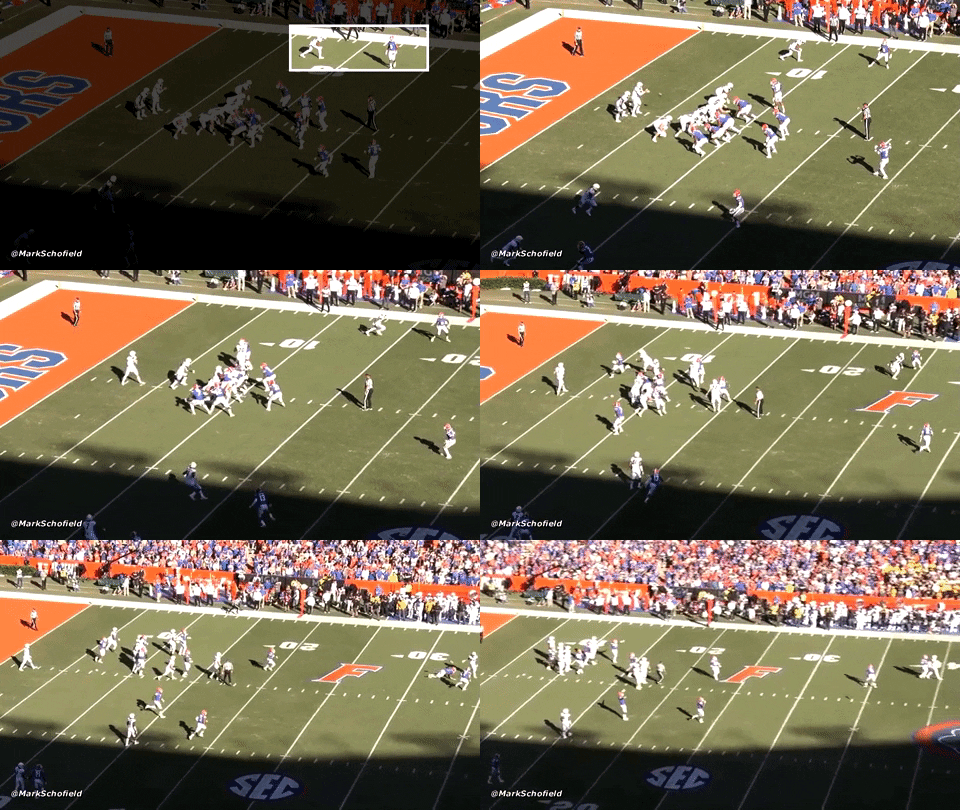
Henderson almost gives Lock this post route to throw, so the QB takes the bait. But then you see the burst from the cornerback to close the window, drive on the throw, and deflect the pass for an incompletion.
That play highlights some of his athleticism, which he showed both on film and at the Combine. Henderson tested very well for a cornerback, with a 4.39 40-yard dash that indicates his long-speed, as well as an explosive 37.5 inch vertical.
Also like Okudah, if you want a scheme-diverse cornerback, look no further. Henderson was used in a variety of both zone and man coverage schemes.
Weaknesses: You have to begin with what Henderson does, or perhaps fails to do, against the run. There are times when he seems minimally engaged in coming up against the run, or making tackles on running backs in space. Now, if you look at corners for what they do against receivers, this might not be an issue. Let’s not forget, Deion Sanders hated tackling, so much so he said recently that “[t]hese shoulders were made for suits, not for Brandon Jacobs.” But if your team is a man-coverage heavy system, Henderson is a fit. There is also the issue of his play slipping a bit in 2019. Pro Football Focus charted him with allowing 20 completions on 39 targets, for a passer rating of 109.0 in 2019. This was by far his worst season in that category. PFF also graded him with a 58.9 coverage grade, a big fall from the mark of 81.7 he earned in 2018. That is why it makes sense to give his 2018 film a viewing. When you do, you see plays like the above.
Conclusion: The slippage in 2019, combined with some of his reps against the run – or “business decisions” as others have termed them – are cause for concern. But sometimes you need to look at the full body of work. In 2018 Henderson delivered the type of play commensurate with a top pick in the draft. Giving those games a look might ease concerns scouts and coaches have about him. The player we saw a year ago is the kind of CB you can draft early and be confident in, regardless of your defensive scheme. Finally, consider this: In the run-up to this draft the late buzz has teams perhaps favoring Henderson over Okudah. Whether that is a pre-draft smokescreen – or an accurate play of the land – remains to be seen.
Comparison: Metrics-wise, Henderson compares favorably to Quentin Jammer, the former Chargers and Broncos cornerback. On the field, however, Henderson is reminiscent of Bradley Roby. The only caveat is that when Roby was coming out of Ohio State, he was much more aggressive in how he played against the run.
12. Henry Ruggs III, WR, Alabama

Height: 5’11″ Weight: 188
40-Yard Dash: 4.27 seconds
Bench Press: N/A
Vertical Jump: 42 inches
Broad Jump: 10 feet 11 inches
3-Cone Drill: N/A
20-Yard Shuttle: N/A
60-Yard Shuttle: N/A
Bio: Henry Ruggs III came to the game of football late in high school, finally committing to the sport full time his junior year. Coming out of Alabama’s Robert E. Lee High School Ruggs had offers from Florida State, Auburn, Florida and Michigan but ultimately decided to stay close to home and play for Nick Saban at Alabama. He saw minimal playing time as a true freshman, but worked his way into the starting lineup as a sophomore in 2018 and never looked back. He caught 46 passes for 729 yards and 11 touchdowns in 2018, and another 40 passes for 744 yards and seven touchdowns last season. In each of his years with the Crimson Tide, Ruggs averaged over 15 yards per reception, including an impressive 18.6 a year ago.
What also helps his game is his well-rounded athletic background. Ruggs was also dominant on the basketball court as well as in track and field, and his senior year in high school he set a state record in the 100 meter dash with a time of 10.58 seconds.
Stat to Know: Ruggs dropped just five passes during his Alabama career, despite seeing a total of 139 targets.
Strengths: It is extremely easy to point at that 40-yard dash time and list speed as the first strength. It is certainly warranted, as Ruggs has the blazing wheels to make him a home run threat on any route, from anywhere on the field. I mean…
You cannot coach that, you cannot teach that, and you ultimately might fail to stop that. Ruggs has the potential to turn plays like that from an eight-yard gain into a touchdown in the blink of an eye.
But you would be mistaken to call Ruggs purely a speed guy. He is a solid route-runner who is unafraid to work over the middle of the field. Ruggs tracks the football well in the vertical passing game, and given his speed he is a threat on jet sweeps and in the screen game. Plus, similar to how the Kansas City Chiefs use Tyreek Hill, you can use him as a decoy at times. Send him in jet motion and watch the defense over-react, and then hit them for a huge play using another offensive piece.
Ruggs also is solid at the catch point, as illustrated by the small number of drops over his collegiate career.
Weaknesses: Some might point to his production, in contrast with say Jeudy’s, and wonder why with his combination of route-running and speed Ruggs did not put up better numbers. At first blush this could be a fair complaint, but remember that Ruggs was playing with Jeudy (a first-round talent this year) as well as Devonta Smith and Jaylen Waddle, who are likely future first-round selections. There are only so many targets to go around, and with Ruggs seeing the vast majority of his snaps on the outside, some of the players operating in the slot were often the first read. With four potential early picks to choose from, Alabama’s quarterbacks often knew their first read was going to be open.
Ruggs also could learn to attack defenders a bit better, in terms of setting them up with his release, attacking their leverage, threatening their frame and then getting separation off this breaks. His speed has enabled him to get consistent separation in the college game, but he will face a more level playing field at the next level.
Conclusion: Ultimately, Ruggs has that Ace card that you cannot scheme for as a defense: Pure speed. The NFL is a copycat league and teams that are trying to build an offense similar to what Andy Reid has assembled in Kansas City are going to want a player like Ruggs, who can force a defense to over-react and leave themselves exposed somewhere else on the field. Ruggs’ ability to stress a defense at every level of the field is going to cause defensive coordinators headaches from the day he enters the league.
Comparison: Having mentioned it earlier, his speed and potential usage is similar to how Tyreek Hill is utilized in Kansas City.
11. Jedrick Wills, OT, Alabama

Height: 6’4″ Weight: 312
40-Yard Dash: 5.05
Bench Press: N/A
Vertical Jump: 34.5 inches
Broad Jump: 113 inches
3-Cone Drill: N/A
20-Yard Shuttle: 4.84
60-Yard Shuttle: N/A
Bio: A string of colleges, including Michigan, Notre Dame, Tennessee, and Kentucky, were after Wills coming out of Lafayette High in Lexington, Kentucky. But as so many top recruits do, Wills chose the Crimson Tide. He managed 121 snaps as a true freshman, allowing no sacks, hits, or hurries on 34 pass-blocking snaps, and things just accelerated from there. When right tackle Matt Womack suffered an injury in 2018, it was time for Wills to step in, and he never left the right side after that.
“I took minimal reps at Alabama,” Wills has said of a potential switch to left tackle. “Leading up to this pre-draft process, I’m trying to do both because that’s something teams are asking about. I’m just trying to have that versatility. It’s something that’s new. Every time at a new position, it’s something you have to get used to. It’s something I’m trying to get comfortable with.”
What’s the biggest challenge with the switch?
“Probably the muscle memory. Being on the right side for so long, it’s something that feels a little bit different. You switch your feet up, using your right hand, your punch time is going to be different. It’s small things.”
Stat to Know: Wills allowed just one sack, five quarterback hits, and 27 quarterback hurries in 970 career pass-blocking snaps.
Strengths: Straight-up demolisher in the run game. Explodes out of his stance, and if there isn’t somebody right in front of him to damage, he goes looking for work in a hurry. Goes after his assignment as a defensive tackle would with an absolute attack mentality. Tremendous upper-body strength augmented by a wide base — good luck out-leveraging him. Has the hand speed and strength to keep defenders at bay with a simple swat. Traps and limits edge-rushers well, if not consistently, with his hands. Once he catches a defender, that defender had better have a second move, or he will quickly disappear. Has the base punch and power of a tackle 30 pounds heavier, and the agility that matches with his size.
Weaknesses: Wills’ wide stance and aggressive nature make him vulnerable to movement concepts in space — as agile as he can be, he’s also prone to flat-out missing people at the second level. Looks out of place at times in zone concepts; floating around when he could be locking on. Needs to clean up the tendency to reach both in the run game and in pass pro. Kick slide in pass pro is decent, but will need work against rushers who cross his face quickly. Gets grabby when his hand technique is left wanting.
Conclusion: Wills is probably going in the top 10, and if you’re surprised by that, you may want to catch up with the realities of the NFL as it stands. The most important offensive lineman for the Chiefs in their Super Bowl run was right tackle Mitchell Schwartz, who pitched a near-perfect postseason and played at an MVP level against the 49ers in Super Bowl LIV against the 49ers. Wills doesn’t need to switch sides to be of franchise-level importance.
NFL Comparison: Lane Johnson. Wills is a natural right tackle with the ability to dominate in run sets and improve in his pass protection. Johnson has been an outstanding and highly valuable right tackle since the Eagles took him in the first round of the 2013 draft with similar traits.
10. Antoine Winfield Jr., Minnesota

Height: 5’9″ Weight: 203
40-Yard Dash: 4.45 seconds
Bench Press: N/A
Vertical Jump: 36.0 inches
Broad Jump: 124.0 inches
3-Cone Drill: N/A
20-Yard Shuttle: N/A
60-Yard Shuttle: N/A
Bio: The son of former Bills and Vikings cornerback Antoine Winfield, who played in the NFL for 14 seasons and made three Pro Bowls, Winfield Jr. grew up in Minnesota, but his family relocated to Texas after his dad’s retirement in 2013. There, Winfield Jr. worked his way up to three-star recruit status at The Woodlands High School in Houston. He received offers from Northwestern, Purdue, and Mississippi, but chose the offer from Minnesota as the best fit for him. Winfield missed all but eight total games in the 2017 and 2018 seasons, but bounced back with a vengeance in 2019, with 88 tackles, 3.5 tackles for loss, three sacks, two forced fumbles, eight passes defensed, and seven interceptions.
Like father, like son? In many ways, yes.
“Man, pretty much everything,” Winfield told me when I asked him what he learned from his dad. “He started me off young, so at a young age, I was out there doing footwork drills with him, watching film and pretty much everything football-wise. I learned a lot from him.
“It comes from him, and from film study. Him teaching me how to watch film. When he was in the pros, we’d sit in the bedroom, and he’d be looking at film, and I’d be watching him breaking it down. Showing me what the receivers do and the route concepts and everything.”
Stat to Know: In addition to his seven interceptions last season, Winfield racked up two forced incompletions. He allowed 11 receptions on 22 targets all season, so opposing quarterbacks were generally in better shape throwing away from him as much as possible.
Strengths: Winfield is a run-and-chase deep third safety with the ability to diagnose routes and align coverages to his benefit. High-points potential catches with timed jumps; has the best ball skills in this safety class. Faster on the field than he runs in a straight line because he’s able to intuit what the offense is doing. Matches and trails naturally with receivers. Had the ability and responsibility to alter coverage pre-snap based on receiver alignment. Has outstanding closing speed, but is also confident enough to bait the quarterback and close in. Outstanding recall — will diagnose on the fly based on film study. Wrap tackler with a bigger thump than his size might indicate. Good delay blitzer who can slip through gaps from the box or from free safety. Had 18 run stops last season, so he’s not just a coverage guy.
Weaknesses: Injury history is a concern, but Winfield obviously played healthy in 2019 and his combine performance showed no ill effects of previous injuries. Aggressive to a fault at times when deciphering misdirection. Some teams may shy away from his size, but he’s perfectly capable of making (and preventing) plays with his intelligence and recovery quickness. Raw range isn’t outstanding, though Winfield mitigates this with his ability to shorten the distance between himself and the receiver with his on-field understanding.
Conclusion: Watching tape with Winfield was a fascinating exercise in how important shot-calling and diagnostic skills are to the modern free safety position. And though he has potential as a slot and box player, Winfield screams deep safety with his athletic profile. Moreover, he’s plug-and-play at that position. Take the size and range concerns and throw them out the window — Winfield should be a top-15 pick based on talent and positional value.
NFL Comparison: Earl Thomas. When Thomas came out of Texas in 2010 at 5-foot-10 and 208 pounds, there were people who thought he should move to cornerback because he didn’t fit the physical profile they wanted for the safety position. Thomas proved the doubters wrong with a formidable competitive demeanor and all the smarts you could ever want on the field. Not that Winfield projects to be Thomas in his prime — not yet, at least — but the different for Winfield between the tape and the doubts seem similar. As a pure deep safety, Winfield has no rival in this draft class, and he excels as a desperately needed position.
9. Andrew Thomas, OT, Georgia

Height: 6’5″ Weight: 315
40-Yard Dash: 5.22
Bench Press: 21 reps
Vertical Jump: 30.5 inches
Broad Jump: 109 inches
3-Cone Drill: 7.58 seconds
20-Yard Shuttle: 4.66 seconds
60-Yard Shuttle: N/A
Bio: Thomas was a four-star recruit from Atlanta’s Pace Academy, and he chose Georgia over 28 other schools, including Notre Dame and Michigan. The Freshman All-American started 15 games right out of high school, and moved to left tackle in time for the 2018 season. In 2019, he was awarded Associated Press All-American and first-team all-conference honors after starting 13 games on the left side.
“I think athleticism,” Thomas said at the scouting combine, when asked what separates a good offensive tackle from a great one. “Playing at the next level those guys are freaks, so being more athletic helps you. And then technique, especially at the offensive line positions. Playing against those guys, you have to be a technician. Every down, every play, you have to change it up. It’s almost a like a chess match and you have to be able to adjust to different types of rushers, so I think that makes all the difference.”
Stat to Know: Thomas did his work in zone schemes on 83% of his snaps over three seasons, averaging 6.2 yards per carry (and 6.9 yards per carry when running to his gap in 2018 and 2019), with a 50% Positive Play Rate.
Strengths: Choppy kick-step at times, but he makes it work with excellent diagnostic skills and the proverbial head on a swivel. Has the feet to adjust to quicker defenders trying to slip past him to the pocket. Has a mauling, finishing mentality when moving in slide protection and to the second level. He’s happy to bury pass-rushers who come with less than stellar technique — embarrassed K’Lavon Chaisson multiple times in 2019 when Georgia faced LSU. Quick decision-making allows him to react well to stunts and twists — he hands off naturally when he needs to. Mirrors instinctively against inside moves. Plays from a solid base and doesn’t get rocked back easily.
Weaknesses: Pass sets are more abrupt than smooth — Thomas isn’t yet a natural mover as you’d like from an offensive tackle. Could be vulnerable to late movement from edge-rushers until he refines that. Has the raw strength to bury defenders once he gets his hands inside the numbers, but needs work in clamping on and staying there.
Conclusion: While Thomas isn’t the most agile mover, and I have concerns about the choppiness of his pass-sets against more advanced NFL pass-rushers, he presents the right mentality, levels of strength, and coachable traits to be a top-level tackle early in his NFL career. He’s best suited for a balanced offense in which the run game is a prominent factor, and physicality is a requirement.
NFL Comparison: Eugene Monroe. Like the Virginia alum selected with the eighth overall pick in the 2009 draft by the Jaguars, Thomas checks all the boxes you’d like from a power tackle with improving agility characteristics. He’s as close to “plug-and-play” as you’ll find at the tackle position in this draft class.
8. Javon Kinlaw, DI, South Carolina

Height: 6’6″ Weight: 302
40-Yard Dash: N/A
Bench Press: N/A
Vertical Jump: N/A
Broad Jump: N/A
3-Cone Drill: N/A
20-Yard Shuttle: N/A
60-Yard Shuttle: N/A
Bio: Javon Kinlaw chose the junior college route coming out of Goose Creek High School in South Carolina, enrolling at Jones County Junior College in Ellisville, Mississippi. During the 2016 season, he was a standout at defensive tackle, who was named a second-team All-America selection, a first-team All-Region 23 selection, and the MACJC South Division’s Most Valuable Defensive Lineman when he tallied 26 tackles (including 8.5 for a loss) and 4.5 sacks.
He committed to South Carolina for the 2017, and made 10 starts his first year on campus. He took on an increased role for the Gamecocks over the past two seasons, and had a career-year as a senior in 2019. He posted seven sacks and 26 quarterback hurries. Kinlaw rode that production to a spot in Mobile for the Senior Bowl, where it was apparently early on that he was arguably the best non-quarterback in attendance.
Stat to Know: According to charting data, Kinlaw was second among interior defensive lineman with a pass-rush win rate of 18.1%.
Strengths: Kinlaw explodes off the snap. Simply turn on South Carolina’s game against Alabama and you will see his burst off the line from the opening play of the game. He plays with incredible pad level, but it is his first step that attacks gaps and threatens the structural integrity of the offensive line from the second plays begin. Kinlaw commands double-team blocks in the run game, and constantly frees up those around him to flow to the football and make plays. He also brings incredible lateral agility to the table, and is going to be a problem against zone running plays, and you can imagine how a creative defensive coordinator could employ him in the stunt and twist game.
As a pass rusher, his ability to convert strength to power as well as his bull rush move might be unparalleled in this class. His hands are constantly moving, forcing blockers to counter and second-guess their own actions. Proponents of the concept that “pressure equals production” are going to enjoy seeing plays like this against North Carolina:
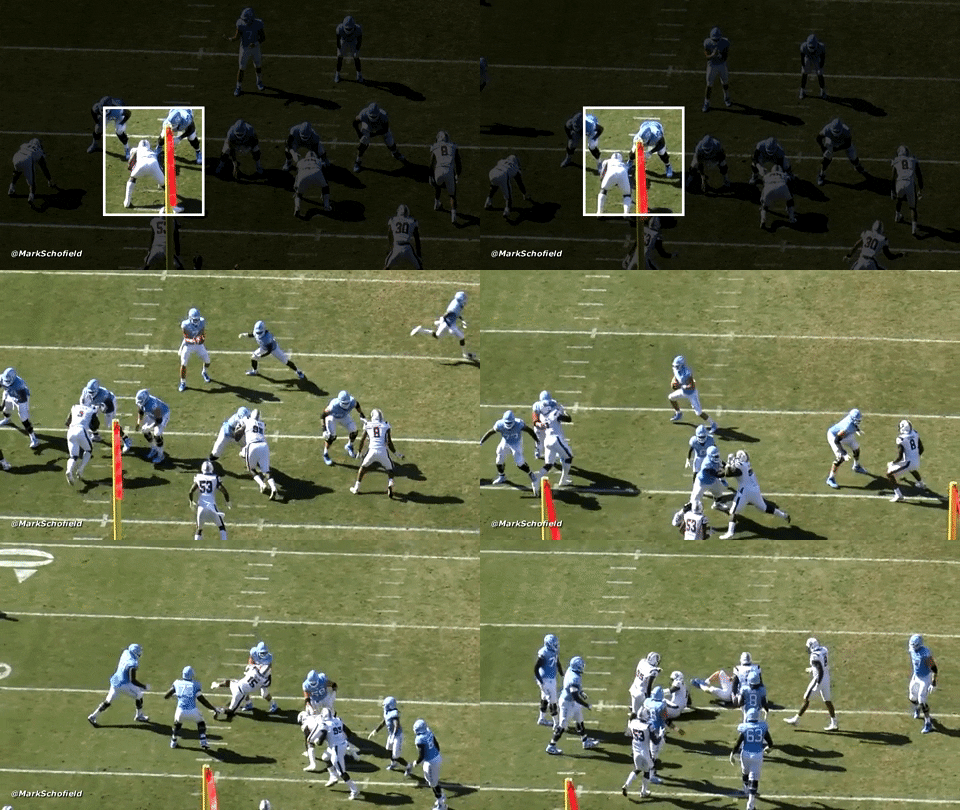
If your interior defensive lineman is going to get double-teamed when the QB drops to pass, you’ll love seeing him fight through the first blocker with violent hands, spin into the second blocker and manage to drive him backward – initially with his back – and still get the QB to move off his spot. Leading to a big sack from the defensive end, left isolated with the right tackle. Pressure equals production.
Weaknesses: Kinlaw often loses track of the play and gets caught peeking into the backfield, which leads to him missing some misdirection plays and running away from the football. He has tremendous hands, but relies on his bull rush too much as a pass rusher. You can see evidence – such as in the above video – of him having other options in his tool kit as a pass rusher but he relies on the bull rush far too much to be a complete player right now.
Conclusion: Kinlaw’s length and size cannot be taught, nor can his explosiveness. This is a tremendous foundation for a disruptive force on the interior of NFL defensive lines. His explosiveness, coupled with that hand work he has developed to date, is enough to make him productive as a rookie. What he learns along the way is can make him special.
Comparison: Retired NFL defensive end Stephen White, in this meaty breakdown of Kinlaw, compared him to current Chicago Bears’ defender Roy Robertson-Harris. This makes a ton of sense, as Robertson-Harris began as an edge rusher before moving inside, and Kinlaw’s disruptive ability on the interior compares to the finished product that Robertson-Harris is now.
7. Jerry Jeudy, WR, Alabama

Height: 6’1″ Weight: 193
40-Yard Dash: 4.45 seconds
Bench Press: N/A
Vertical Jump: 35 inches
Broad Jump: 10 feet
3-Cone Drill: N/A
20-Yard Shuttle: 4.53 seconds
60-Yard Shuttle: N/A
Bio: Jerry Jeudy was one of the top wide receiver recruits coming out of high school, choosing Alabama over a home state option in the University of Miami. He contributed in a small way as a freshman in 2017, catching 14 passes for 264 yards and a pair of touchdowns, but exploded on the national stage as a sophomore in 2018. That season he caught 68 passes on 101 targets for 1,313 yards and 14 touchdowns, averaging a whopping 19.3 yards per reception. Last year he still managed to put up prodigious receiving numbers in a crowded group of receivers, catching 77 passes on 108 targets for 1,163 yards and ten touchdowns.
Stat to Know: Jeudy played both in the slot and on the outside at Alabama, and a season ago he saw 326 snaps inside compared with 271 out wide, according to charting from Pro Football Focus. But he does real damage from the slot, averaging 3.49 yards per route run from the slot over the past two seasons.
Strengths: It is rare to find a complete route-runner coming out of the college game, but this wide receiver class provides some prospects who can give an offense almost a complete route tree coming out of college. Jeudy is no exception. He is the quintessential “full-body route runner,” who can use everything from head to toe to get a defender off balance and then get separation working away form them. Watch, for example, this stop route against Clemson:
Jeudy’s footwork and short-area quickness stands out here, but don’t ignore how he even uses his head at the top of the route, selling the cornerback on a potential vertical stem before finally breaking this off short and working back to the quarterback. This is elite work from the wide receiver here.
What also shows up on this route is Jeudy’s ability to manipulate the leverage of the defensive back on a route. The cornerback immediately snaps his hips to the middle of the field after the snap, giving Jeudy the inside angle but taking away the boundary. Jeudy uses that to his advantage by working into the cornerback’s “blind spot” on the outside, and then breaks off his route to make himself available for the QB.
Another strength of Jeudy’s comes at the catch point. He has solid hands, and can win against most cornerbacks even on those “50/50,” contested-catch situation.
Weaknesses: While Jeudy showed promising speed and change-of-direction ability on film, his three-cone time has some wondering if he can take what he put on film and translate it to the NFL. Jeudy also did not face press coverage as much as other receivers in this class, so he will need to show he can consistently beat press in the NFL, otherwise he might be limited to a slot receiver role as he learns that part of the game.
Conclusion: Jeudy has demonstrated over the past two seasons that he can be an extremely effective receiver at the next level. He gives almost a complete route tree on Day 1, and players with his footwork and full body technique can get separation from NFL defensive backs, which after all is the job of a WR. He is a schematically diverse receiver who can step into any NFL offense and contribute right away.
Comparison: It is hard to avoid comparing Jeudy to some of the previous Alabama receivers, but his route-running – from a full body element – is very reminiscent of Amari Cooper.
6. Tua Tagovailoa, QB, Alabama

Height: 6’1″ Weight: 218
40-Yard Dash: N/A
Bench Press: N/A
Vertical Jump: N/A
Broad Jump: N/A
3-Cone Drill: N/A
20-Yard Shuttle: N/A
60-Yard Shuttle: N/A
Bio: Tua Tagovailoa’s story is well-known. A five-star recruit and the No. 1 overall high school player coming out of Hawaii, Tagovailoa had offers from UCLA, USC, Ole Miss, Texas Tech, Nebraska and Utah but decided to enroll at Alabama, even with the talented Jalen Hurts in the fold. As a freshman, he was given his star chance at halftime of the national championship of all moments, coming off the bench to lead Alabama to a title in a comeback win for the ages over Georgia.
That propelled him to the starting job over Hurts the following season, and he delivered, throwing for 3,946 yards and 42 touchdowns, against just six interceptions, with a passer rating of 137.5. He followed that up with another strong season this past year, statistically, where he completed 71.2% of his throws for 2,835 yards and 33 touchdowns, with just three interceptions.
The problem, however, is the injury history. His career ended with a severe hip injury but that is not the only concern. He suffered a high ankle sprain earlier last season that required surgery, and he came back for the LSU game to battle with Joe Burrow. On the field, he seems to be a very solid quarterback prospect. The medical piece, however, is a huge question mark — and one that just might be difficult to answer in today’s global climate. How comfortable will a team be drafting him if their own doctors cannot perform a physical examination of him?
Stat to Know: Blitz Tagovailoa at your own peril. According to charting data from Pro Football Focus, Tagovailoa posted a 64.9% completion rate when blitzed last season, with a remarkable 10.9 yards per attempt on those attempts.
Strengths: The first thing that jumps out watching Tagovailoa is his crisp release and passing mechanics. The ball pops out of his hand very well and his quick release and clean mechanics make him an ideal fit for a modern West Coast offense. He shows great accuracy to virtually every level of the field and also throws with very good anticipation, although not quite at the level of Burrow.
Tagovailoa is very athletic, with the ability to extend plays outside the pocket and make some impressive throws in scramble drill situations. He throws very well on the move and always keeps his eyes downfield in those situations. He was only sacked 10 times last season, and while part of that low number was due to the games he missed, Tagovailoa is quite capable of escaping pressure and extending plays.
While he does not have the most impressive arm in this class, his arm strength is sufficient for almost everything he will be asked to do in the NFL. He might lack some of the downfield juice, yet this would point to more of a usage or scheme limitation than anything else.
Tagovailoa also shows good processing speed on RPO designs, with the ability to read a defender at various levels of the field and make a snap decision based off his reaction to the start of a play. In modern NFL offenses, this is a huge plus.
Weaknesses: As with many athletic quarterbacks, Tagovailoa’s athleticism carries a bit of a double-edged sword. Many times, his Plan B when his primary read is covered is to extend the play with his legs and rely on his athleticism. This might work on Saturdays, even against SEC competition, but it could get him into trouble in the NFL.
Additionally, there are too many occasions of Tagovailoa playing hero ball. He might fight too long in the pocket and try to extend plays too much, and that gets him into trouble both with interceptions (his end-zone interception this season against Tennessee, for example) and with his history of lower-body injuries. He will need to learn to throw the ball away and/or play for the next down when he gets to the NFL, both to limit mistakes and protect himself.
Tagovailoa also benefited from playing with top receivers Jerry Jeudy and Henry Ruggs III, as well as first-round talent blocking for him. While this should not be used against him in terms of his evaluation, what should be considered as part of his evaluation is how that allowed him to assume far too often. Beacuse of the talent around him, there were times when he would just assume: A.) What the defense was doing; and B.) That his targets would bail him out. That is not a recipe for consistent success. For more on this you can see this video breakdown of his interceptions this season:
Conclusion: Tagovailoa fits perfectly with a modern West Coast offense, rooted in the quick passing game but filled with spread designs and RPO elements. Let him quickly scan the defense pre- and post-snap and get the ball out to his targets in space with room to operate. This will take advantage of his quick release and accuracy in the short areas of the field. Vertical shot plays, often off play-action designs, are the best way to keep defenses honest over the top and give him chances to hit on some deep balls downfield. Asking him to challenge tighter windows in the downfield passing game, something he seemed to shy away from in college, might be asking too much early in his career.
Of course, the biggest question with him is not something I am qualified to answer. Nor are you, unless you happen to be a world-renowned orthopedic surgeon. What is the extent of his hip injury and what limitations, if any, will that place on his career arc?
Comparison: Tagovailoa has a lot of Jimmy Garoppolo to his game, including the quick release and the need for a play-action, RPO heavy offense. The part of his game that he might need to tamp down is his Baker Mayfield side, the passer who seems almost too willing to seek out chaos in and outside of the pocket.
5. CeeDee Lamb, WR, Oklahoma

Height: 6’2″ Weight: 198
40-Yard Dash: 4.5 seconds
Bench Press: 11 reps
Vertical Jump: 34.5 inches
Broad Jump: 10 feet 4 inches
3-Cone Drill: N/A
20-Yard Shuttle: N/A
60-Yard Shuttle: N/A
Bio: From the moment he stepped on campus, CeeDee Lamb was contributing to the Oklahoma passing game. As a true freshman in 2017 Lamb caught 46 passes (on 68 targets) for 801 yards and seven touchdowns, averaging 17.5 yards per reception. His numbers improved every single season he was on the field, jumping to 65 receptions for 1,156 yards and 11 touchdowns as a sophomore, and 62 receptions for 1,325 yards and 14 touchdowns last season. As a junior in 2019, Lamb averaged an incredible 21.4 yards per reception, the third-highest average in the nation and the highest among receivers with more than 40 receptions.
Stat to Know: 146.5. That is the passer rating Lamb generated on his targets over the past two seasons in Norman. I think NFL quarterbacks would love having someone like that to throw to.
Strengths: Another thing that will make Lamb’s NFL quarterbacks happy is the receiver’s catch radius. The idea of a “50/50 ball” goes out the window with Lamb’s ability to snare throws that seem to be off target:
Then this is this play against UCLA that still looks absurd:
Wherever the pass is, Lamb can go and get it. He excels at the catch point, and does a tremendous job of high-pointing the football.
Lamb is also a technically sound route-runner, who is at his best on routes working back to the quarterback off the vertical stem. Curls, comebacks and hitches all see him rolling his hips down into the break and working back to the QB violently, gaining separation as he cuts. After the catch? Lamb is explosive there as well, and PFF charted him with 26 broken tackles last season, the most in the country. On the rare occasions when he faced press coverage, Lamb was able to win at the line of scrimmage by getting small and evading the jam, allowing him to get into his route quickly.
Weaknesses: Lamb’s top end speed is not elite, but the 4.5 that he ran at Indianapolis was perhaps a tic quicker than most expected from him. This could be a prime example of overthinking a prospect, because his catch radius and route-running means that even without elite speed, he is usually open enough. He also operated in a wide-open offense that generated a ton of free release for him, so despite his ability to beat press when he saw it, he’ll see a lot more of it when he moves to the league.
Conclusion: Unless you’re Al Davis and speed is the bottom line, Lamb is as clean as it gets from a WR prospect. His hands, catch radius and ability after the reception make him a fit for almost any offense, and he projects as an ideal “Z” receiver in most systems. He can operate effectively at all levels of the field, and is a genuine threat with the football in his hands in space. Teams that overthink his long speed and pass on him are going to regret that decision.
Comparison: PFF compared Lamb to DeAndre Hopkins in their draft guide, and the comparison is apt. He might not have the top end speed of other receivers, but his route-running and catch radius, plus his play style and projected NFL role, align well with Hopkins.
4. Isaiah Simmons, Defense, Clemson

Height: 6’4″ Weight: 238
40-Yard Dash: 4.39 seconds
Bench Press: N/A
Vertical Jump: 39 inches
Broad Jump: 11 feet
3-Cone Drill: N/A
20-Yard Shuttle: N/A
60-Yard Shuttle: N/A
Bio: Isaiah Simmons was a two-sport athlete for Olathe North High School in Olathe, Kansas. Simmons was a wide receiver and a defensive back on the football team, and a long jumper for the track-and-field team. Simmons was the state champion in the long jump in both 2014 and 2015, and his career-bests jump was 23’8″. But as a three-star prospect on the gridiron, he committed to Clemson over Michigan, Nebraska and Missouri. He started his career for the Tigers in 2017, playing primarily as a safety. In 2018 Simmons spent most of his time in the slot, and according to Pro Football Focus he fared well, as they graded him with an overall grade of 88.9 playing as a slot cornerback.
Last year, Simmons did it all. He played 100 or more snaps at edge defender, linebacker, strong safety, free safety and slot cornerback. On film, he excelled at every single position.
Stat to Know: Simmons is extremely disruptive at the catch point. He forced eight incompletions, tying him for the top number among linebackers last season.
Strengths: Where to begin? Simmons has the athleticism to cover wide receivers both out of the slot and on the outside. He has the awareness to make plays in space at all levels of the field. He has the size and length to erase tight ends in the passing game. Simmons was built to play defense in the modern NFL. It does not take long to see how he can impact a game. Take the National Championship Game against LSU. Right at the outset, he blitzes off edge on the first play of the game, chases Joe Burrow all over the field and keeps him (as best as he can) in the pocket. Second play of the game, covers Thaddeus Moss on a stick route, plays off him, breaks perfectly on the route for a pass breakup, and he reads the route concept perfectly. He plays sideline-to-sideline against the pass and the run. If you are running a route near him and he can get to you, he is going to put you on your backside with a jam (ask Moss about that). He can play as a half-field safety and break downhill on plays in front of him. He can run stride-for-stride with Justin Jefferson on a crossing route in the red zone.
Simmons can do everything asked of him on the football field.
Some might wonder about his ability to defend the run as a more traditional linebacker. The film shows a player who handles his responsibilities and assignments the right way. For example against Wofford he was tasked with handling the pitch man on speed option plays, and he did that assignment perfectly. So if you ask him to align at middle linebacker and fit into a gap against the run, he will do that too.
Where he does truly stand out is what he can do against the passing game. Given his experience at both safety and slot cornerback, everything feels natural for him. He can play off coverage over receivers, tight ends and running backs and click-and-close to the catch point like a cornerback. When in zone coverage he knows just how long to stick on a route before passing it off to the next defender. While he can play a single- or two-deep safety role, he can also play in the middle of a Tampa 2 in that underneath hole spot and erase tight ends.
Perhaps my favorite play of his is this one from the National Championship Game:
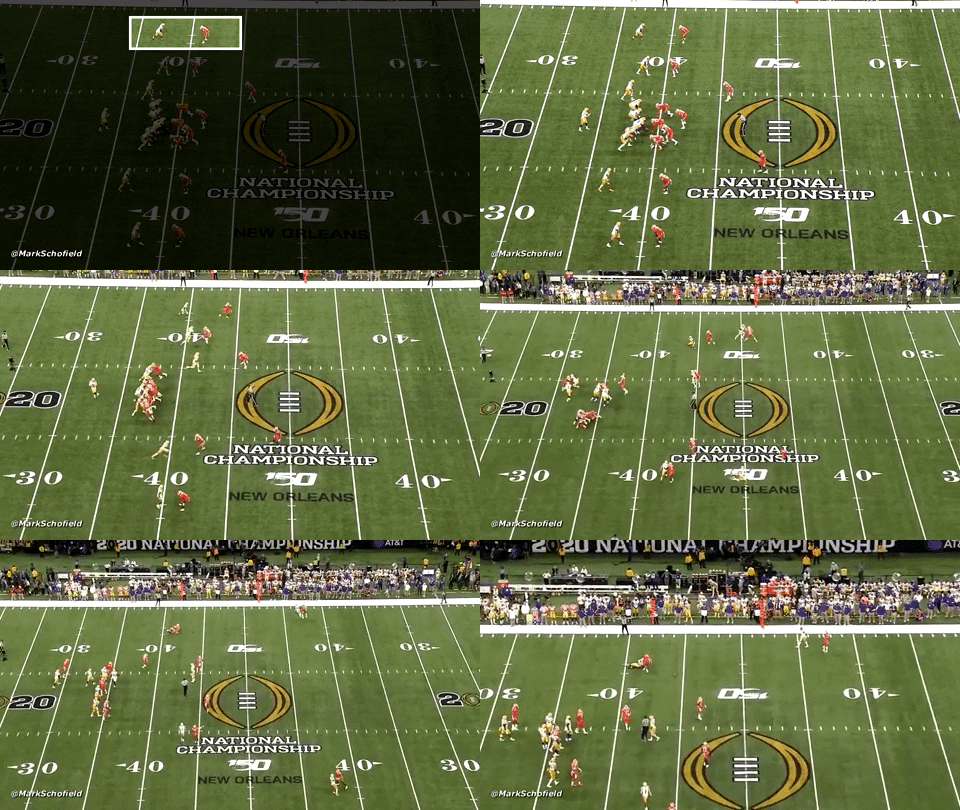
Simmons aligns along the boundary across from running back Clyde Edward-Helarie. He backpedals off the snap and recognizes the route concept, a smash-fade design with the running back running a hitch route and the slot receiver releasing vertically on a fade route. Simmons, despite the rub element to this concept, does not panic. Instead he slides down over the hitch while keeping an eye on Burrow, and when the QB throws the hitch route the defender is in perfect position to break up the throw at the catch point.
Weaknesses: For a player like this, we need to handle the weaknesses section a little differently.
The fear with Simmons is that an NFL team tries to pigeon-hole into a specific role. Whether as a “linebacker” or a “safety,” and by doing so eliminates the versatility and athleticism that Simmons offers on the defensive side of the football. If he is artifically hamstrung by old school minds on his NFL coaching staff, that will reduce much of what he offers. So the hope is that Simmons lands with a forward-thinking defensive mind who employs him more as a matchup weapon than anything else.
Now yes, there are parts of what he has done over the past few years that require a bit of projection. He played in a defense that was predominantly a 3-1-7 defense, and it is unlikely his NFL home is going to copy what Brent Venables put together for Clemson. So projecting him as an off-ball player fitting gaps against the run is a bit of an unknown. But again, asking him to be that kind of player is just overthinking what he can be in the NFL.
So the weakness is really just a lack of imagination from his NFL coaching staff.
Conclusion: The bottom line is that Isaiah Simmons is a defensive specialist that you can employ virtually anywhere on the field. You can see him rush the passer off the edge on first down, lock down a tight end on second down, and run with a slot receiver on third down. He can play a single-high safety look, or as a half-field safety, or even at boundary corner if necessary. His best “traditional” NFL role might be as a middle linebacker in a heavy Tampa-2 defense. He could be the modern version of Derrick Brooks in that role, running with tight ends and slot receivers, but in today’s game there is so much more that he can do. Draft him and just start dreaming of different ways to employ him.
Comparison: Captain America. Iron Man. Superman. Black Panther. Thor. Basically pick a superhero and that is Isaiah Simmons. Except Batman. He was a rich guy who bought a ton of toys. That is my hot take for the day.
3. Jeff Okudah, CB, Ohio State

Height: 6’1 Weight: 205
40-Yard Dash: 4.48 seconds
Bench Press: 11 reps
Vertical Jump: 41.0 inches
Broad Jump: 135.0 inches
3-Cone Drill: N/A
20-Yard Shuttle: N/A
60-Yard Shuttle: N/A
Bio: The son of Nigerian immigrants, Okudah grew up in New Jersey first and then Texas, where he became the top cornerback prospect in the nation at South Grand Prairie High School. He chose Ohio State after getting offers from just about every major program, and found success as he climbed the Buckeyes’ depth chart. In 2019, his first season as a full-time starter, he had 35 tackles, one tackle for loss, two forced fumbles, 21 passes defensed, and three interceptions.
Okudah continued his competitive demeanor at the scouting combine, when some guy at the scouting combine asked him about his “sloppy technique.”
Receivers know how this kid felt.
“For me, I kind of try to take bits and pieces from each player,” Okudah said at the combine, when he wasn’t berating impertinent reporters. “So for me, I like watching how Richard Sherman understands real concepts. I like watching Patrick Peterson’s consistency and his technique. Jalen Ramsey’s physicality, his aggressiveness. I watch how Stephon Gilmore switches up his leverage every time to break the quarterback. So, I just take bits and pieces and try to emulate all of that.”
Stat to Know: In 440 coverage snaps last season, Okudah gave up just 27 catches on 58 targets for 282 yards, one touchdown, three interceptions, and an opponent passer rating of 45.3.
Strengths: It does not take long to see how talented – and pro-ready – Okudah is to play cornerback at the next level. Turn on any game and within moments you will see skills and traits that translate to the next level. Take this one play against Maryland, the third defensive play of the game for the Buckeyes:
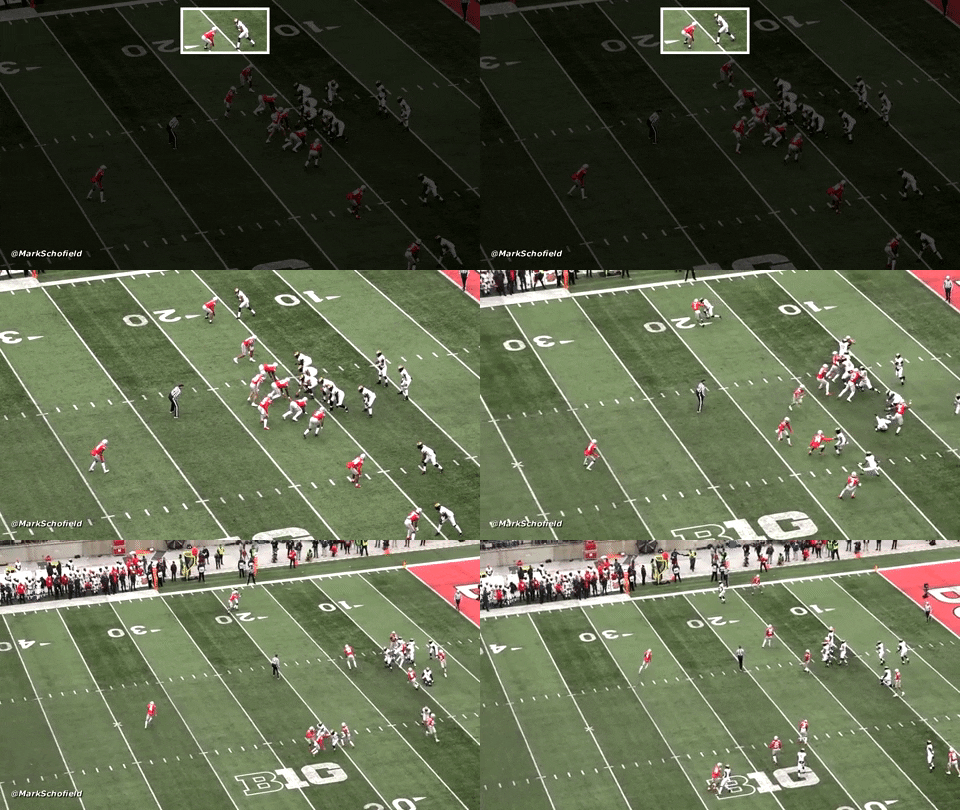
Okudah is in press alignment to the outside, using inside leverage against the wide receiver. Rather than panic at the start of the play, he is patient with both his feet and his hands, like a cobra waiting to strike. When the receiver declares his route by releasing to the outside on a vertical stem, Okudah then gets his hand into his shoulder pads to maintain his relationship with him, and slow his momentum. But alas! The receiver is actually trying to get the corner to bite on the vertical release and suddenly hits the breaks, to run a hitch route. No matter, Okudah has the hips and the footwork to stop on a dime, drive back downhill and make a play at the catch point.
One play, almost everything you want to see in a cornerback.
Okudah is schematically-diverse, aggressive at the catch point, and plays the position without fear. His Combine positional workout was almost pristine, from his change-of-direction ability to his footwork in the backpedal. I mean…pristine:
As an aside, there is a version of that set to “Smooth Criminal” that is also worth a click.
He checks every box. Except maybe the musical one, but you’re drafting him to cover, not sing.
Weaknesses: If you want perfection, then perhaps you can find a weakness or two. Okudah was hit with flags two years ago, but that was something he cleaned up this past season. Still, he does get a bit physical at times and with how the game is called in the NFL, he might draw his share of flags. He could be a bit better at tracking the football and breaking up passes, Pro Football Focus charted him with 11 forced incompletions, which was only tied for 60th in FBS last season. So he is not perfect I guess. Not sure that really counts as a “weakness” but given that it is “anonymous scout season,” perhaps it does.
Conclusion: The bottom line is simply this: Okudah can flat-out cover. Everything about his is executed at a high-level, and the fact that Okudah is plug-and-play in any defensive system speaks volumes.
Comparison: Aqib Talib makes a great deal of sense as a comparison. Bill Belichick often stressed with his defensive backs the ability to flip their hips and change direction, and that is perhaps why the New England Patriots focus mightily on the three-cone drill as a piece of player evaluations. With Okudah, like with Talib, his footwork and change-of-direction ability is a critical component of what makes him great.
2. Chase Young, EDGE, Ohio State

Height: 6’5″ Weight: 264
40-Yard Dash: N/A
Bench Press: N/A
Vertical Jump: N/A
Broad Jump: N/A
3-Cone Drill: N/A
20-Yard Shuttle: N/A
60-Yard Shuttle: N/A
Bio: Young started high school as an undersized quarterback, switching to defensive end and tight end once he saw a growth spurt. By his senior season, he’d earned Washington Post Defensive Player of the Year honors with 118 tackles, 37 tackles for loss, 19 sacks and five forced fumbles. Offers came from just about every major program in the country, but after a flirtation with Maryland, he chose Ohio State, following in the footsteps of Joey and Nick Bosa as top-shelf Buckeye edge-rushers. He put up 98 tackles, 40.5 tackles for loss, and 30.5 sacks in three seasons at Ohio State, though there were some concerns about the three-game sackless streak at the end of his collegiate career against Michigan, Wisconsin, and Clemson, Young had a ready answer for that at the scouting combine.
“I had a lot of quarterback hits, a lot of pressures. If you understand football, you would see that. You’ll see how they changed their whole offensive game plan for one guy. A lot of people might not know how to really study a tape or may not know how to watch football, but if you know football, I made an impact in those games.
“Being the best defensive end isn’t about sacks, it’s about being the most disruptive player on the field. You can do that without having a sack.”
As I wrote during the combine, Young was absolutely correct about this. He was a top disruptor throughout the entire season, and he projects to be the same type of weapon at the NFL level very quickly.
Stat to Know: Young recorded a preposterous 75 total pressures in 2018, and while his opportunities were relatively limited in 2019, he still had 56 pressures in just 320 pass-rushing snaps (as opposed to 470 the year before).
Strengths: True field-flipping defender who forces opposing offenses to design their game plans around avoiding him. Has ideal first-step quickness to set tackles on edge and prime wins through the arc to the pocket. Turns the corner to the pocket with excellent bend and power. Strong enough to disable blockers when he gets his hands into their chests. Maintains his speed through the pocket to work mobile quarterbacks. Has a nice array of moves from bull-rush to swim and club/rip that can be developed more specifically at the NFL level. Sorts and sifts through multiple blockers to get where he wants to go. Spies the quarterback through the snap and has an innate sense of how to create pressure from broken plays. Adept enough with his feet to do a decent job in short coverage. Works gaps more than he uses a true inside counter, but has the tools to make it work.
Weaknesses: Young needs a more complete plan when he heads wide and gets beaten. Inside counter isn’t developed as it needs to be. Needs better awareness for run plays, zone reads, and misdirection when he’s pinning his ears back. Redirection reaction can be a problem at times, though the recovery speed is obviously there. Wins more on pure athleticism and power than advanced traits, though he’s well on his way.
Conclusion: The question of whether Yonng is the best and/or most valuable defensive player in this draft class is a fascinating one, and probably highly reliant on whether you think pressure or coverage is more important at the NFL level. There are those who might prefer cornerback Jeff Okudah, Young’s Ohio State teammate, because Okudah brings a lockdown man-coverage mentality that’s as worthy of franchise consideration as any non-quarterback skill set. But if you’re looking for an edge defender with an obvious and easily transferable ability to terrorize quarterbacks at the NFL level, look no further. Young is a different player than either of the Bosa brothers, but he certainly looks to have the same type of potential.
NFL Comparison: Aldon Smith. Smith was an absolute force as a pass-rusher before off-field issues unfortunately wrecked his athletic potential. But when Smith was on his game, he had the same combination of size, explosive speed, and unusual power that allowed him to total 33.5 sacks in 2011 and 2012 — the most for any NFL player in his first two seasons since the sack became an official statistic in 1982. Young absolutely has the ability to make the same kind of impact, and has All-Pro potential especially if he cleans up a few non-pass rush issues that will make him a more complete player.
1. Joe Burrow, QB, LSU

Height: 6’3″ Weight: 221
40-Yard Dash: N/A
Bench Press: N/A
Vertical Jump: N/A
Broad Jump: N/A
3-Cone Drill: N/A
20-Yard Shuttle: N/A
60-Yard Shuttle: N/A
Bio: A highly regarded recruit coming out of high school, where he was named Ohio Mr. Football his final season at Athens High School, Joe Burrow started his college career at Ohio State. However, with a crowded quarterback room that included Dwayne Haskins, J.T. Barrett and Tate Martell, Burrow eventually found his way to the transfer market and the LSU Tigers.
It is difficult to recall a rise like Burrow has experienced over the past season. Given the extensive, year-round coverage that the NFL draft receives online and in print, the summer scouting season often uncovers a few wild cards at every position, quarterback included. This past summer, players such as Cole McDonald of Hawaii and K.J. Costello from Stanford were mentioned as possible draft board risers. Yet Burrow was almost an afterthought. Even someone who wrote about him, like me, still viewed him as a Day 3 guy.
But then, this season happened. Burrow put together a memorable senior season, capping it with a Heisman Trophy and a national championship. Only, this was not your father’s LSU passing game. The Tigers were an aerial assault this season, with Burrow setting FBS and school records in a number of categories. His 60 passing touchdowns are a new FBS record, and his efficiency rating of 202.0 is also a collegiate record. His 5,671 passing yards are a new single-season record at LSU, and his 76 career touchdowns (remember, 60 of those came last season) are a new mark at the school, besting Tommy Hodson’s previous mark of 69.
Stat to Know: Burrow’s numbers this season are all prolific, and any of the previous numbers mentioned could fit this category. However, when you consider that in the NFL the vast majority of throws are made within 10 yards of the line of scrimmage, Burrow this season completed 206 passes on 238 attempts for 15 touchdowns and not a single interception on throws in the 0-9 yards downfield range. His passer rating in that area was 122.9.
Strengths: However, Burrow is not the top quarterback in this class for the numbers he put on the field, but rather how he put those numbers together. He displayed throughout his senior campaign the traits and work that are desired in the league. He displayed accuracy to all levels of the field, and Pro Football Focus charted him with the highest percentage of on-target passes of any quarterback in their four seasons of measuring that statistic.
Beyond that, Burrow’s ability to maneuver around crowded and collapsing pockets has him ready to handle life as an NFL quarterback. In Joe Brady’s offense, the vast majority of the passing plays were five-man protection schemes, leaving Burrow responsible for that sixth, unaccounted for, defender. But he was adept at either using his legs to extend plays (all while keeping his eyes downfield) or finding his hot receiver to make the defense pay for blitzing him.
Burrow also has the ability to make anticipation throws, better than his peers and among the best we have seen from a prospect in recent history. His ability to get the ball out on time and in rhythm, before his target makes his break, is going to give his receivers a chance after the catch from Day One … and make his receivers very happy.
Finally, Burrow does a lot of the little things extremely well as a quarterback, from using his eyes to influence defenders to employing shoulder shrugs and/or pump fakes to get defenders out of position. This extends from his feet to his toes. Watch his footwork in the pocket, Burrow is always in position to throw from a solid platform, even if he is moved off his spot, or carrying out a mesh with the running back on an RPO design.
Weaknesses: Perhaps the biggest weakness with Burrow is that the rise almost seems too perfect. It makes one wonder if it was the quarterback, or Joe Brady’s offense, that led to his rocketing up draft boards. Burrow is not a huge threat as a runner. He will get you what he can with his legs, but defenses are not going to dedicate a ton of resources to stopping him as a ball-carrier. He lacks upper-level arm talent, and on some of his deeper throws he needs to put more air on the football. However, he is still very accurate down the field, and his ability to anticipate helps him in this regard.
Conclusion: Burrow is a scheme-diverse, well-rounded quarterback prospect who should be the top player off the board come draft night. His lack of fear in the pocket and his willingness to give his receivers a chance is going to win the respect of teammates early in his career. His ability to anticipate throws and extend plays is going to lengthen his career. Finally, you cannot oversell the competitive toughness factor. Sometimes you just know when a quarterback inspires those around him, and you saw that this season with Burrow and the Tigers. He has that it factor, and it matters at the quarterback position.
Comparison: Tony Romo with a small side of Tom Brady. Look, comparisons are dangerous, especially when you slide in Tom Brady’s name next to a quarterback. But watching Burrow’s footwork in the pocket, from creating space to keeping his feet ready to throw, gives me Brady vibes. Overall, Burrow is very similar to the former Dallas Cowboy.




.png?w=600)








