The end of The Tempest finds Prospero stripped of book and staff. At Shakespeare in the Park, they’ve even taken away belt and braces. As embodied by Sam Waterston (Law & Order, The Newsroom), Prospero’s shirttail flaps forlornly as he begs the crowd’s indulgence. But Waterston, a stage great, has rarely wanted for spirits to enforce or art to enchant (his recent Lear being the rare exception). Even in this tricky role, his charms are not quite o’erthrown.
This changeable, layered Prospero leads director Michael Greif’s patchy interpretation of the late romance. As Waterston plays him, Prospero is both a tyrant and a victim. Robbed of his dukedom, he now reigns over a semi-desert isle, enslaving the sylphs and goblins that inhabit it. He can be a kindly master or, as the weals on Caliban’s back show, a pitiless one. He even has harsh words for his daughter Miranda (Francesca Carpanini, endearing if bland) and her civil suitor Ferdinand (Rodney Richardson, appealing and unexpectedly acrobatic) when he suspects that either might defy him.
When this Prospero storms, Waterston’s expressive tenor thins and frays. His feeble despotism is his answer to past injuries. He seems to want to choose a nobler course of speech or action (Waterston projects a sort of helpless decency), but until the play’s end he’s too frightened of appearing weak to give up his schemes and decrees.
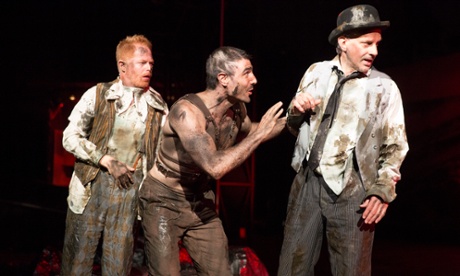
The Tempest is an unruly play, wildly imaginative and potentially deeply moving, but also kind of a mess. There are four or five plots that join up untidily, like a jigsaw puzzle whose pieces don’t quite fit. Greif’s production, though handsome, doesn’t have the vision to pull it all together or impose a compelling logic on the abrupt shifts in tone. The betrothal plot is sweet, if slight, and the clown scenes are winning enough, mostly owing to the superb timing and droll line readings of Jesse Tyler Ferguson (Modern Family). But the scheming among the royals is dull stuff and the overarching narrative, of Prospero’s bid to restore his dukedom, is often ancillary, though you can blame Shakespeare for this as well as Greif. And who needs more than one masque?
The set, an industrial trestle backed by roiling waves, and the lights, which mimic neon tubes, are fine to look at, but seem at odds with the more organic style of acting. And the bondage rigs that Ariel (a lissome, broody Chris Perfetti) and Caliban (a fiendish Louis Cancelmi) wear – like chastity belts for the chest– seem borrowed from a much pervier production. Yet submission and dominance are clearly a preoccupation here. What resonates most here are Prospero’s relationships with his supernatural servitors and his startling choice to change revenge for forgiveness, oppression for liberty. The production finds strength in this clemency.
That ought to be enough and yet it isn’t. Or maybe it is. When all the stories and characters at last combine there’s a deficiency of heft, pathos and alchemy. But there are few better ways to spend a summer evening than in Central Park under a darkening sky amid the firs, birds and fireflies. Even an imperfect Tempest is reasonably enchanting. Its sounds and sweet airs give delight and hurt not.