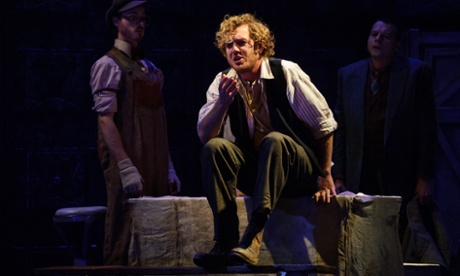
James Bonas’s English Touring Opera production of The Tales of Hoffmann reinvents Offenbach’s final masterpiece in terms of German expressionist cinema of the 1920s. The conceit suits the piece remarkably well. The historical ETA Hoffmann, on whose morbidly surreal short stories the work is based, is widely regarded as an expressionist precursor, while the opera’s sense of beauty under threat from the macabre resonates through the imagery of German film in the wake of the first world war: the film theorist Siegfried Kracauer, the leading authority on the cinema of the period, was also, significantly, Offenbach’s principal German biographer.
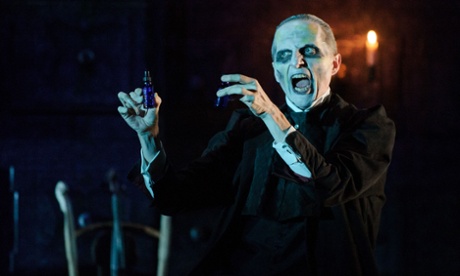
Bonas accordingly reimagines Hoffmann (Sam Furness) as a washed-up auteur, poring obsessively over his own work, while his former leading lady Stella (Ilona Domnich), poached by one of his rivals, attends a grand premiere elsewhere. His cinematic tales form multiple attempts to encapsulate her elusive sexuality, while the sinister nemesis that erodes his mind is effectively Murnau’s Nosferatu, chillingly embodied by Warwick Fyfe.
Not all of this, however, works as well as it might. Louise Mott’s Nicklausse, the voice of reason and humour in an increasingly insane world, looks incongruously like Oliver Hardy got up as a schoolboy, possibly suggesting the beckoning Hollywood mainstream that Hoffmann wilfully ignores, though Bonas’s thinking here isn’t entirely clear. More pertinently, he misjudges the Olympia episode, where the doll proves to be a skeletal stop-motion animation puppet, manipulated by Spalanzani’s assistants. The scene is awkwardly unconvincing, and the production only gathers steam after the interval, where the horribly effective Antonia episode is out of Wiene’s The Cabinet of Dr Caligari, and we find femme fatale Giulietta presiding, Dietrich-like, over a kind of Weimar Republic multi-sexual jamboree.
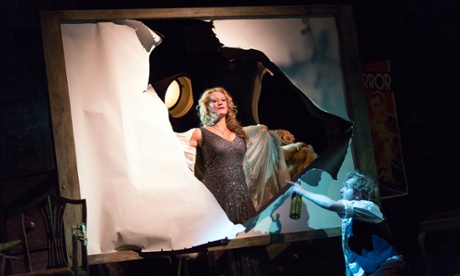
Furness, however, is terrific in the immensely difficult title role. Gauchely attractive, he charts Hoffmann’s descent from naive idealism to self-destructive despair with compelling veracity, and sings it all with great ease and impeccable style. Domnich has the multiple heroines well within her vocal grasp, though Bonas gives her too little to do in the Olympia scenes, and she only comes into her own as Antonia, whose terrors she conveys with disturbing conviction. Fyfe impresses, but could sing quietly more frequently, while Mott is pushed, at times, in her upper registers. Philip Sunderland’s conducting ideally needs a bit more edge and bite. Ultimately, though, it’s Furness’s night.
• At Buxton Opera House, 17 October. Box office: 0845 127 2190. Then touring until 21 November.