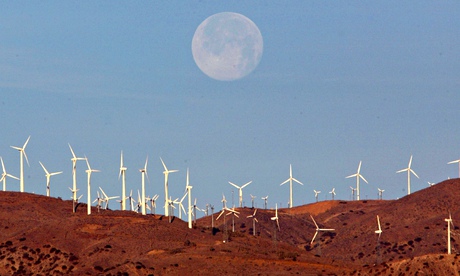
Latin America is experiencing a revolution. Modern renewable energy sources are blooming in a region that relies on fossil fuels and hydropower. A decade ago, the scenario was different. Now, clean energy alternatives are flourishing at a fast pace.
Why?
The myth has been unveiled. Renewables are no longer more expensive and complex to deal with than fossil fuels. In fact, in the past five years the price for solar panels has fallen over 60% and turbine costs have decreased 25%. In 2013 alone, US$16bn was invested in renewable energy in the region accounting for 7% of global clean energy investments.
Companies in the region are looking for business opportunities to manufacture solar panels and turbines. Brazil, for example, has emerged as a wind power manufacturing hub. By 2016, Brazil will become the major assembler in the region and producer of turbines made entirely in the country.
Governments in Latin America are not only responding favourably to the market, but also encouraging it. Countries like Chile, Colombia, Peru, Brazil, Mexico, among others, have created regulatory frameworks that foster clean energy projects.
Towards a green economy
Latin America wants to avoid climatic upheaval. Historically, most of its carbon emissions resulted from deforestation and land use change. Now it is different. Regional emissions from deforestation have been falling due to country-level action. Brazil, for example, has reduced its deforestation rate by 70% due to national policies.
But more needs to happen. Energy demand has increased in the region and could double in the next two decades. Will Latin America invest in fossil fuels and lock itself into a high-carbon emissions path or will it build a green economy?
Some countries have already chosen the latter. Uruguay and Costa Rica are on their way to a carbon neutral economy: more than 80% of their energy, including hydropower, is renewable. From 2008-12, Nicaragua had the highest annual growth of non-hydro renewable energy in the region. By 2030, Chile will generate 20 times more wind power than today.
Beyond helping the environment, renewables create between 1.5 to 7.9 times more jobs than fossil fuels and can solve energy poverty.
Rural electrification
We used to believe that an expanding grid was the best alternative to electrify isolated rural populations. It is not. Renewable energy sources are better for rural populations because they are generally cheaper, do not need a grid investment and are cleaner than traditional energy. In fact, 19 out of 26 countries in the region have public programs to electrify rural areas with clean energy.
Such is the case in Peru, which currently has a plan to provide solar energy to 500,000 poor households. This project is part of a series of clean energy initiatives the government has been leading. In 2006, the government installed 4,200 solar systems in the Amazon. In 2011, 33,000 people gained access to solar power.
These initiatives are profitable. From 2010 to 2011, the solar market in Peru generated about US$5.4m. Solar power is proving to be a bright alternative to solve energy poverty. Peru is shining.
Ongoing challenge
Renewables flourishing does not mean fossil fuels are perishing. Countries that are developing incentives and regulatory frameworks for clean energy are also exploring new oil and coal reserves, or new exploitation techniques like fracking.
This affair with fossil fuels also influences where a country allocates its money. In 2011, around US$20bn was destined to subsidise fossil fuels in the region, almost the same amount as the overall investment in renewables.
Shifting the fossil fuels subsidies to foster renewables will be a complex move. Oil, coal and gas are powerful sectors, yet the co-benefits of clean energy are making renewables a much more attractive option.
A bright future
The region’s energy matrix still depends on fossil fuels (40%) and hydropower (54%). Only 6% of the energy in the region comes from non-traditional renewable energy sources. This is rapidly changing.
In just 6 years (2006-12), total renewable energy capacity in Latin America grew over 230%. It is estimated, that if the region exploited just 4% of its non-hydro renewable potential, it could meet the energy demands of their growing economies.
Billions of dollars are being invested. Climate action is urgent. Governments are regulating. It is projected that by 2050, non-traditional renewable energy sources will scale up from a modest 6-20% of the energy matrix.
Latin America will have the opportunity to showcase its commitments and pledge to build a world economy powered by renewables at the UN climate change conference to be hosted in Peru in 2014. It is increasingly evident that economic growth attached to renewable energy is the best development alternative.
Content produced and managed by WWF