“If the CT had been performed earlier it would have changed her outcome.”
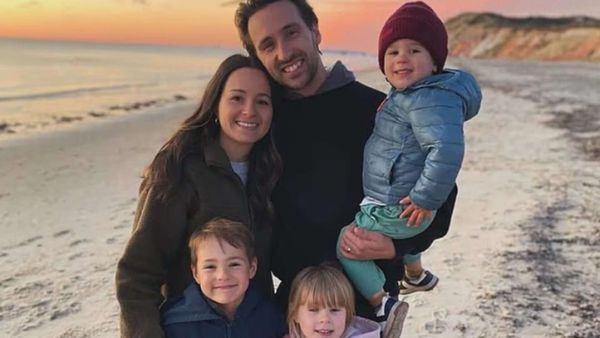
Two brothers surround their dad in an embrace as Joanne Charlton’s family process the idea the adored mum-of-three could have been saved if doctors had listened to her when she was first seen in A&E.
Those closest to her had to dry their eyes multiple times during the inquest into her death two-and-a-half years ago, held at Bolton Coroner’s Court, as they heard there were missed opportunities to save the 48-year-old.
After three difficult days of evidence, several failures and inadequacies in her care were highlighted to coroner John Pollard - who determined that none of these errors could be considered the gross failings needed to constitute negligence.
Her family listened as Mr Pollard recorded that Joanne had died from natural causes, before deciding there was no need to issue any reports to prevent future deaths, as all the faults in this case rested on individuals rather than systemic failings - leaving her family asking: “What more could we have done?”
The events of January 2019
During the course of the hearing, Mr Pollard heard evidence from several healthcare professionals involved in Joanne’s care, after the beloved mum was struck down with severe pain in her neck, head, and upper back that left her screaming in agony on several occasions in January 2019.
The first day of the hearing on Wednesday, September 29, heard Joanne first came to the attention of medical professionals after worried partner of 30 years, Barry Hignett, called 111 for medical advice on January 19, after she’d been ill for the previous three days.
Giving evidence, Mr Hignett, who had two children with Joanne, explained her condition worsened quickly, and he called 111 for advice at around 10pm on the Saturday night after asking a neighbour whether she agreed his partner needed to go to hospital.
A rapid response vehicle was sent to their home and Craig Hamer, the paramedic on board, determined Joanne didn’t need to go to hospital, instead arranging for an out-of-hours consultation with a GP that evening, the inquest heard.
When the GP arrived at around 3am on the Sunday morning, January 20, he diagnosed Joanne as having flu-like symptoms.
But the court heard that her neck pain, difficulties putting her chin to her chest, and sensitivity to light should have all been red flags indicating possible meningitis.

She was first seen by doctors in the Accident and Emergency department at the Royal Bolton Hospital on January 21, 2019, after the pain continued, escalating to the point where she was crying out in agony at times as her head “feels like it’s going to blow up”.
She was taken to the department that morning by paramedics, where she reportedly asked a nurse for a CT scan before being told “funding doesn’t allow for everybody who comes in with a headache to have one”.
The junior doctor who assessed her, Daniel Prescott, also determined that Joanne had flu, despite two swabs for the infection coming back as negative.
When he brought Joanne’s case to the attention of his senior physician, Jonathan Taylor, the consultant on duty in A&E that morning, Dr Taylor recalled Dr Prescott asking whether they should perform a CT scan, with the senior doctor saying that wasn’t necessary.
Joanne was discharged to recover at home, being advised to take paracetamol and drink lots of water.
Tragically, her condition deteriorated even further, with the mum left “howling” in pain as she clutched her head.
Another ambulance was called, and Joanne waited 52 minutes for the paramedics to arrive due to a lack of resources - despite her call being deemed a category 2 emergency that should be responded to in 18 minutes.
When she finally arrived at Royal Bolton Hospital for the second time, her condition deteriorated again, with a statement from one of the doctors saying her consciousness level dropped rapidly, before she had a heart attack and had to be placed on life support as she was unable to breathe on her own.
A CT scan at this time showed a 39mm mass in her brain which was causing swelling and high pressure in her skull.
She was rushed to Salford Royal Hospital, where a surgeon assessed her and determined there was nothing that could be done to save her.
Her life support was switched off on January 23.

A postmortem examination determined that Joanne was suffering from rhombencephalitis - a rare condition which refers to multiple types of swelling around the cerebellum and brainstem - the parts of the brain responsible for balance and life-sustaining functions.
The pressure in her skull, caused by swelling cutting off the flow of fluid around the brain, had pushed some of the tissue out the base of her skull, restricting the brainstem’s function and making it difficult for her body to sustain itself.
Dr Neil Papworth, a pathologist, determined Joanne’s death was caused by raised intracranial pressure with herniation, which had been caused by the rhombencephalitis - although they weren’t sure what had sparked this.
When asked if an earlier CT scan could have prevented Joanne’s death, Dr Sarosh Irani, an expert in neurology, said an earlier scan would have given surgeons the chance to intervene, releasing pressure in the skull, or allowed neurologists to prescribe steroids to ease swelling - two options that would have dramatically improved Joanne’s chances.
However, he also believed it was reasonable for medics to skip the imaging, saying: “A reasonable body of medics would have acted in the manor of the decisions made.
“There was an opportunity to have performed a CT head scan which would have minimised the risk to the patient and maximised her chances of recovery but this did not constitute a breach of duty.
“They assessed her very carefully and thought this was an alternative diagnosis - based on their very thorough assessments that seemed a reasonable approach to discharge the patient.
“If you did CT everyone with a bad migraine - well that’s what the system is trying to avoid and unfortunately it’s got it wrong in this case.
“I think it was reasonable not to do a CT scan although clearly in the end it was the wrong decision.”
The failings
Although the hearing heavily focused on why Joanne hadn’t been taken for a CT scan, other faults were highlighted during the evidence given.
Angela Lee, a service delivery manager for NWAS, told the court that Joanne had been forced to wait 52 minutes for an ambulance, despite her call being registered as a category 2 which should have seen a response within 18 minutes.
The delay was down to a lack of resources, as this was a particularly busy period for the ambulance service.
Addressing the court, Ms Lee said: “The ambulance was sent out at 1418, 52 minutes after we’d received the call.
“This was a particularly busy period in January 2019.
“At the time of the emergency call the duty manager recorded there was a long number of emergency calls waiting so we had to prioritise resources based on time and category.”
Since then, NWAS have been given a number of new vehicles, along with being able to use volunteer and private ambulances during the pandemic, but are occasionally still struggling according to Ms Lee.
Michael Jenkins, the consultant paramedic expert asked to give evidence on the NWAS involvement with Joanne, said she should have been taken to hospital on January 19, when she first presented to the service.
In a report, the advanced practitioner with the Welsh Ambulance Service said that Craig Hamer should have been able to gain the same medical history held by the 111 call handler on arrival, that information along with his own assessment should have shown enough red flags to warrant further investigation in hospital.
Mr Jenkins criticised the notes taken by Mr Hamer that evening, saying he didn’t feel there was sufficient history documented.
He also pointed out that two red flags for possible meningitis were present during that examination, and should have alerted Mr Hamer to the possibility that something was seriously wrong.
Although Joanne was never diagnosed with meningitis, a lot of the symptoms from the rare rhombencephalitis present themselves in similar ways - with headaches, stiff necks, light sensitivity, and disorientation common signs of the condition.
Mr Jenkins said: “There’s nothing that gives me the confidence that the patient was able to be managed at home.
“I’m not saying that the history wasn’t undertaken, but it just hasn’t been documented thoroughly.
“There’s sufficient red flags in the patient report form (PRF).
“If there’s meningism present, which there was, then it’s a red flag and the patient should be taken to hospital.
“However, the world of paramedicine isn’t black and white so it’s procedure to ask for clinical support if you’re unsure, and to the paramedic’s credit he did seek clinical support from the out of hours doctor.”
Following the inquest, a North West Ambulance Service spokesperson said, “We acknowledge the Coroner’s findings and thank him for the sensitive way in which he has handled this matter.
"It was recognised Ms Charlton passed away from a very rare condition and deteriorated quickly. Our deepest sympathies are with Ms Charlton’s family in what remains an incredibly difficult time for them. "
The court also heard that blood taken from Joanne when she was first admitted to A&E on January 21 came back with several abnormal results, indicating a wider issue than flu.
Swabs testing for two types of influenza both came back negative, with an elevated white blood count indicating a more serious cause of her symptoms.
However, when junior doctor Daniel Prescott assessed Joanne, he believed she was suffering with flu or an unknown viral infection - a belief shared by his senior Johnathan Taylor who was the consultant on duty in the A&E department that day.
The pair decided to discharge Joanne less than two hours after she’d arrived at A&E without a scan, after believing she could rest at home and return if her symptoms worsened.
Dr Prescott, now a general medical officer in the British Army, looked for signs of meningism, which would indicate a potential meningitis infection, and recorded that she had reported sensitivity to light and was able to put her chin to her chest when asked.
Dr Taylor reported being asked by Dr Prescott whether they should perform a CT scan on Joanne, but decided this wasn’t necessary based on her assessment - a decision he took full responsibility for in court.
Mr Pollard queried why they had decided not to perform the scan, after Dr Prescott admitted there was a “missed opportunity”.
Addressing the doctors he said: “This poor lady’s been to the hospital and the medical experts on a number of occasions and you don’t know what’s wrong with her - it’s not very good really is it?
“If a patient attends at a hospital, you have a guess that it might be the flu, you don’t know, you don’t do a CT scan, you know she’s been having numerous correspondence with paramedics, and then you say go home with lots of paracetamol and have lots of fluid you’re telling me that’s appropriate?
“You haven’t done all the tests available to establish the pathology.
“I’m not asking you to go into wonder medicine, I’m asking you to perform a CT scan that’s performed day in day out.”
He also criticised Dr Taylor for his lack of notes taken on the day, and a note that assessed Joanne as having a Glasgow Coma Score of 15 - which had been based on assumptions and not an actual examination as Dr Taylor watched her interacting with other people in her cubicle.
What now?
Mr Pollard did not feel it would be appropriate to write to the involved authorities enacting section 39 of the Coroners and Justice Act 2009 - also known as a preventing future deaths report.
He said that although there were failures and inadequacies in Joanne’s care, these were down to individuals rather than systemic, and the report would not help anyone in the future.
Addressing the court as he concluded Joanne’s death had been from natural causes, he said: “Although tragically sad in such a young person, Joanne’s death occurred entirely naturally.
“If Joanne died at home without seeking any medical assistance I would record this as a natural death and that would be that.
“As we know, she and others in her family did keep medical help and I must look at that aspect and see if that in any way alters my conclusion.”
He first discussed Craig Hamer’s assessment of Joanne, where he scored her pain as a one-out-of-ten, and noted she had mild sensitivity to light and a slightly raised temperature.
A note on the PRF saying Joanne was not sweating or clammy was also called into question, after Mr Harmer admitted not asking about these symptoms.
Mr Pollard added: “Michael Jenkins commented on the lack of information documented on the PRF from January 19 and for what it’s worth, I agree with that view.
“He said the NWAS information was inadequate, especially the PRFs
“Craig Hamer told me he did not agree that there were several red flags, again the expert witness disagreed with that fact.
“He performed an adequate examination, but it could have been more comprehensive and more questions could have been asked which might have seen Joanne taken to hospital where professionals might have been able to diagnose the problem and might have been able to save her - it will be noted in that last sentence there are a lot of ‘might’s.”
Joanne’s first visit to hospital on January 21 also raised a lot of concerns for the coroner, with inadequate notes, a poor examination practice, and a seeming lack of investigation into what could be causing Joanne’s illness.
Mr Pollard continued: “Dr Prescott, at that time a very junior doctor, examines her and reaches the conclusion she has the flu - was he influenced by the same conclusion of the out of hours practitioner?
“Dr Taylor agrees with his diagnosis and plan without actually entering the cubicle or speaking to the patient.
“He told me he did not accept that there were ‘red flags’, he says he performed an assessment but there are no notes.
“Communication was not satisfactory and left much to be desired.
“Joanne is discharged home with water and paracetamol, on reflection there was a missed opportunity for a CT scan.”
When moving onto Joanne’s final hours, Mr Pollard accepted that her care was “suboptimal” at times, but none of the failures amounted to negligence.
“Joanne had the first scan of the brain done but by the time of the transfer to Salford Royal it was really too late to do anything.
“All medical professionals agreed it was a very rare condition and is very hard to diagnose.
“I have considered whether there was such a gross failure of basic medical care at any stage to add a negligence tag.
“Whilst the care provided by the ambulance service, the out of hours doctor, and A&E was at time suboptimal it’s fair to say that basic medical care was given and whilst a CT scan would have almost certainly saved Joanne’s life there did not exist any obvious justification for carrying out a scan.”
Speaking after the inquest, her son Anthony said: “My mum was lovely to everyone, she had lots of friends and family - everybody loved her.
“There were so many people at the funeral, it was standing room only.
“She was really loved.”


.png?w=600)