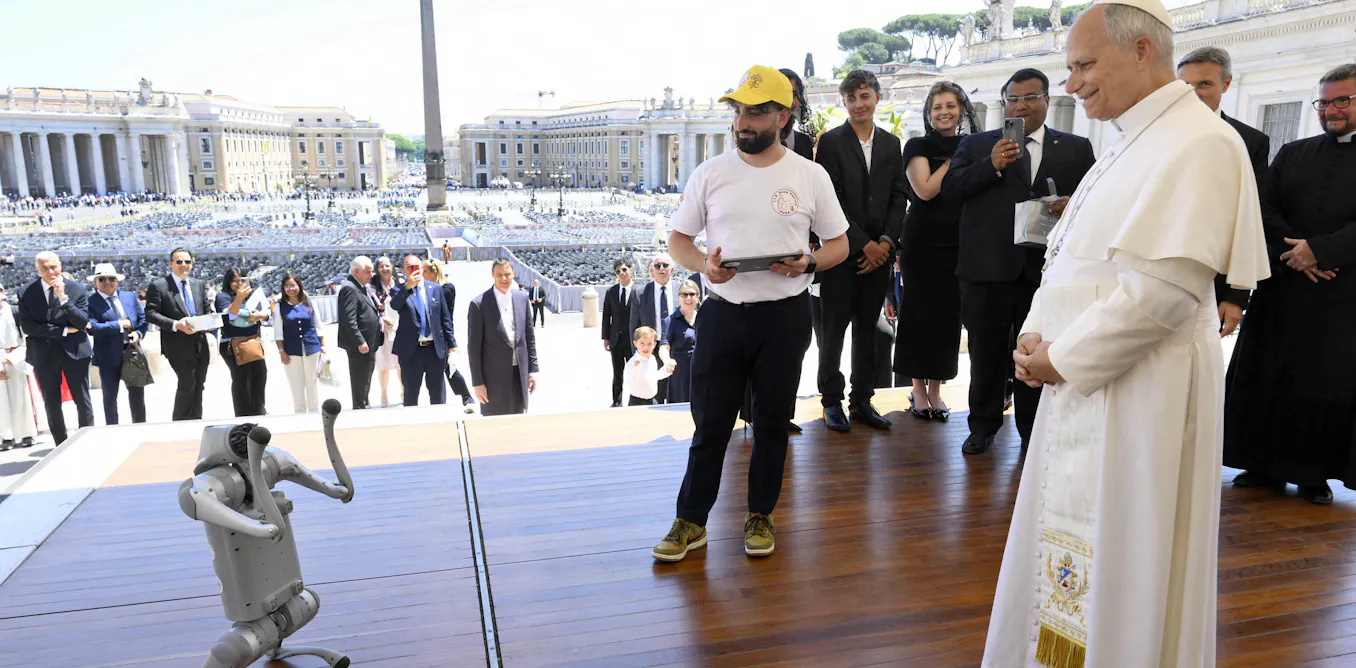
For the last few years, I’ve been seconded to assist the Catholic Church’s unprecedented global grassroots listening initiative. Just as that process drew to a close, I received a surprise request: would I help Pope Leo XIV launch his first social encyclical, focused on what it means to be human in a time of artificial intelligence?
It is difficult to think of a more important theme right now than the impact of digital technologies, AI and robotics on every level of our social interactions and structures.
The Vatican has addressed technological questions before. My research includes the social teaching of popes since 1891, starting with Pope Leo XIII’s influential text Rerum Novarum (Of New Things), which addressed the impact of the industrial revolution on working people (and which this new text commemorates). A range of previous letters have addressed both the opportunities and dangers of technology.
Of course, the Vatican does have a chequered history with regard to theological reflection on scientific and medical developments. Over the past decade, it has been pursuing focused and, in my view, productive conversations with the AI tech sector through initiatives such as the Minerva Dialogues – a series of closed-door conferences with leading figures from both worlds. In this sense, the concern with AI does not spring from nowhere.
Nonetheless, Magnifica Humanitas (Magnificent Humanity) was a landmark moment: a papal text addressing AI as its central focus for the first time, launched by a pope in person – this does not usually happen – in the presence of the very industry it sought to critique. The encyclical panel on which I sat also included Chris Olah, co-founder of the AI tech firm Anthropic.
All of this meant a much higher level of media and public interest. In the run-up to launch, questions about the make-up of the panel and how equipped a pope is to comment on AI showed me this text would be controversial. And that’s OK.
The job of the text is both to offer the stimulus of a particular tradition – Catholic social teaching – and to encourage debate among people with a variety of views about what makes for a common good use of AI technologies. Our task as a panel was to explore both of these realities.
Not anti-technology but pro-human
The Vatican was unconcerned about the encyclical’s lack of neutrality because it declares its hand transparently – and does not believe the tech sector operates with a neutral mindset either.
The inclusion of Anthropic on the panel was welcomed by some as a sign of serious engagement with the sector on these issues. For others, it showed a risk of naïvety about the Vatican’s corporate capture, or of privileging the voices of capital.
The document calls for a movement out of the silos of private boardrooms where the morality (and profits) of new technologies is decided by the few, into a public space of transparency, participation, common benefit and shared power – if that is possible.
Olah did at least note that the tech sector requires exactly the kind of conversation this text promotes: a public, shared conversation in which the shape of our working, educational, political and social lives are not determined by a few wealthy individuals.
The text is neither anti-technology nor anti-industry. It is pro-human, pro-social and resistant to false religious claims that AI will, in itself, save us. It resists the idea that human limits are things to be despised and overcome with models of perfected or eternal bodies or minds.
It stresses that AI should enhance the human capacity for finite, embodied relationships, for meaningful work as part of a dignified life, and for the human person to be recognised as an end – not a tool of utility, power or profit.
Technology is as old as humanity. It is part of how we shape and steward our world. It preserves and fosters our survival, and the social lives that give us meaning. Pope Leo was clear: what matters are the ends to which these new AI technologies are set, and their relationship with the Earth’s natural resources.
Reshaping the idea of being human
The Vatican has issued previous texts comparing human and artificial intelligence, as well as a separate text critiquing trans- and post-humanisms. The added dimension in Leo’s first social encyclical is to ask questions about how technologies are reshaping the very idea of being human – rescripting work, education, politics and warfare – and how they are enacting and enmeshed in new cultures of dominating power.
The text interrogates freedom and flourishing – two categories central to Enlightenment thought.
Within the church, there are theologians who are engaged optimists regarding the possibility of AI technologies, and those who are more guarded. There are also some who might be characterised as “radical pessimists” – an honourable tradition to be distinguished from the merely cynical.
The new text draws from each of these perspectives, while remaining closest to a prudential middle. It names the risk of new dependencies, exclusions, manipulations and inequalities. Any positive and hopeful account of such new tech must be able to face and respond to these realities.
Above all, this text marks a new phase in the papacy’s public (rather than closed-door) involvement in debates about AI technology. Its invitation is for a social dialogue on many levels across many groups, sectors and stakeholders.
My experience is that views on these matters are lively and fiercely contested. But above all, they are urgent.
This article was originally published on The Conversation. Read the original article.