When Tesla’s founder Elon Musk launched the firm’s Powerwall low-cost home solar batteries in May, it seemed to be a watershed moment: the moment the world woke up to the potential of energy storage technology.
While solar manufacturers globally are focusing on such home solar and storage devices – something clearly apparent at the world solar industry exhibition Intersolar in Munich in June – arguably just as significant is the development of bigger storage devices that utilities can use.
“Energy storage is a way to increase grid flexibility,” says Jean-Michel Durand, technical adviser at the European Association for Storage of Energy. It will also support the take up of smart grids, he says, “because it will allow operators to use electricity when it is needed and not when it is produced”.
According to US research company IHS, global energy storage is set to grow by six gigawatts a year by 2017, and more than 40 gigawatts by 2022 – a remarkable increase on the 340 megawatts installed in 2012/13.
Storing energy when generation is high and demand is low allows energy companies to release it back on to the grid when there is a surge in demand – such as the so-called television pick-up in the UK, when a million kettles are switched on for half time cups of tea during a big football match – and ensure a quality flow of energy.
Over the past five years in Europe alone around 150 gigawatts of wind and solar generation have been installed, and “programmability” – the ability to predict and plan supply from renewable energy sources (RES) – is improving, especially when using state-of-the-art renewable generators and better weather forecasting.
However, intermittent supply from these renewables is still a big challenge, which utilities and grid operators are working together to address, explains Christian Noce, from the global infrastructure and networks department at energy multinational Enel. Key to this will be storing their energy so it can be used at flexible times.
The company’s subsidiary Enel Green Power is developing the ActiveRES project, which is looking at ways of integrating renewable plants into the grid with the help of electrochemical – or battery-based – storage systems. These will also help improve efficiency at the plants, as they will no longer have to shut down when production exceeds grid capacity. Such storage will finally realise the goal of these plants acting as much as possible like generation from conventional energy sources.
“There is a real value to society of putting storage on the grid,” says Anthony Price, director of UK industry group the Electricity Storage Network. “We need to have lower emissions; we need to place less reliance on fossil fuel and more reliance on sustainable forms of energy; we need to have a secure supply of electricity; and we need to do things economically, and storage is a wonderful tool because it can help us do all this.”
To work efficiently, says Price, we need a combination of different storage technologies, ranging from pumped hydro – when water is pumped into a reservoir and can then be released to create energy – to new, ultra-efficient flywheels (rotating devices that store energy by spinning, which work in a similar way to a potter’s wheel).
For decades, pumped hydro was the only way to store large amounts of energy, and there are now opportunities to do much more with it. Optimisation of pumped hydro includes retrofitting “variable speed” technology, which copes better with variable renewable power generation, and will help to ensure reliable electricity supply.
And, of course, there are much better batteries, a vast range of different solutions, each designed to work in different conditions and with different forms of power generation. “We’ve changed battery chemistry phenomenally,” says Price, recalling the days when mobile phones were as thick as bricks.
That brings us back to Elon Musk’s batteries. As well as the home Powerwall, Tesla is also building bigger batteries aimed at utilities that Musk hopes will play a key role in the future of green power. Enel Green Power has recently teamed up with Tesla to install a battery-based storage system for its solar and wind plants that will improve integration with the grid and increase output.
This is part of a wider agreement between the two companies for Enel to use Tesla technology in its business. That agreement is part of a broader Enel Green Power programme to test stationary storage systems, which includes pilot projects that involve other major global players in the sector, such as Fiamm, General Electric, Samsung SDI and Toshiba.
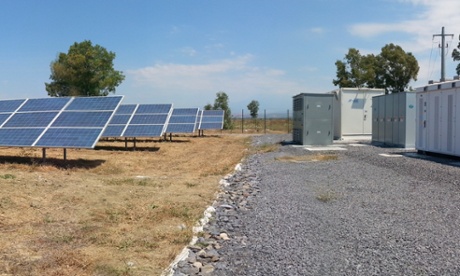
Much new storage capacity will be decentralised, at the local electricity substation level, for instance, where it is best placed to soak up excess energy created by local domestic solar panels. But there will also be large centralised storage facilities connected to the main grid.
“Decentralised storage is not the silver bullet,” says Noce, “but it should be seen as part of the development of a more efficient and stable grid, supporting a smarter electricity system and better use of renewable resources.”
In remote, isolated areas off the grid, storage becomes even more important. In fact, says Irene Fastelli, programme manager of storage projects at Enel Global Generation, while integrating energy storage systems creates value at all levels of the electricity system, such technology is indispensable when it comes to isolated systems.
One such isolated place is the Canary Islands. The depth of the seabed between mainland Spain and the archipelago means it cannot be connected to the national grid. Through its STORE Project, Enel is introducing three different storage systems to help Canary islanders save the renewable energy they generate. These include a system of lithium batteries on Gran Canaria, a flywheel energy storage system on La Gomera, and a bank of ultra-capacitors, which store energy in an electrical field rather than in a chemical reaction, in La Palma.
The aim is to show that large-scale electricity storage systems can improve, in technical and financial terms, the reliability and performance of island networks and support the integration of RES says Fastelli.
New storage technology has also come to the small Italian island of Ventotene, in the Tyrrhenian Sea. The island is powered by four diesel generators, which were struggling to cope with seasonal swings in demand caused by the annual influx of tourists. Domestic solar panels are also growing in popularity.
Enel’s answer has been a storage system based on lithium-ion batteries, which supports solar generation and optimises use of power from existing diesel engines, reducing emissions and fuel consumption by up to 20%.
Enel hopes to use the technology on other Italian islands with comparable conditions to Ventotene, as well as remote areas served by micro-grids.
Incorporating storage into fossil fuel-based systems presents many opportunities beyond Ventotene’s diesel plant. Large storage systems that use compressed air or liquid to store energy can improve fossil fuel power plants’ flexibility and increase plant life, Fastelli explains.
And what about the impact of new storage technology in developing countries? Price believes such storage can help bring affordable electricity to the developing world, particularly parts of South America, Africa and Asia where it’s unlikely electricity grids will ever be built.
“Give people a solar panel, a convertor and a small battery and they’ll be using day time electricity as nighttime light – sunlight into reading light,” Price says. As well as supporting education and learning, this simple system can also be used to pump clean water and cool medicines.
In a remote part of Chile, Enel Green Power has installed a hybrid off-grid power plant. The mining village of Ollagüe at the border with Bolivia previously only had diesel generation. EGP built a 230kW hybrid power plant, with solar and wind. This is equipped with a 520kWh electrochemical storage system, using Sodium Nickel Chloride technology supplied by Fiamm.
This plant is expected to satisfy more than 85% of the energy needs of this remote, high altitude desert area, where temperatures can vary by 20C in a single day. That should limit use of the diesel generator to sporadic periods in winter. Moreover, storage helps the power plant to provide energy 24 hours a day, whereas previously the power went off at 2pm each day. “Indeed, this was also a perfect example of realising a project where innovation and sustainability are intrinsically bounded, and finally, it gave to the team a lot of motivation,” says Luigi Lanuzza, head of storage innovation at Enel Green Power.
Storage will also reduce dependency on fossil fuels in the developed world.
A 2015 report by the International Renewable Energy Agency (IRENA), sets out a roadmap for energy storage. It suggests storage will help the renewable share of annual global power generation rise from 22% in 2014 to at least 27%, and possibly to as much as 40%, by 2030.
The IRENA report emphasises the important role storage is going to play in bringing electricity, especially green energy, to islands and remote areas. “Many of the 52 small developing island states [have] ambitious plans to move their power sectors towards renewables,” it says. “For example, countries like Dominica, Fiji, Guyana, Maldives, Nauru, Samoa, Solomon Islands, Timor-Leste, Tonga, Tuvalu and Vanuatu are targeting renewable energy shares of at least 50% before 2030.”
Content on this page is paid for and produced to a brief agreed with Enel, sponsor of the energy access hub at the Guardian Global Development Professionals Network.