Dutch landscape art is a lovely detour for the imagination, best enjoyed on a Sunday afternoon. Actually, that's not quite right – it creates its own benign Sunday around it. Presumably that was the appeal for Amsterdam merchants in the 17th century who enjoyed peering into tranquil rustic worlds painted with a cartographer's eye for the shapes of fields. Landscape painting often fills a void in urban hearts. Many of the first great European images of the countryside were painted in Venice – a city cut off from its rural territories by water. Similarly, in their tall canalside houses fitted with cranes to raise goods to lofty warehouses, Dutch merchants must have longed for clean air and open spaces.
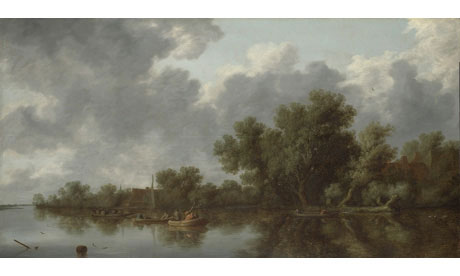
The National Gallery in London is rich in Dutch landscape paintings. One that entrances me is Salomon van Ruysdael's River Scene (1632). This painting has made me look again at the entire genre it belongs to. Did I say these pictures are realistic, topographic, reassuring? But anyone who gazes at Ruysdael's river under a cool sky will soon notice what is strange about it. The soft pale green trees that fringe the river are reflected in its calm glassy surface so completely and clearly that the painting depicts two worlds, not one: the mirror-world in the water conjoins with its counter-image above, the roots of the trees literally pointing in two directions. What at first seemed a simple scene turns out to hint at a portal to another dimension, a grotesque intertwining of worlds.
There is as much suggestion, as much mystery in this painting as in any surrealist dreamscape. Indeed, you might compare it directly with the reflective landscape of Salvador Dalí's Metamorphosis of Narcissus in Tate Modern.
In fact – do that. Both museums are free. A walk between the National Gallery's Room 16 and Tate Modern's Level Two galleries to compare Dalí with Ruysdael would provide a two-way key between art's different universes. Excitement in art is not always announced by drums and drama. Still waters run deep.