The Star Wars planet, Martian puppetry, a forbidden star and a falling satellite – in pictures
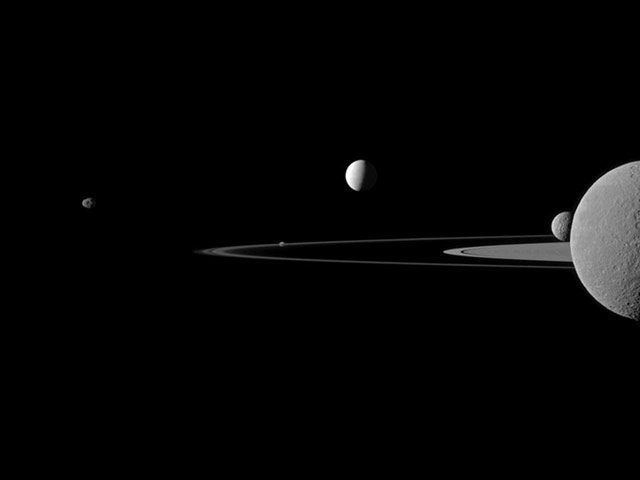
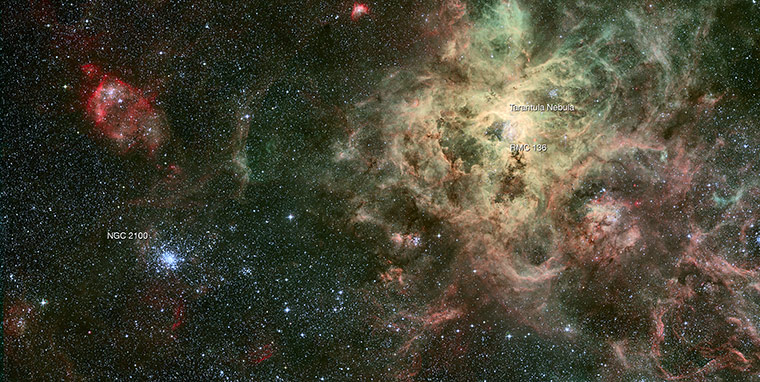
The star cluster NGC 281 is located about 9,200 light years from Earth and almost 1,000 light years above the plane of the Galaxy, giving astronomers an almost unfettered view of the star formation within it. This composite contains x-ray data from the Chandra X-ray Observatory (purple) with infrared observations from the Spitzer Space Telescope (red, green, blue). The large columns of gas and dust on the left of the image probably contain newly forming starsPhotograph: Chandra X-ray ObservatoryA family portrait of Saturn's moons (five out of its 62 known major satellites) taken by Nasa's Cassini spacecraft. Janus (179 kilometres across) is on the far left; Pandora (81 kilometres) orbits between the inner A ring and thin outer F ring near the middle of the image; bright Enceladus (504km) is above the centre of the image; half of Saturn's second largest moon, Rhea (1,528km) is seen on the right; the smaller moon Mimas (396km) can be seen beyond RheaPhotograph: JPL-Caltech/Space Science Institute/NasaThe dramatic surroundings of the star cluster NGC 2100 in the Large Magellanic Cloud. The picture is dominated by the Tarantula Nebula, the most active region of star formation in the Local Group of galaxies that includes the Milky Way. The picture was created from images taken in visible light by the Wide Field Imager on the MPG/ESO 2.2-metre telescopePhotograph: European Southern Observatory
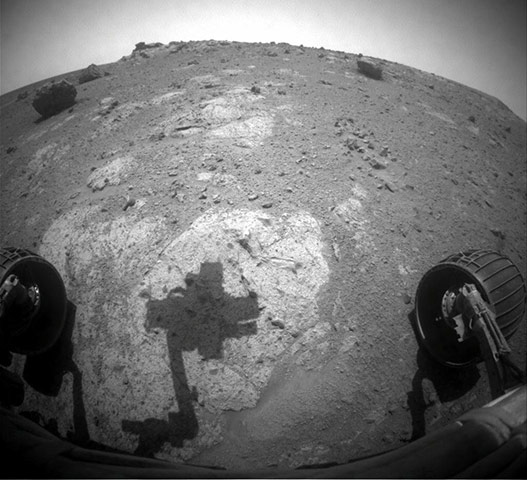
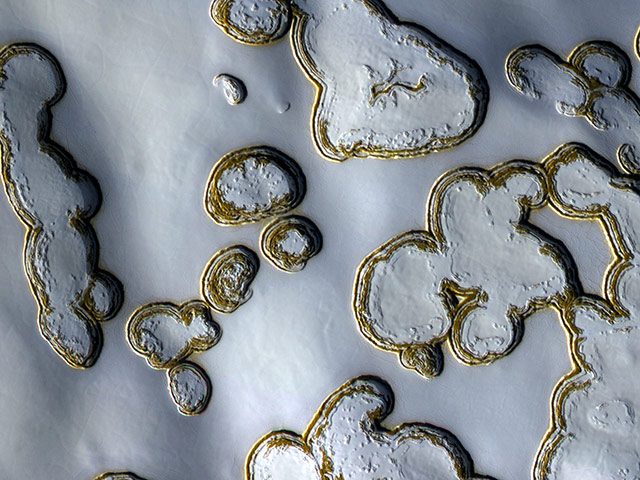
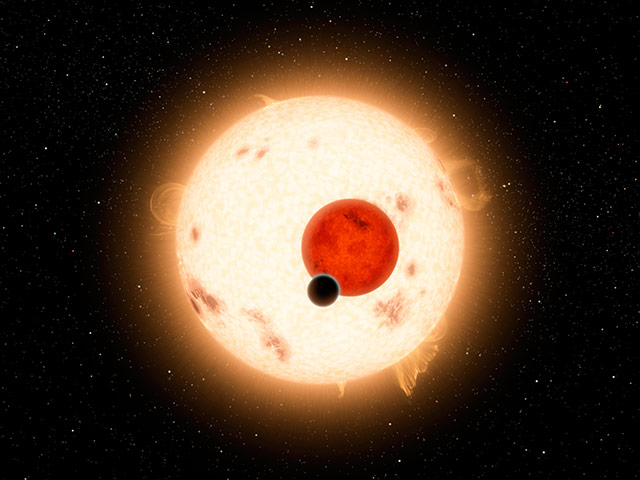
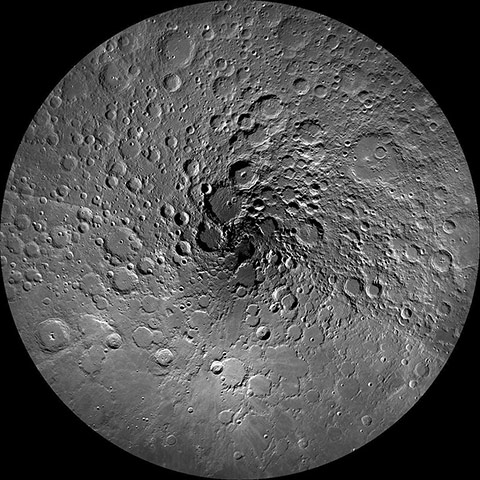
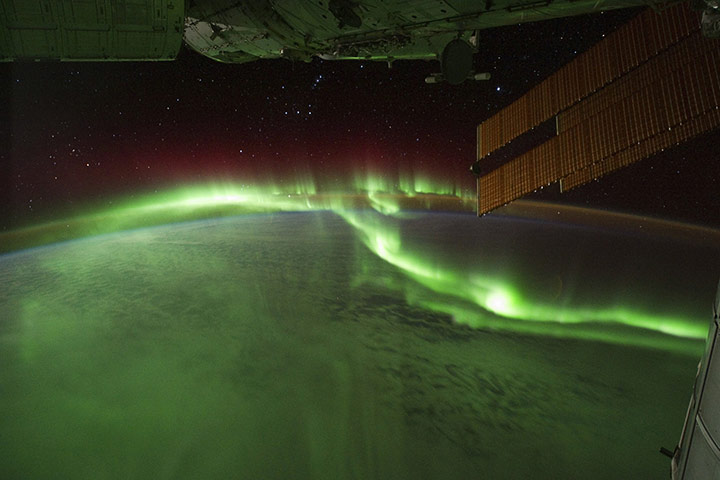
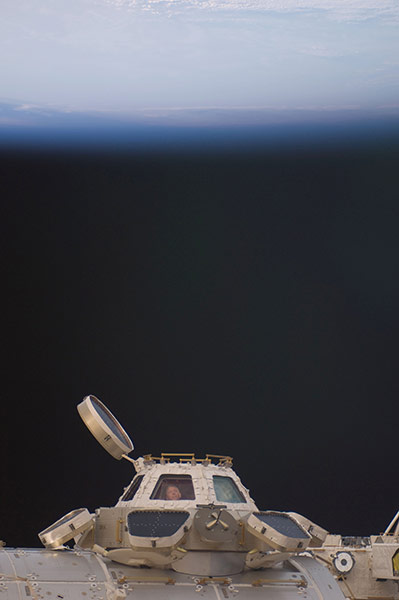
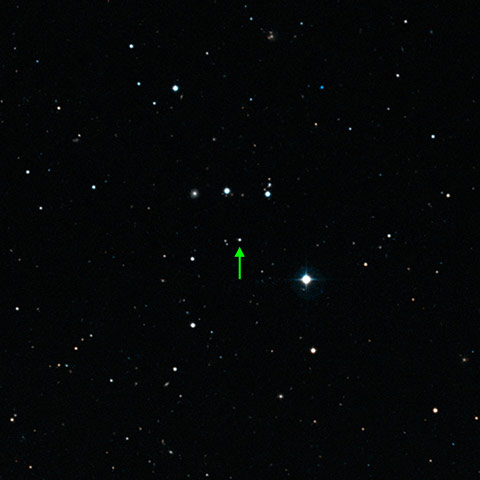
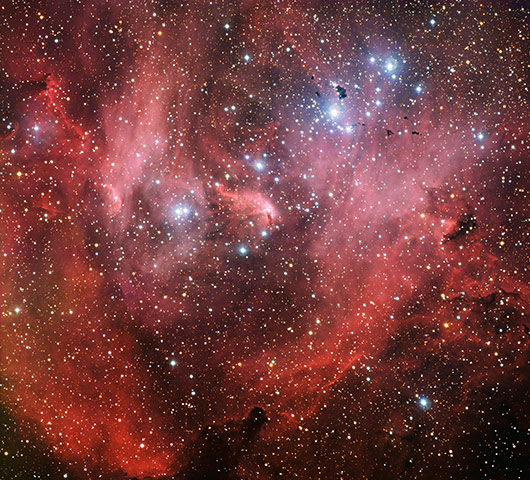
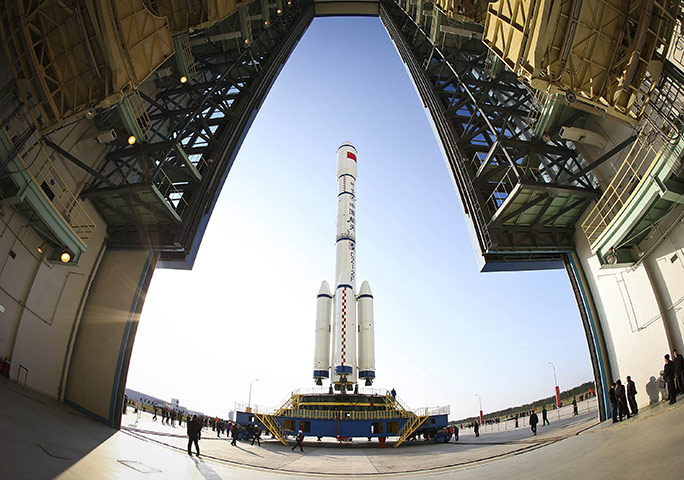
Shadow puppetry on Mars: The robotic arm of Nasa's rover Opportunity casts a shadow on a rocky outcrop dubbed "Chester Lake". The image was taken during the 2,710th Martian day, or sol, of Opportunity's work on Mars (8 September ). Chester Lake, bedrock exposed on the rim of Endeavour crater, is the second rock approached by Opportunity for closer inspection since it arrived at the crater in August after a three-year trek Photograph: NasaAround the south pole of Mars, toward the end of every Martian summer, the warm weather evaporates some of the vast carbon dioxide ice cap. Pits begin to appear and expand where the carbon dioxide dry ice is turning from a solid into a gas. The precise composition of 'gold lining' of dust that defines the pit walls remains unknown. The HiRISE camera aboard the Mars Reconnaissance Orbiter captured the image in late JulyPhotograph: JPL/NASANasa's Upper Atmosphere Research Satellite, or UARS, re-entered the atmosphere and crashed into the Pacific on 24 September without the loss of life some had feared. Launched in 1991 from the space shuttle, UARS had been keeping a close eye on the chemical constituents of the atmosphere before slowly falling and burning up in it Photograph: NASANasa's Kepler mission spotted a world where two suns set over the horizon instead of one. Nasa described the planet, called Kepler-16b, the most "Tatooine-like" yet discovered in our galaxy. Unlike Luke Skywalker's home world Tatooine in Star Wars, the newly discovered planet is a cold world with a gaseous surface. But like Tatooine, it circles two stars. The larger, a K dwarf, is about 70% the mass of our sun, and the smaller, a red dwarf, is about 20% the sun's massPhotograph: JPL-Caltech/R. Hurt/NASAA composite image of the moon's north polar region captured by Nasa's Lunar Reconnaissance Orbiter Camera, or LROC. The image is a mosaic composed of 983 pictures taken over a one-month period during the moon's northern summer. One of LROC's objectives is to map areas of permanent light and shadow on the moon's surfacePhotograph: GSFC/NASAAstronauts on the International Space Station used a digital camera to capture this image of the aurora australis or southern lights over the Indian Ocean on 17 SeptemberPhotograph: ISS/NASANasa astronaut and flight engineer Mike Fossum looks out of a window of the Cupola of the International Space Station, with the blackness of space and Earth's horizon as a backdropPhotograph: ISS/NASAThis ancient star, in the constellation of Leo, should not exist according to astronomers' current theories of star formation. It is too small and has too few elements heavier than hydrogen and helium to have condensed from clouds of gas and dust when it was born around 13 billion years ago. And yet there it is in the picture …Photograph: European Southern ObservatoryThis new image from the Wide Field Imager on the MPG/ESO 2.2-metre telescope shows the Running Chicken Nebula, a cloud of gas and newborn stars around 6,500 light years away in the constellation of Centaurus (The Centaur)Photograph: European Southern ObservatoryThe dwarf irregular galaxy Holmberg II, as seen by the Hubble Space Telescope. The galaxy is dominated by bubbles of glowing gas – sites of star formation. As high-mass stars form in dense regions of gas and dust, stellar winds blow away glowing shells of the surrounding materialPhotograph: NASA/ESAThe Long March II-F rocket that will carry China's first space station module Tiangong-1 into orbit is rolled out to the launchpad at the Jiuquan Satellite Launch Centre on 20 September. Tiangong-1 will serve as a rendezvous and docking platform for China's space programme. The module was launched into space on 29 SeptemberPhotograph: APSaul Perlmutter, Adam Riess and Brian Schmidt won the 2011 Nobel Prize in Physics on 4 October for their research on supernovae. The Nobel jury said: 'They have studied several dozen exploding stars, called supernovae, and discovered that the universe is expanding at an ever-accelerating rate.' They added that the discovery had changed mankind's understanding of the universe. The Crab Nebula (above) is a supernova remnant first recorded by observers in China and Japan in 1054 Photograph: J. Hester and A. Loll (Arizona State University)/NASA/ ESA
Sign up to read this article
Read news from 100's of titles, curated specifically for you.