Cycling’s annals are littered with stories of defying pain and riding on to glory. Bernard Hinault won the 1980 Liège-Bastogne-Liège in a blizzard of snow, in conditions so cold that he suffered permanent nerve damage to his fingers. That’s thought of as heroic. Geraint Thomas fractured his pelvis on stage one of the 2013 Tour de France and finished the race, three weeks later, despite the agonising pain. What a legend.
Even tragedy, like the death of Tommy Simpson, has a perverse allure to it, taken as proof that a rider should stop at nothing to reach the finish – Simpson’s apocryphal last words “put me back on my bike” have endured.
Suffering is part of cycling, that much is clear. Even for you and I, regular cyclists, there is something magical about grinding to the top of a climb, getting through that mental block and holding on till the very peak. We all know the sense of accomplishment after getting that metallic taste in your mouth, of pushing your heart rate into zone five.
Pro cyclists, meanwhile, are a level above. Even without any kind of serious injury, a three-week Grand Tour puts an incredible toll on a body, with the collected niggles that come with cycling 3,000km in 21 days.
Riders simply don’t want to stop, that much is clear. After all the hours on the bike, the time away from home, the altitude camps, the strict diet, it is understandable – why put that to waste when you can keep riding? Even after the most horrendous crash, you see riders wanting to get back on their bike, to get going again. It’s understandable, as the race disappears up the road without them in it
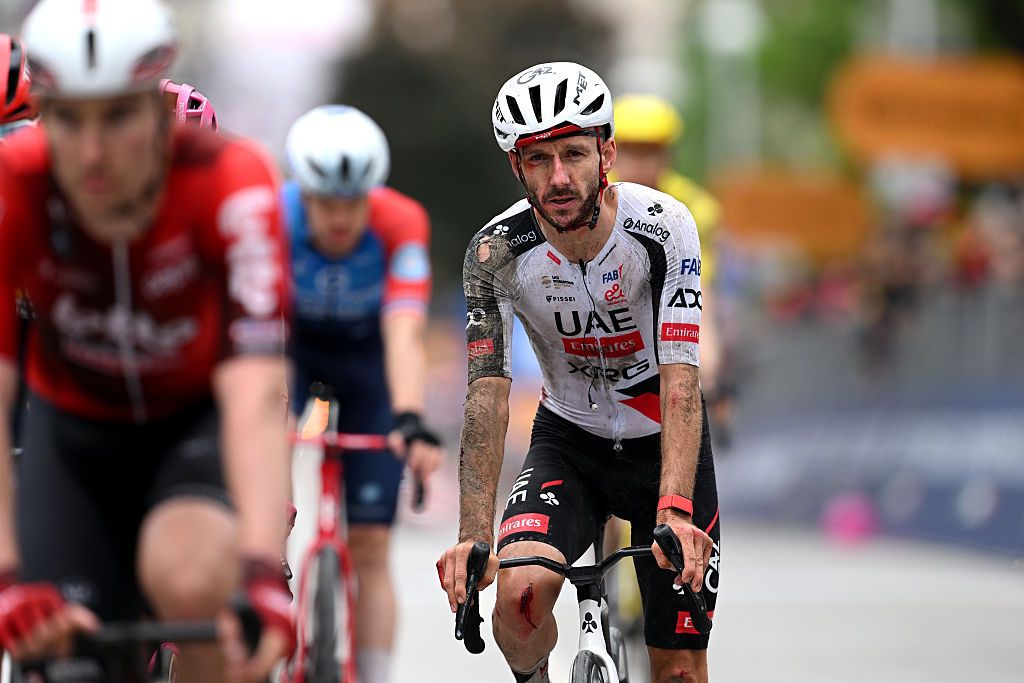
The opening weekend of the Giro d'Italia saw a blatant example of this, as Adam Yates came down in the major crash on stage two, emerging from the side of the road covered in mud and blood, and remounted, with his helmet skewiff, to finish over 13 minutes behind the stage winner.
In the first instance, he was cleared to continue. "Adam had a lot of blood on his face from the crash; he had a cut behind the ear," UAE Team Emirates-XRG sports director Fabio Baldato said at the finish. "We checked him over, so we'll see what the doctor says.”
Then the inevitable news came: Yates had shown concussive symptoms after the stage, and would not be starting stage three. It was one of those situations where us armchair doctors seemed to know before the team did. As last year, when Jonas Vingegaard continued riding at Paris-Nice before developing concussion symptoms, it is clear that there is a hole in the UCI’s concussion protocol, with the incentive still being to keep a rider riding.
In an Instagram story, Pinarello-Q36.5 soigneur Xenia De Roose wrote of the difficulties that come with the scenario of a rider being hurt, but wanting to continue: “People sometimes underestimate the mindset of elite athletes.
“These riders dedicate their entire lives, make enormous sacrifices, and push themselves beyond limits just to be at the start of a race.
“Telling an athlete like that to abandon is never an easy decision.
“In some situations, stopping them can have a significant mental and emotional impact, sometimes even greater than the physical consequences they are feeling in the moment.”
All of this is true, which is why cycling needs to find some way of having an independent voice in the conversation on whether a rider can continue. The athletes themselves will want to continue, it’s in the best interest of the team for them to continue, but where does that leave their wellbeing?
Immediate concussion tests after every crash would disrupt races entirely. Riders undergoing tests could be towed back to the bunch, but this would simply increase the grey areas, what if the incident happened at the end of a race, and it could also open the door for abuse. Perhaps riders undergoing concussion tests in stage races might be allowed to finish without losing any time, but this could be deeply unfair on a mountain stage, and provides no solution in a one-day event.
There needs to be more focus on protecting riders though, rather than simply getting them back on their bike. I understand that cycling isn’t rugby or cricket, that there can’t be a pause every time an incident happens, but there should be more leeway for neutralising a race and allowing time to assess the situation, and to triage possibly injured riders. That would have helped everyone a great deal on Saturday.
This isn’t the 1960s, and there is more understanding of duty of care around riders, even amidst the suffering of cycling. The sport would be a better place if we didn’t glorify pain. De Roose is right that riders don’t take “stop” easily as an answer, but that decision should be taken out of their hands.
This piece is part of The Leadout, the offering of newsletters from Cycling Weekly and Cyclingnews. To get this in your inbox, subscribe here.
If you want to get in touch with Adam, email adam.becket@futurenet.com.