For most new leaders, to have an inaugural speech interrupted by not one but two standing ovations for your predecessor would be nothing short of disastrous.
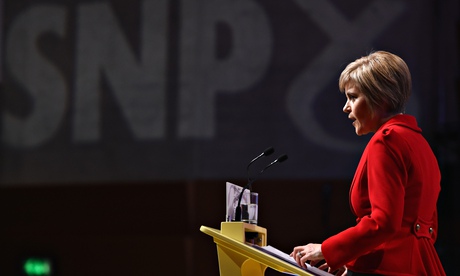
But yesterday afternoon, as the affectionate crowd in Perth concert hall bounced to its feet at Nicola Sturgeon’s first mention of Alex Salmond, it was a measure of the genuine esteem between the pair, as well as canny choreography, that the new leader of the SNP – soon to be confirmed Scotland’s first female first minster – was happy enough to devote the start of her speech to that “champion of our nation”, and still managed not to be upstaged by him.
There was an audible catch in Sturgeon’s throat as she began by telling the gathered faithful: “To stand here before you today, for the first time as your leader, is the proudest moment of my life.” It had been an emotional weekend for the SNP: the first time it had come together nationally since its defeat in September’s independence referendum. Yet it was ludicrously buoyant, despite this glaring fact, thanks to a huge surge in membership and in the polls.
And what Sturgeon lacks in the oratorical furbelow and cosy wit that was Salmond’s stock in trade, she made up for in detail. This was a serious, crafted speech. But it also evidenced the tightrope walk that the new leader faces. The SNP has regularly drawn fire for trying to be all things to all people, not least in the referendum campaign. Perth felt like the last-chance saloon for galvanising rhetoric, and Sturgeon has six short months before the general election to prove that her party is a truly progressive alternative to Labour.
Most importantly, this requires her to ditch the handy get-out of what might be achieved with more powers later and concentrate on what the Scottish government can do with its existing capacity ... whilst continuing to push for more powers later. She needs to implement a progressive programme of government now or risk alienating no voters who see the Scottish government as purely independence-focused, as well as new SNP members who want a more radical agenda, while keeping up the pressure on the Smith commission for the maximum devolution that so many yes and no voters want. It’s quite a balancing act.
In one of the most telling lines, Sturgeon said she wanted to speak to “those beyond our party ranks, to no voters as well as to yes voters”. Making a plea for unity at the general election, hammering the message that a vote for Westminster parties meant a return to business as usual and the evaporation of promised powers, she called for the country to “come together, this time, as one Scotland. Lend us – Scotland’s party – your support.”
In order to avoid sounding as if she were asking the audience to “vote yes in 2015”, the meat of the speech was of the reddest hue. It was a blatant pitch to Labour voters, damning a party that “has taken Scotland for granted for far too long” and “lost its soul”. Voting Labour to keep the Tories out was, she said, the “biggest con-trick in Scottish politics”.
She is far more sure-footed on the territory of practical social justice – a living wage for subcontracted cleaners in Scottish government offices, a new childcare pledge similar to that in the Scottish government’s independence white paper – than skipping over small-business bonuses. But there was much that was easy to say and harder to put in to practice: pledging an NHS budget that would rise in real terms every year inevitably has consequences for other departments; £100m next year to mitigate Tory welfare cuts won’t be enough, and it was notable that she avoided talking directly about austerity, which Holyrood will have to implement regardless of who wins at Westminster.
Sturgeon also had a message for Miliband: no SNP support for a minority Labour government if Trident stays in Scotland. Given how unlikely it is that the Labour leader would agree, it seems a fairly reckless hostage to fortune and it’s worth remembering that even in Scotland the mood on nuclear weapons is split. She was more explicit when saying that she would never consider coalition with the Tories, again something that’s easy to say but which neatly differentiates the SNP from Labour’s unhappy experience with the Tories in the Better Together campaign. There are lots of things that it’s easy for the SNP to say right now, so they are saying them loudly and frequently.
Sturgeon returned to the subject of independence at the end of her speech, insisting that “by our actions and our achievements we will make and we will win the case”. The referendum result “becomes our base camp, and from there the summit is in sight”.
The trouble is, there are plenty of Scots who voted no to independence and consider themselves to be on an entirely different mountain. If Sturgeon can, by an immediately, actively progressive programme for government, convince them to support her party next May, current polling suggests the SNP could blow Westminster politics wide open. But this doesn’t factor in a reinvigorated Scottish Labour party under a new leader who wants his territory back.