Don't be fooled. The Office for National Statistics may have revised up its estimate of growth in the third quarter of 2011 but that doesn't mean that the economy is stronger than we thought. Nor does it have any bearing on whether the UK is heading back into recession. Indeed, the small print of the ONS release is hardly encouraging in that respect.
In broad brush terms, what has happened is that the output of the economy is now thought to have been 0.1% lower in the second quarter of the year, when there was disruption from the Japanese tsunami and the extra bank holiday caused by the royal wedding, and 0.1% higher in the third quarter when those one-off effects unwound. Over the year to the third quarter of 2011 the UK growth rate has remained unchanged at a modest 0.5%.
There were one or two pieces of encouraging news. Business investment was stronger than expected and for the first time in a year there was no retrenchment from the consumer. The bad news was that the increase in activity between July and September relied heavily on companies building up inventories, stocks of goods that they expected to sell later, while the much-anticipated boost from exports failed to materialise. It is a reasonable bet that the weakness of both domestic and overseas demand will lead to firms running down their stocks in the final months of 2011, while the outlook for exporters has become grimmer and grimmer as the year has reached its end, largely due to the deepening crisis in the eurozone.
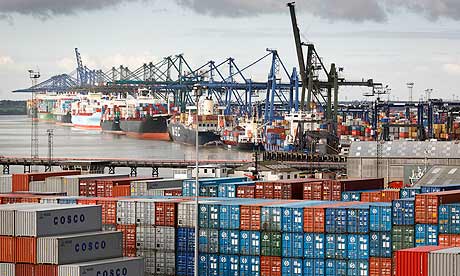
One final reason for concern comes from the separate ONS release for the balance of payments in the third quarter. This provides a more comprehensive analysis than the monthly trade figures, since it takes account of the profits and dividends earned overseas by UK companies and by foreign-owned companies in the UK. Ministers had been modestly cheered by the last set of balance of payments figures three months ago, since they showed the deficit dwindling to just £2.4bn. That has now been revised up to £7.4bn, while the third-quarter deficit rose to a record high of £15.2bn.
The current account figures are notoriously volatile but there is nothing in the data to suggest that the economy is about to experience the rebalancing the government is awaiting. Unless, of course, imports collapse as the economy heads back into recession, something that is a very real possibility.