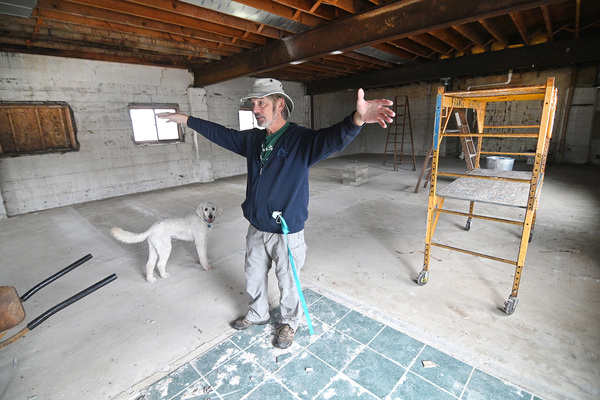
SANFORD, Mich. — The first three days after the flood, after picnic tables and recycling bins went floating past his house, Aaron Lindgren was so broken he couldn't talk on the phone.
"Text me," he told everyone, because that way a guy who's spent his life getting things done didn't have to try to explain the desolation of not knowing how or where to start.
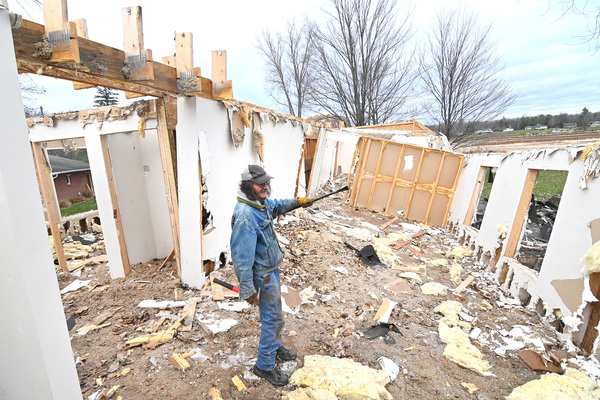
Now he's good. Thursday marked six months since the Edenville Dam breached 10 miles north of Sanford and unleashed millions of gallons of chaos downstream, through Wixom and Sanford lakes and the Tittabawassee River. Earlier this month, his sister had just repainted the living room, and Lindgren and a buddy were re-siding his house.
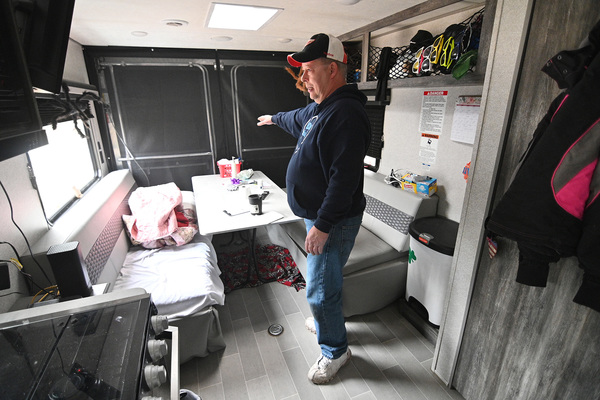
He's still sleeping in a trailer on the lawn, but that's optional. He gets a little misty talking about the shock of it all, but that's natural.

"The guy two houses down, he had bluegills in his attic," said Lindgren, 50. "The widow next door, the insurance company gave her $10,000 and she just walked away."
The bad news remains easy to spot in the Village of Sanford, home to a shade fewer than 1,000 resilient souls northwest of Midland. There are concrete slabs in the spots where 20 or 30 houses used to stand. Where Sanford Hardware reigned as the center of commerce downtown, there's a rectangle of mud, and a change in the boundaries of the flood plain might keep the store from coming back.
But there's plenty of good news, too, or at least better news. To start with, it doesn't look like anyone will face winter in a tent.
Village president Dolores Porte poked around, and then posed the question in the online gathering spots for people whose quiet communities became federal disaster areas: Everybody got a roof?
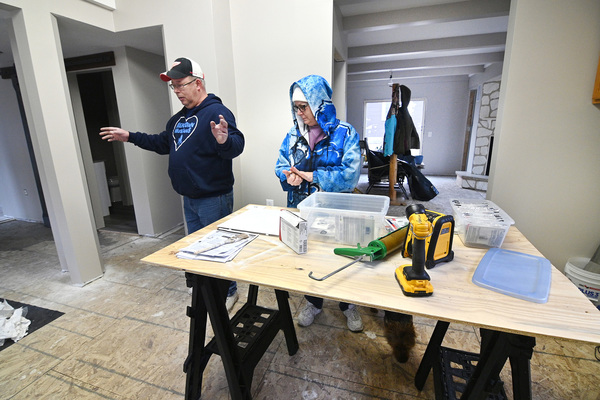
Some of them might be aluminum, but yes, she was told. An older fellow living in a trailer said his garage is almost done, and it's heated. The dad and three kids living in a 5th-wheel camper mounted on a plywood platform have moved to a motel in Midland; he'd prefer to be closer to the site where a mobile home is supposed to replace the little house that drifted away, but now breakfast is free and the shower works.
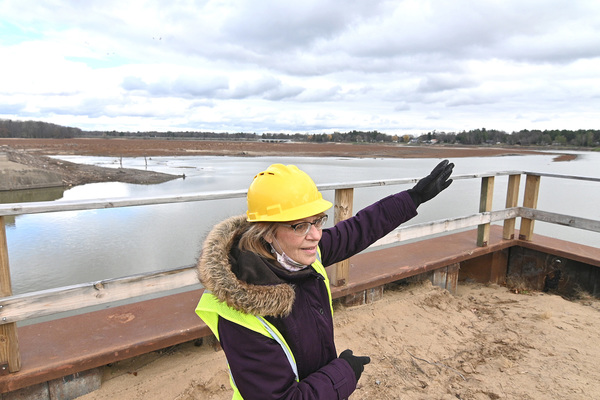
"The mud was like ice skating," said Porte as she led an informal tour of the area near Sanford Dam and onward into the village center. "I wore boots for three months."
An accountant by training, Porte is a retired Dow Chemical executive who traveled the world but never lived far from where she grew up. Like the other village officers, she is paid $50 a month.
Until May, she said, "if there was a hole, we plugged it. If the playground equipment was getting old, we'd get a grant to replace it." Since the flood, "we're working 12 hours a day."
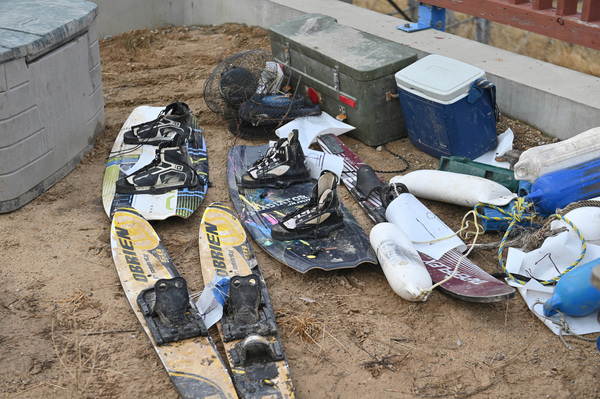
She pointed to one of the slabs: that was the city clerk's house, and she used to take work home, so those records are gone. Other records were kept at the Department of Public Works, which flooded, so they're somewhere between Sanford and Midland along with trucks and weed trimmers and all the Christmas decorations.
The treasurer's house was pummeled, too, so Sanford is writing its checks by hand.
It's coping, though.
COVID-19 has spiked in Midland County, from barely 600 known cases on Oct. 5 to 2,217 last Tuesday. With the Canadian border closed, the price of wood has spiked as well; a 2-by-4 that cost $3 when the dam broke May 19 is $9 now.
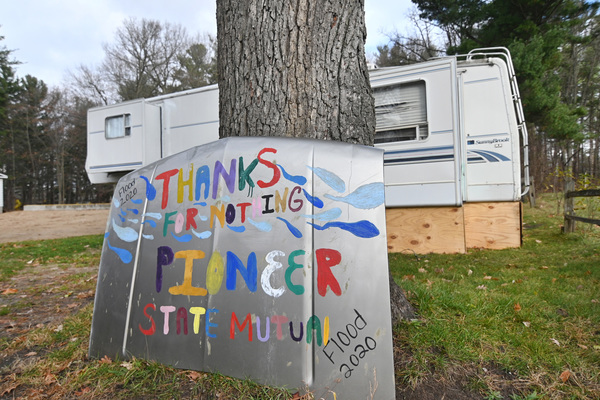
Contractors and skilled tradespeople are overwhelmed, and insurance companies are the targets of insulting yard signs, such as the one painted in bright colors on the propped-up hood of a truck: "Thanks for nothing Pioneer State Mutual."
But the thing about small towns is that everybody pitches in, Porte said, and the thing about small rural towns is that someone always has the piece of heavy equipment or the expertise you need.
Lindgren, an operator at Dow Chemical in Midland, has a high school friend who hangs drywall. That helped. The new windows took 60 days to arrive, but they showed up and they're installed in the house he grew up in and then bought from his parents 22 years ago.
The last time Sanford had a flood, during a heavy rain in 2017, the worst of it for Lindgren was a puddle in the side yard. This time, after a monsoon launched a chain reaction that drained the lakes, his large appliances were tipped over and floating through the house.
When the emergency sirens went off, he said, he and long-time girlfriend Lisa Davy only had time to grab the essentials — the cat, the dog, the Gray Goose.
He didn't even think to put his new $4,000 Taylor guitar on a high shelf, so it was ruined. Her $50 I'm-just-learning guitar was in a fabric case, and it bobbed on the surface, unharmed.
When they came back, he financed a 29-foot Forest River toy hauler, the kind with a bed up front and a rear section ideal for four-wheelers or kayaks. They lived in it for months. When a bedroom was finally ready in the house, she moved and he stayed behind with his gas heat, cable and two TVs.
At this point, he explained, "we need our space."
SMALL, LARGE VICTORIES
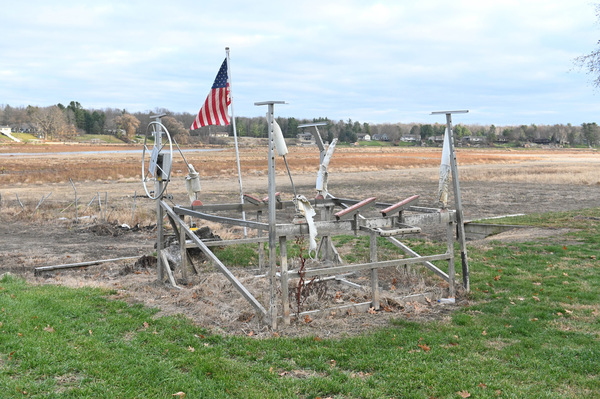
Sanford lost most of its restaurants in the flood and much of its identity. Now it's a waterfront town with no water, and it's projected to stay that way for five years minimum, until the dams are repaired and the lakes refilled.
Amid the huge, obvious losses, however, there have been small victories. Or large victories, if they're yours.
One woman's mobile home was uprooted and destroyed. Somewhere within it was the urn holding her mother's ashes. "Don't take this away," she spray-painted on the side, and below that she put her phone number. The urn was found in a bedroom, buried in mud.
Porte was walking with a woman who looked down at something poking out of the muck. "Oh," the woman said, "these are my refrigerator magnets." She wiped them clean and put them in her pocket.
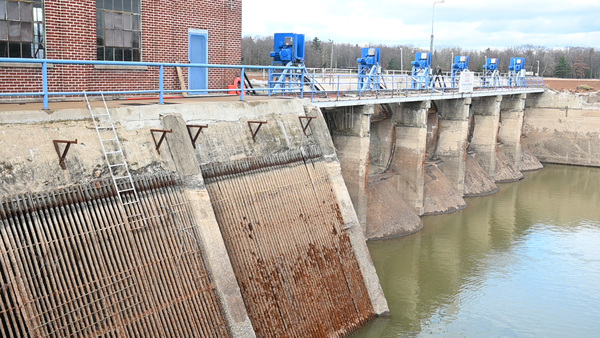
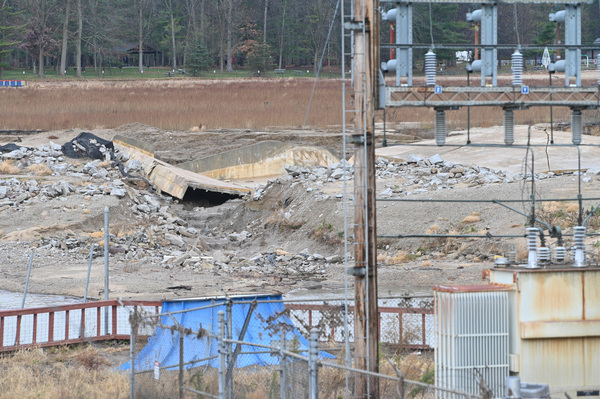
One of the workers clearing the 3.7 million pounds of debris piled 30 feet high against Sanford Dam opened a tackle box and was enough of an angler to recognize muskie lures, and good ones at that. He posted a photo online, and on Nov. 14, Ron Berry had his lures back.
Berry said he was so thrilled to spend time with them that he'd probably skip a day of deer hunting.
Connie Methner, 63, reopened CJ's Hairstyling on the main drag, West Saginaw Road, in early October. She's three-quarters of a mile from the Tittabawassee, and she'd had water to the ceiling.
"People are driving by, tooting their horns," she said. "People are waving at you."
As with most places, there's a divide in Sanford between the haves and the have-lesses, accentuated by some of the $500,000-plus homes on the lake outside the 1.5-square-mile village.
"This is the first time everybody was the same," Methner said. "Everybody lost. Even if you didn't lose your property, you lost your restaurant or your beauty shop."
The rebuild of the three-chair shop cost her $60,000 and any hope of an imminent retirement. Her insurance company acted as though they'd never met, she said, but to her, the flood was much less an act of God than a series of human errors.
The many lawyers handling group cases blame the state for leaning on the Edenville Dam operator to raise lake levels, the better to protect freshwater mussels. The operator, Boyce Hydro, stands accused of poor maintenance and design; it filed for bankruptcy protection on July 31.
Leah Lollar lives three houses from the dam on a high enough lot that she thought she was safe from water, if not fire: her dream home burned to cinders nine years ago.
When the lake rose and the siren sounded, she and her husband, Mark, had time to put their three small parrots and two large ones into their travel cages, collect their elderly neighbors, and steer their RV toward a campground distant enough to be safe. Mark will spend the winter re-creating the intricate woodwork in their ruined basement.
"I don't like when people call it just a flood," Lollar said. "It was a dam breach. This is a man-made mess, and the people have basically been told, 'Too bad for you guys.'"

The dam "shouldn't have been privately owned," she said. "The state shouldn't have allowed them to go on and on without making the repairs." And as for the state's concern for bivalves, one of which was endangered, "Do they have mussels now? How did that work out for them?"
FLOOD PLAIN CONCERNS
The flood, or failure, or colossal foul-up, caused $200 million in damage from Edenville to Midland, according to the state. It destroyed 150 homes, damaged 790 others and savaged public streets and buildings to the costly tune of $34 million.
By the time the rush of water reached the river, it was a fire hose blasting into an eyedropper. Where the river bends east stood Village Park, home to baseball and softball diamonds that served 350 kids a season.
Andy Clark is one of the board members who hopes to get the fields rebuilt by 2022. He watched a 500-pound propane tank flow backward up a good-sized Tittabawassee tributary.
"The craziest thing I saw in all of this," he said, was a backflow so fierce it blew out a culvert. "I hope to never see anything like that again."
In Sanford, five of the seven bridges wrecked by the overflowing lake and river are now back in use. If residents are peeved at their insurance carriers, many are pleased with FEMA; the application process can be convoluted and no one is being made whole, but checks have been written.
A newer concern is the October shift in the boundaries of the flood plain.
"The data should reflect that it wasn't a 500-year flood. It was a dam breach," said village councilman Lon Wackerle.
Wackerle said he was so moved by the spirit of cooperation post-flood that he and his girlfriend bought two sorely damaged buildings on West Saginaw — a restaurant called Lanny's whose owner has reopened in Midland, and a chiropractic office that they hope to turn into a dance or yoga studio.
That building has an apartment in back, a needed amenity in an area with a housing shortage even before the high waters.
"I've been accused of toxic positivity," said Wackerle, accompanied in the future dance studio by a Goldendoodle named Walden. The flood "made me know that this is my home for the rest of my life."
The owners of Sanford Hardware wish they could share his certainty.
They're hoping to rebuild and reopen in their old spot. The flood plain designation would require them to put the entrance seven steps above ground level, said Adam Sian, not a tenable arrangement for older customers or people carrying snowblowers.
His father, store owner Dennis Sian, is appealing the ruling to the state. Meantime, the former 10,000-square-foot store is operating in 3,000 square feet, offered at no charge by a friend who cleared out a woodworking shop to make room.
"If nothing else, it kind of boosts morale when a business comes back," Adam Sian said.
Some won't. The leading dinner spot, Alex's Railside Restaurant, reopened at the Midland Mall in the former home of a Ruby Tuesday's. But the Red Oak, another mainstay, is undergoing an extensive and expensive renovation.
"We have a couple of pizza places. Subway. McDonald's," Sian said. "You can only do that so much."
MANY UNKNOWNS
Little things, agreed Teresa Quintana, can mean a lot — even as small as a slice of pizza or a postcard.
After the post office flooded, it relocated to a Chevy 3500 cargo van. The building just reopened, "and those little things make a big difference just for quality of life," she said.
Quintana, a real estate agent, co-founded a Facebook page called Sanford Strong that became the go-to spot to hear about drywall giveaways or the free dinner pick-ups in the parking lot at Cole's Wrecker Service.
It's still unclear, she said, how badly home prices will be hurt by the loss of the lake. With addresses in short supply, she said, she sold a 1,668-square-foot house in two days for $5,000 above the $150,000 list price, even though the entire main level needs to be redone.
Larger, unblemished homes that have lost their lake view might be another story. The expectation is at least a 25% drop, but "appraisers are having a really hard time," she said, "because of a lack of comparable sales."
Another unknown is the cost of restoring the dams and lakes. One unwelcome estimate for Sanford Lake residents was $2,700 to $4,000 per home for 40 years, atop the premiums they have already paid in price and property taxes.
But that's down the road. Porte, the village president, would rather focus on reopened bridges and the other incremental successes.
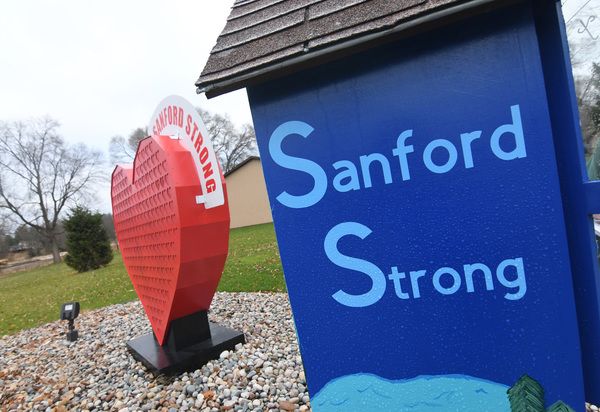
Near the dam and the repaired public works yard, there's a 6-foot-tall red metal heart with a reminder on one side, taken from the website and increasingly taken as gospel. It's a phrase that stops being a cliche when you've moved thousands of tons of sludge and rubble: "Sanford Strong."
The sculpture was donated by a sign and lighting company and delivered in an open truck, "and people followed it all the way through town," she said.
There was muted grousing later from people concerned about the cost, which was nothing. Someone online asked her, "What value does it have?"
She responded with one word:
Hope.