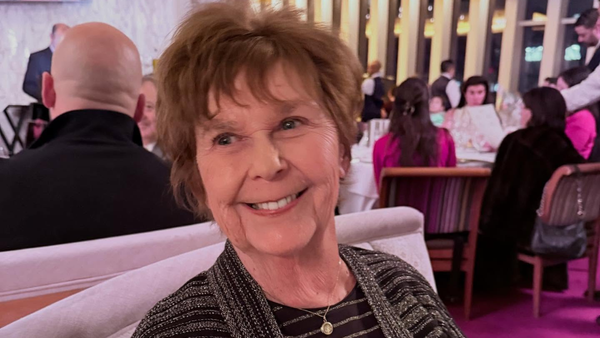
Twice a week, at the Marks & Spencer cafe on Eltham High Street in south-east London, Mary Marshall meets her sisters, Joan, Sheila, Kath, Pat and Anne.
“They all know us in there,” says Mary. “It can be loud. We do have our rows. Someone came up to us once and said, ‘What was all that about?’ I said, ‘Oh, nothing. Come around 3pm any Tuesday or Saturday and there will be another one.’”
The six sisters – Mary the eldest at 92 through to Anne, “the baby” at 77 – have been bickering vociferously ever since their childhood in wartime London and Sussex.
“We all pinched each other’s clothes. We didn’t have many and you always knew who had your vest. From then on, we’ve always argued,” says Joan, 90. “But it never lasts long.”
Now, Joan’s nephew, Jim, son of Kath, 85, has collected their stories – disagreements and all – in a book about an extraordinary sibling bond. Today, four of the sisters are gathered at Kath’s daughter’s house. Sheila, who has a bad cold, and Pat, who is caring for her husband – who has sadly since died – are missing. They are mentioned frequently.
“We just depend on each other,” says Mary, explaining what sisterhood means to them. “We know we are very lucky, and while we’re all still here we see each other all the time. And we’re on the phone every day.”
“Especially if it’s Kath on,” adds Joan. “She’ll talk for two hours. I have to put the phone down to go to the toilet.”
Kath does not deny the charge. “My husband comes in and says he’s watched three programmes while I’ve been on the phone. He had to get unlimited calls on his mobile. There’s plenty to talk about. Do you remember so and so? Then that leads somewhere. Then you get off and realise you forgot to mention something.”
Their closeness – “I should think we know everything about each other. We’ve got no secrets – you couldn’t have,” says Mary – is due in part to the particular circumstances of their childhood. “We brought ourselves up,” says Mary.

In September 1939, the Jarman sisters (as they then were) and their mother, Annie, were among the many people evacuated from their south London neighbourhood to Hailsham in East Sussex.
The family would not be separated, insisted Annie, and when no billet was found for a group of seven (including three-month-old Anne) they were eventually offered an empty house. No 18 Battle Road was semi-detached, with a school and green fields opposite. The Jarmans initially lived downstairs, and the girls’ father, Pierce, joined them at weekends. Upstairs, for a time, were Mrs Endicott – a neighbour from their Bermondsey home – and her seven children.
“We thought it was a huge house, with a nice big garden and a side path and everything,” says Joan, “but none of us can remember where we actually all slept.”
The family quickly settled into a routine: housework, school (where, to Mary, taught previously by nuns, the teacher “looked just like Errol Flynn”), games in the kitchen (playing schools, shoe shops and hat shops were favourites with the sisters providing a ready supply of pupils and customers) and a bit of time at the local playground.
All this was thrown up in the air when Annie died in June 1941, aged 45. “I remember us standing at the bedroom window waving her off in the ambulance to London,” says Joan. Annie had been hospitalised before – she had tuberculosis, although her daughters did not know it – and they assumed she would soon be home. “That was the last we saw of her.”
One of the girls’ three spinster aunts came to stay. “She just showed me the telegram: ‘Annie died this morning,’” says Mary. When Kath and Sheila, then nine and 11, came home from school they too were given the news. “She said, ‘Your mother’s dead.’ It was so callous,” recalls Kath.
Pierce, concerned for his daughters, suggested his sisters stay permanently. Unsurprisingly, the girls were not keen. “We said we would look after ourselves,” says Mary. “We knew we could manage. We’d learned a lot from my mum. Besides we didn’t want them there.”

The billeting officer was persuaded to give the arrangement a go – although the sisters don’t remember anyone checking on them – and for the next four years, Mary, 16, and Joan, 14, who left the part-time job she had just started, assumed the traditional roles of father and mother respectively.
Mary went to work. Joan cooked, sewed and cleaned. Everyone did their chores and in the evenings the girls chatted – although not often about missing their mother – and listened to the radio. Would-be suitors were allowed in only when their father was present at weekends. “We knew we had to behave and we absolutely did,” says Joan.
On Friday evenings, Pierce arrived to a clean, tidy house. “We would meet him off the Green Line bus on the high street,” she adds.
Their mother’s absence was keenly felt by the older girls in particular. “When you want your mum, when you start your periods or something, you really feel that loss,” says Joan.
For Anne, only two when Annie died, her older sisters took on a maternal role, playing with her, later taking her to nursery school in her pram. “As I got older, I think people thought Joan was my mum,” says Anne. “I never really said I didn’t have a mother because Joan was always there.”
With only one specific memory of Annie – pulling her from the fire when she fell and burned herself as a baby – Anne’s sisters remain a comforting link to her mother. “They are the only ones who I can talk to about her. Your siblings are the only ones who share your childhood experience.”
There was no shortage of love in the household – “Daddy was always so proud of us,” says Kath – but the enforced independence and the initial hostility from local children towards the evacuees drew the sisters closer and, says Mary, “hardened us a bit. We grew up quick. We weren’t frightened.”
Only now, says Joan, does their situation strike them as sad. “We never felt sorry for ourselves. We just got on with it. Now I look back and I could weep. At a time when we needed help, no one really gave us a shoulder to cry on.”
The resilience they developed came also, believes Kath, from their mother. “She had a very strong personality. It’s probably rubbed off on us all. We can all look after ourselves. We are all quite similar in that respect.”
To outsiders, agrees Anne, the sisters probably appeared formidable, even in childhood. “We were known as the ginger girls from Battle Road. We didn’t really have any trouble.”
Although they have developed other friendships over the years, it has never struck them as particularly necessary. “We didn’t need anyone else as children, or now,” says Kath. Holidays, parties and outings were always amply filled with their own families.
The girls all married in age order. Mary first, to a Canadian soldier she met in Hailsham, the next four sisters finding husbands at a church youth club on their return to London after the war. Pat met her husband at work. Between them the sisters have had 15 children. Mary, Joan, Sheila, Anne and Pat are now widowed.
“The husbands always had plenty to talk about,” says Joan. “They would be off in their corner and leave us to it.”
Trying to do anything else, they admit, would be difficult. “We do all talk at once. In a big family you don’t get a word in edgeways if you don’t interrupt,” says Kath.
“We finish each other’s sentences,” continues Joan, illustrating her point. “We can always follow what everyone is saying.”
At the family dinner table, recalls Joan, being vocal was a lesson learned early. “If we had rabbit we’d all shout for leg. My dad used to say, ‘It’s only got four bloody legs.’”
While their conversation is not rooted in the past – with tangents including the Brit awards, the comfort of leather sofas and the predicted gender of Joan’s forthcoming first great-grandchild – it is a regular source of material, and disagreement.
“We don’t all remember things the same, but when we are all together we talk about the past a lot,” says Mary. “It is our way of bringing back the family we have lost.”
• The Sisters of Battle Road by JM Maloney is published by Corgi, £6.99. To order a copy for £5.94, go to bookshop.theguardian.com or call 0330 333 6846. Free UK p&p over £10, online orders only. Phone orders min. p&p of £1.99.