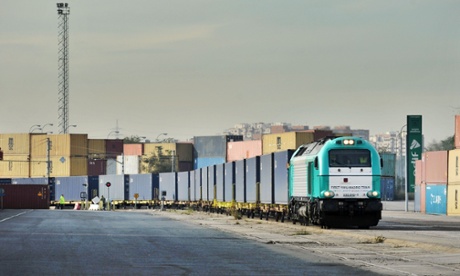
The longest rail link in the world and the first direct link between China and Spain is up and running after a train from Yiwu in coastal China completed its maiden journey of 8,111 miles to Madrid.
En route it passed through Kazakhstan, Russia, Belarus, Poland, Germany and France before arriving at the Abroñigal freight terminal in Madrid.
The train, which carried 30 containers, was met by the mayor of Madrid, Ana Botella, and the minister of public works, Ana Pastor. The railway has been dubbed the “21st-century Silk Road” by Li Qiang, the governor of Zhejiang province, where Yiwu is located. Its route is longer than either the Trans-Siberian railway or the Orient Express.
The first train was carrying 1,400 tonnes of cargo, mostly toys, stationery and other items for sale over Christmas across Europe.
According to China’s ambassador to Spain, Zhu Banzao, it will return laden with wine, jamòn and olive oil in time for the Chinese new year in February.
Yiwu is the world’s largest wholesale hub for small retail consumer goods and plays host to a vast 4 sq km market where tens of thousands of traders work daily.
The journey was a test run to assess the viability of adding Spain to a route that already links China with Germany five times a week. Those trains link Chongqing, a vast industrial city in south-west China, with Duisberg, and Beijing with Hamburg.
China is Spain’s biggest trading partner after the European Union, with bilateral trade worth around £16bn.
China is Spain’s third largest source of imports, after Germany and France. About half of these imports are made up of mobile phones and clothing. The Spanish president, Mariano Rajoy, was in China in September where he signed deals said to be worth more than £6.3bn.
A major advantage of the rail route is speed. The train took just three weeks to complete a journey that takes up to six weeks by sea. It is also more environmentally friendly than road transport, which would produce 114 tonnes of CO2 to shift the same volume of goods, compared with the 44 tonnes produced by the train, a 62% reduction.
The train would have been faster but the cargo had to be transferred three times during the journey as a result of incompatible rail gauges. The locomotive also had to be changed every 500 miles.
The service is being operated by InterRail Services and DB Schenker Rail and in Spain by DB’s Spanish offshoot Tranfesa.
At the welcoming ceremony the Madrid mayor pointed out that a majority of the city’s 30,000 Chinese residents hail from Zhejiang province.
Relations between Spain and China took a dive earlier this year when a judge sought international arrest warrants for former president Jiang Zemin and four top officials in relation to alleged genocide in Tibet. The Spanish parliament took barely 10 days to throw out the case.