Get all your news in one place.
100's of premium titles.
One app.
Start reading
Latin Times
Latin Times
Politics
José Gutierrez

The Silent War for Venezuela's Gold: Troops Move In, Mafias Flee, Investors Wait

Miners work at an artisal gold mine in Las Brisas de Cuyuni, near the town of Las Claritas, Bolivar state, Venezuela, on June 11, 2026. Venezuela, home to the world's largest oil reserves, also has deposits of gold, diamonds, bauxite, coltan and rare earths, but much of its mining areas notably the 112,000 sq km Mining Arc located in remote regions far from major cities is controlled by armed gangs or guerrilla groups. (Credit: Photo by Federico PARRA / AFP via Getty Images)

The helicopters arrived without warning. Amid explosions and low-flying maneuvers, hundreds of miners hastily abandoned the Las Claritas and Kilometer 88 mines in southern Bolívar state, as military columns moved into one of Venezuela's richest — and most violent — territories. A shopkeeper in Las Claritas told Reuters that drones flew low overhead for hours during the night, and residents declined to be named out of fear for their safety. The scene marked the beginning of something far more significant than a routine security operation.

The question echoing throughout the country is as simple as it is unsettling: Why now? For decades, the state allowed mafias, armed "syndicates," and corruption networks to flourish over the continent's most coveted gold mines — activity that non-governmental organizations and U.N.-backed investigators say is largely controlled by organized crime groups and armed factions. Today, those same structures are being pursued with unprecedented determination. And the answer, according to multiple sources and press reports, lies not in the barracks, but in the boardrooms where the economic future of the Orinoco Mining Arc is being negotiated.

Because behind the roar of weapons another war is being waged, silent and with much greater consequences: the dispute over who will control one of the largest reserves of mineral wealth in the hemisphere.
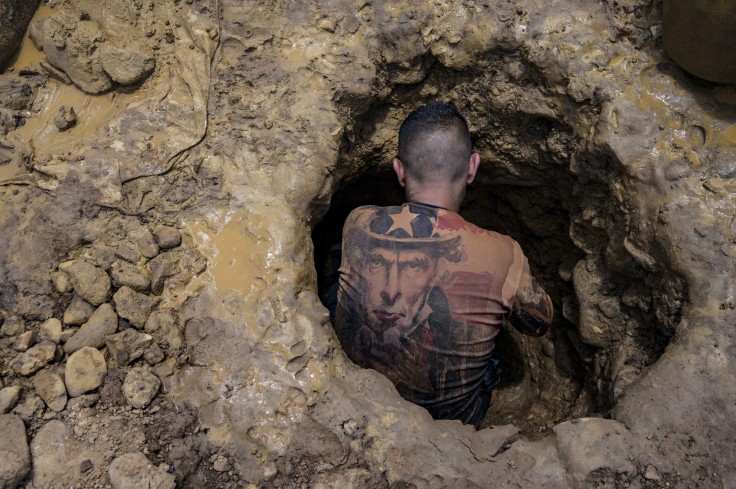
TOPSHOT - A Venezuelan miner wearing a shirt with the image of "Uncle Sam" works digging in a mine to extract gold, which will then be sold in El Callao, Bolivar State, Venezuela, on August 29, 2023. In the town of El Callao, extracting gold from soil starts off as a kid's game, but soon becomes a full-time job that human rights activists says amounts to child exploitation. (Credit: Photo by Magda Gibelli/AFP via Getty Images)

The turning point has a date. In early March 2026, U.S. Secretary of the Interior Doug Burgum visited Caracas accompanied by representatives of more than two dozen U.S. mining and minerals companies, many of which had previously operated in Venezuela. The message was unequivocal: the West wants access to Venezuela's strategic resources — gold, coltan, copper, diamonds, bauxite, and rare earth elements — which have become top-tier geopolitical assets, in part as Washington seeks to counter China's hold on critical minerals.

The results came quickly. A Washington-brokered agreement was announced between Venezuelan state mining company Minerven and the commodities giant Trafigura for between 650 and 1,000 kilograms of gold doré bars of roughly 98% purity — a contract reported at an approximate total value of $165 million. Burgum himself later confirmed that the first physical shipment of Venezuelan gold, valued at $100 million, had been brought home — the first such precious-metals shipment between the two countries in more than two decades.
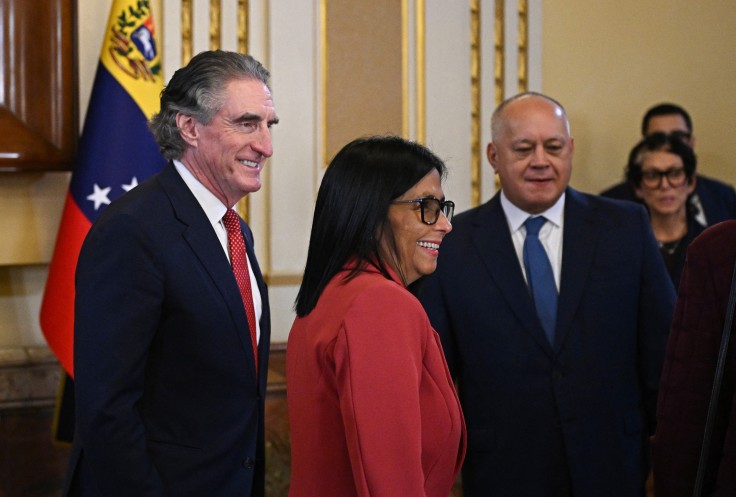
Venezuela's interim president, Delcy Rodriguez (C), US Interior Secretary Doug Burgum (L) and Minister of Interior, Justice and Peace Diosdado Cabello react during a meeting at the Miraflores Presidential Palace in Caracas on March 4, 2026. US Interior Secretary Doug Burgum on March 4, 2026, became the latest senior Trump administration official to visit Venezuela, as Washington pushes to ramp up oil and mineral production in the country. (Credit: Photo by Federico PARRA// AFP via Getty Images)

The deal has not escaped scrutiny. In April, Senate Finance Committee ranking member Ron Wyden sought answers from Trafigura on the structure of the agreement and its safeguards against corruption and human-rights abuses, noting potential conflicts with U.S. counter-terrorism financing requirements.

The Treasury Department, through its Office of Foreign Assets Control, moved in parallel. The day after Burgum's visit, OFAC issued General License 51, authorizing certain activities involving Venezuelan-origin gold — later broadened on March 27 by General Licenses 51A, 54 and 55 to cover a wider range of minerals and mining operations. And Venezuela's National Assembly, after an initial vote on March 9, advanced a new mining law to replace regulations dating to 1999 — opening the sector to private and foreign capital, with terms that could authorize joint ventures, adjust royalty regimes, and allow international arbitration.

But no transnational corporation invests billions in a territory dominated by armed gangs. For that capital to flow in, the state must guarantee that the mines and routes are under control. That, according to analysts and independent media, is the true purpose of the mega-operation: not to restore public order out of conviction, but to prepare the ground for a new economic phase. Reporting indicates that investors conducted technical inspections in El Callao a day before the military deployment. Notably, Burgum had said the companies traveling with him have proven track records of integrity, and that the Rodríguez government was offering security assurances to firms willing to do due diligence and reopen mines in those hard-to-reach areas.

Amid this reorganization, a silence stands out that many consider telling: that of Diosdado Cabello, Minister of the Interior and Justice. He was present in the room during the meetings with the U.S. delegation; yet he has not presented official reports or made statements about the operations, something unusual for a figure who speaks frequently. Given this information vacuum, there is speculation as to whether the order to militarily seize these territories came from him, from Delcy Rodríguez, from Gustavo González López, or from all three together. As of this writing, no authority has offered a public accounting of the operation, and local officials have not commented on whether anyone has been killed or injured.
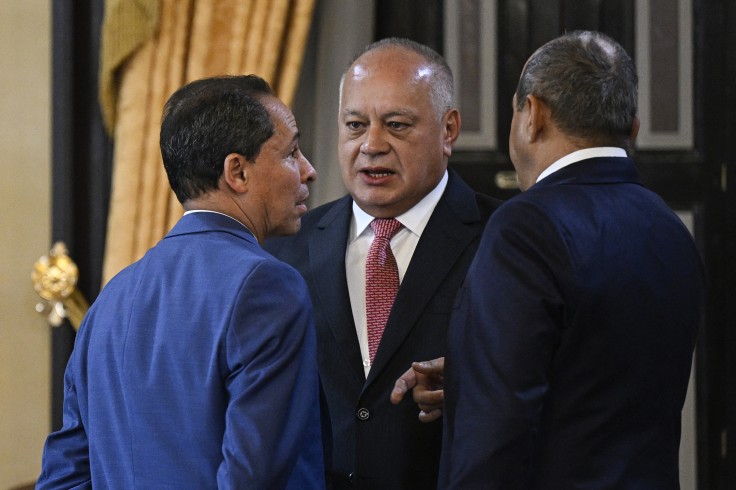
Venezuela's Interior Minister Diosdado Cabello (C) chats with Colombian Intelligence Director Rene Guarin (L) during a bilateral meeting at the Miraflores presidential palace in Caracas on April 24, 2026. Colombia's President Gustavo Petro arrived in Venezuela on April 24 for a bilateral meeting with interim President Delcy Rodriguez, focusing on border security and energy cooperation. (Credit: Photo by Federico PARRA// AFP via Getty Images)

Meanwhile, on the ground, something is happening that could have irreversible consequences. When the military cordon tightened, the criminal groups' first reaction wasn't to resist — it was to flee. Former regional lawmaker Américo De Grazia said the military bombed and opened fire on illegally controlled mines, forcing miners to flee. "The thieves left," a local resident recounted.

In their retreat, according to reports, these groups are said to be destroying documents, dismantling camps, erasing routes, and even removing graves — with a clear objective: to prevent the future reconstruction of the crimes, abuses, and corruption networks, including military ones, that operated for years in the area. Human-rights monitors are already demanding transparency: the rights group Provea warned of the risk of extrajudicial executions and arbitrary detentions against the civilian population, while NGOs caution that a purely military intervention could trigger mass displacement and violence.

The south of Bolívar is experiencing a territorial reorganization that has little of a conventional operation and much of a geoeconomic maneuver. The expulsion of the mafias that the state itself tolerated for decades coincides, with surgical precision, with the opening of the mining sector to transnational capital. The key to this secret war lies not in who is firing today, but in who will sign tomorrow; as long as the government maintains secrecy regarding the new concessions, the suspicion that order was established to serve business — and not the people — will continue to grow. And if the evidence of the crimes committed during that dark period disappears completely amid the withdrawal of the gangs and official silence, the new economic phase of the Orinoco Mining Arc will have been born on a deliberately erased history.
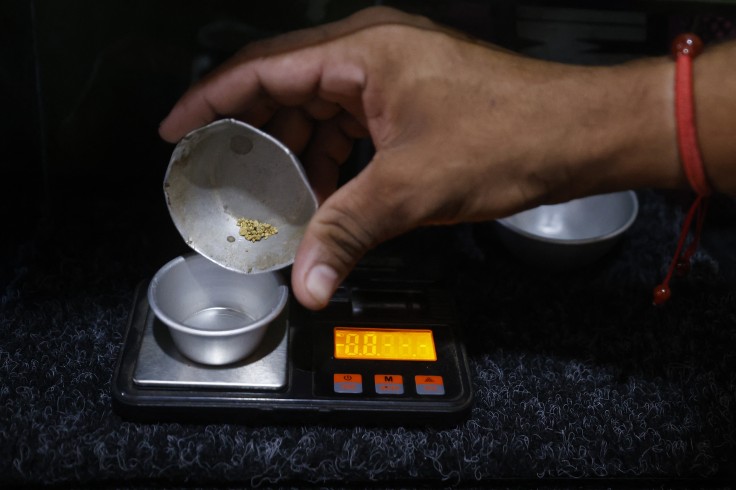
A man pays at a store with grams of gold, which is the main means of payment in the mining town of El Dorado, Bolivar state, Venezuela on May 24, 2025. El Dorado is part of a region christened by the government as the Arco Minero del Orinoco, which has large mineral reserves and is criss-crossed by illegal mining and organised crime, and where trade with gold dust is common currency. (Credit: Photo by Pedro MATTEY / AFP)/AFP via Getty Images)

The helicopters arrived without warning. Amid explosions and low-flying maneuvers, hundreds of miners hastily abandoned the Las Claritas and Kilometer 88 mines in southern Bolívar state, as military columns stormed into one of Venezuela's richest—and most violent—territories. The scene, described by witnesses as the largest show of force in the region in years, marked the beginning of something far more significant than a security operation.

The question echoing throughout the country is as simple as it is unsettling: Why now? For decades, the state allowed mafias, armed "syndicates," and corruption networks to flourish over the continent's most coveted gold mines. Today, those same structures are being pursued with unprecedented determination. And the answer, according to multiple sources and press reports, lies not in the barracks, but in the boardrooms where the economic future of the Orinoco Mining Arc is being negotiated.

Because behind the roar of weapons another war is being waged, silent and with much greater consequences: the dispute over who will control one of the largest reserves of mineral wealth in the hemisphere.

The turning point has a date. In March 2026, U.S. Secretary of the Interior Doug Burgum visited Caracas accompanied by dozens of representatives from American mining and energy companies. The message was unequivocal: the West wants access to Venezuela's strategic resources—gold, coltan, copper, diamonds, bauxite, and rare earth elements—which have become top-tier geopolitical assets.

The results came quickly. A Washington-brokered agreement was announced between the Venezuelan state mining company and the commodities giant Trafigura for up to 1,000 kilograms of gold. Burgum himself confirmed that the United States received an initial shipment of Venezuelan gold valued at $100 million, the first in more than two decades.

The Treasury Department, through its Office of Foreign Assets Control, issued a license expressly authorizing the export, sale, transportation, purchase, and refining of Venezuelan gold in U.S. territory. And the National Assembly approved a new mining law that opens the sector to private and foreign capital, the details of which are still being handled with remarkable secrecy.

But no transnational corporation invests billions in a territory dominated by armed gangs. For that capital to flow in, the state must guarantee that the mines and routes are under control. That, according to analysts and sources cited by independent media, is the true purpose of the mega-operation: not to restore public order out of conviction, but to prepare the ground for a new economic phase. Press reports even indicate that delegations of US investors conducted technical inspections in El Callao just one day before the military deployment.

Amid this reorganization, a silence stands out that many consider telling: that of Diosdado Cabello, Minister of the Interior and Justice. According to press reports, Cabello participated in the meetings with the US delegation; however, he has not presented official reports or made any statements about the operations, something unusual for a figure who speaks frequently. Given this information vacuum, there is speculation as to whether the order to militarily seize these territories came from him, from Delcy Rodríguez, from Gustavo González López, or from all three together. No authority has yet offered a public accounting of the operation.

Meanwhile, on the ground, something is happening that could have irreversible consequences. When the military cordon tightened, the criminal groups' first reaction wasn't to resist: it was to flee and cover their tracks. "The thieves left," a local resident recounted.

In their retreat, according to reports, these groups are destroying documents, dismantling camps, erasing routes, and even removing graves, with a clear objective: to prevent the future reconstruction of the history of the crimes, abuses, and corruption networks—including military ones—that operated for years in the area. Non-governmental organizations are already demanding transparency from the government and warning that a purely military intervention could trigger mass displacement and violence against civilians.

The south of Bolívar is experiencing a territorial reorganization that has little of a conventional operation and much of it is a geo-economic maneuver. The expulsion of the mafias that the State itself tolerated for decades coincides, with surgical precision, with the opening of the mining sector to transnational capital. The key to this secret war lies not in who is firing today, but in who will sign tomorrow; as long as the government maintains secrecy regarding the new concessions, the suspicion that order was established to serve business—and not the people—will continue to grow. And if the evidence of the crimes committed during that dark period disappears completely amidst the withdrawal of the gangs and official silence, the new economic phase of the Orinoco Mining Arc will have been born on a deliberately erased history.

Sign up to read this article
Read news from 100's of titles, curated specifically for you.
Already a member? Sign in here
Related Stories
Top stories on inkl right now
One subscription that gives you access to news from hundreds of sites
Already a member? Sign in here
Our Picks
Fourteen days free
Download the app
One app. One membership.
100+ trusted global sources.